
Just Two Tablespoons of Tomato Paste a Day Improved Attention and Memory in a Human Trial
Evidence review & editorial synthesis
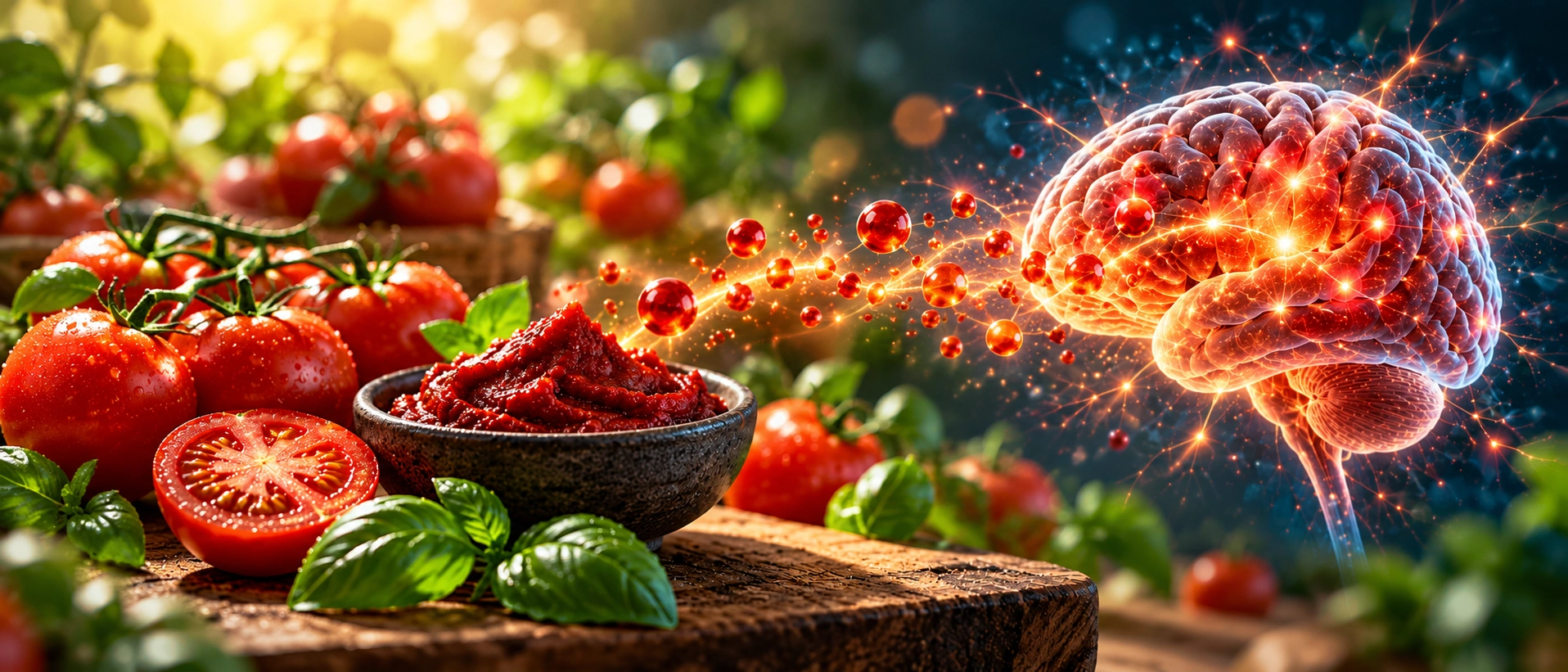
A familiar ingredient from the kitchen may have an unexpected effect on the brain. In a randomized human trial, eating roughly two tablespoons of concentrated tomato paste every day for three months improved certain measures of attention and the ability to remember names. The results raise an intriguing question: could an ordinary food help support mental performance without relying on specialized nootropic supplements?
Two Tablespoons a Day, Three Months of Testing
Researchers in Barcelona recruited 47 healthy adults aged 40 to 55; 42 completed the study. Each person followed two three-month dietary periods in randomized order, separated by a month-long break. In one period, they ate concentrated tomato paste daily. In the other, they followed a diet low in lycopene, the red carotenoid abundant in tomatoes.
The amount was adjusted to body weight, averaging 34.6 grams of tomato paste per day, or roughly two tablespoons. That supplied approximately 38 milligrams of lycopene. The product was ordinary concentrated tomato paste, not an experimental drug or a purified supplement.
This crossover design allowed the researchers to compare participants with themselves under different dietary conditions. They measured attention, processing speed, associative memory, blood markers, and functional brain activity before and after each period.
What Actually Improved?
The most interesting findings involved selective attention and face-name memory. During the tomato-paste period, participants performed better on a timed attention task in which they had to identify relevant letters among distracting ones. Their concentration-performance score improved by 7.2 points, and the processing-speed measure by 8.3 points relative to the control period. These are test-score differences, not equivalent to being a certain percentage more focused in everyday life.
The memory result is easier to picture. In a test matching previously shown faces with names, the tomato-paste period yielded an advantage of 0.8 correctly matched pairs. In everyday terms, that is roughly one additional correct face-name association on the study task. It does not mean that participants suddenly developed dramatically better memories, but the measurable difference is noteworthy for an ordinary food.
Crucially, not every cognitive measure improved. The signal centered on particular aspects of attention and associative memory rather than a general improvement across all mental abilities.
Why Might Tomatoes Affect the Brain?
Tomatoes are a major dietary source of lycopene, a carotenoid associated with antioxidant and inflammatory signaling pathways. Unlike some plant compounds, lycopene can cross the blood-brain barrier. Processing tomatoes into paste concentrates the compound, which is one reason this everyday ingredient interested the researchers.
Blood lycopene concentrations rose markedly during the tomato-paste period, providing a biological indication that participants had actually increased their intake. Researchers also examined brain-derived neurotrophic factor, or BDNF, a protein involved in neuronal adaptability. BDNF showed a borderline increase, while exploratory brain scans revealed changes in functional connectivity across several networks.
These secondary findings offer possible clues, not a confirmed explanation. Tomato paste contains several bioactive compounds, and the trial cannot establish that lycopene alone was responsible. The value of the experiment lies primarily in the observed performance differences on the cognitive tests.
A Simple Food, and What Else Has Evidence?
The results are appealing because no elaborate routine is required. Tomato paste can be added to sauces, soups, or other familiar meals. That is a practical food choice, not a validated treatment for memory disorders. The study was small, involved healthy middle-aged adults, and was not blinded. Participants also knew which dietary period they were following. Larger trials will need to show whether the changes persist and matter outside the testing room.
People interested in other substances studied for cognition can explore our guide to nootropics. Two supplements with human research behind them are Bacopa monnieri, a botanical extract investigated especially for memory, and creatine monohydrate, better known for exercise performance but also studied for certain cognitive tasks. Results vary across trials and neither is proven to amplify the effects of tomatoes.
The most enjoyable implication is also the simplest: meaningful nutrition research does not always begin with an exotic ingredient. Sometimes it begins with a spoonful of something already in the kitchen.
Scientific References & Further Reading
- Anchor Study: “Tomato Intake Improves Cognitive Performance and Modulates Functional Brain Networks in Healthy Adults: A Randomized Crossover Clinical Trial.” (López-Solís R, et al. Antioxidants. 2026;15(5):644. doi:10.3390/antiox15050644.)
- Bacopa Evidence: “Comparative effects of Bacopa monnieri and Ginkgo biloba on cognitive functions.” (Systematic review and network meta-analysis. 2026. PMID:41678913.)
- Creatine Evidence: “The effects of creatine supplementation on cognitive function in adults.” (Systematic review and meta-analysis. Front Nutr. 2024. doi:10.3389/fnut.2024.1424972.)
Disclaimer: This article is for informational purposes only and does not constitute medical advice. It is not a substitute for diagnosis, treatment, or individualized medical care.