

The Slow-Wave Engine: How to Maximize Deep Sleep for Maximum HGH Release & Physical Recovery
If you track your sleep using smart rings or biometrics, you've likely experienced the morning frustration of seeing a high total sleep time paired with a dismal metric: Only 25 minutes of Deep Sleep.
You slept for eight hours, yet you wake up feeling heavy, sore, and physically unrecovered.
In the world of biological optimization, not all sleep stages are created equal. While REM sleep recalibrates your mind and emotional bandwidth, Slow-Wave Sleep (N3 Stage / Deep Sleep) is where your physical body performs structural repair.
It is during these delta-wave brain cycles that your pituitary gland releases over 70% of your daily Human Growth Hormone (HGH), your immune system synthesizes cytokines, and blood flow shifts heavily into skeletal muscle tissue.
If you want to bounce back from intense training, eliminate chronic systemic fatigue, and preserve structural youth, you must master the mechanics of Slow-Wave Sleep. Here is the exact science-backed framework to systematically double your nightly Deep Sleep quota.
1. The Physiology of Delta Waves: The HGH Surge
During the first half of the night, your brain wave frequency slows dramatically, dropping from fast alpha/beta activity down to high-amplitude Delta Waves (0.5 to 4 Hz).
 Delta-wave oscillations synchronize pituitary hormone release, shifting the body into an intense anabolic repair state.
This electrical slowing signals a cascade of cellular repair:
- Massive Growth Hormone Pulse: The hypothalamus releases Growth Hormone-Releasing Hormone (GHRH), triggering an intense surge of HGH into your bloodstream. This rebuilds muscle micro-tears, strengthens tendon integrity, and mobilizes fat burning.
- Systemic Blood Pressure Drop: Heart rate slows down, and vascular smooth muscle relaxes, allowing arterial tissue to heal and lower cardiovascular strain.
- Mitochondrial Glycogen Replenishment: Muscle cells aggressively reload cellular ATP and glycogen stores, preparing your motor units for explosive physical output the following day.
If your core body temperature remains elevated or your central nervous system is stuck in sympathetic dominance (fight-or-flight), your brain fails to lock into continuous Delta-wave frequencies. The result? Anabolic shutdown.
2. The Core Body Temperature Threshold
The single most critical mechanical trigger for Slow-Wave Sleep is Thermoregulation.
To initiate Deep Sleep, your internal core body temperature must drop by approximately 2°F to 3°F (1°C to 1.5°C). Your body dumps heat by dilating blood vessels in your hands and feet (vasodilation).
If your sleeping environment is too warm, or if your mattress traps body heat, your hypothalamus senses ambient thermal stress. To protect against overheating, your brain aborts the transition into Stage N3 sleep, forcing you to remain in light, easily disrupted Stage N2 sleep.
3. The 3 Master Saboteurs of Deep Sleep
Even elite athletes routinely destroy their deep sleep capacity through three hidden metabolic mistakes:
I. Late-Night Glycemic & Digestive Burden
Eating a large meal or heavy carbohydrates within 2-3 hours of sleep causes a surge in insulin and spikes core metabolic rate. Digestion requires significant circulatory work, raising your resting heart rate (RHR) during the exact first 3 hours of sleep when Deep Sleep should peak.
II. Late Alcohol Consumption
While alcohol acts as a central nervous system sedative that helps you fall unconscious faster, it completely fragments sleep architecture. As your liver metabolizes ethanol, it creates a rebound sympathetic response, crushing HGH release and reducing Deep Sleep duration by up to 80%.
III. Late-Day Stimulants & Adenosine Masking
Caffeine has an average half-life of 5 to 7 hours and a quarter-life of up to 12 hours. Even if you can fall asleep with caffeine in your system, it blocks Adenosine A1 receptors in the brain, preventing the deep neural synchronization required to generate high-amplitude Delta waves.
4. The Deep Sleep Protocol: How to Double Your Slow-Wave Quota
To systematically expand your Deep Sleep metrics, implement this targeted protocol:
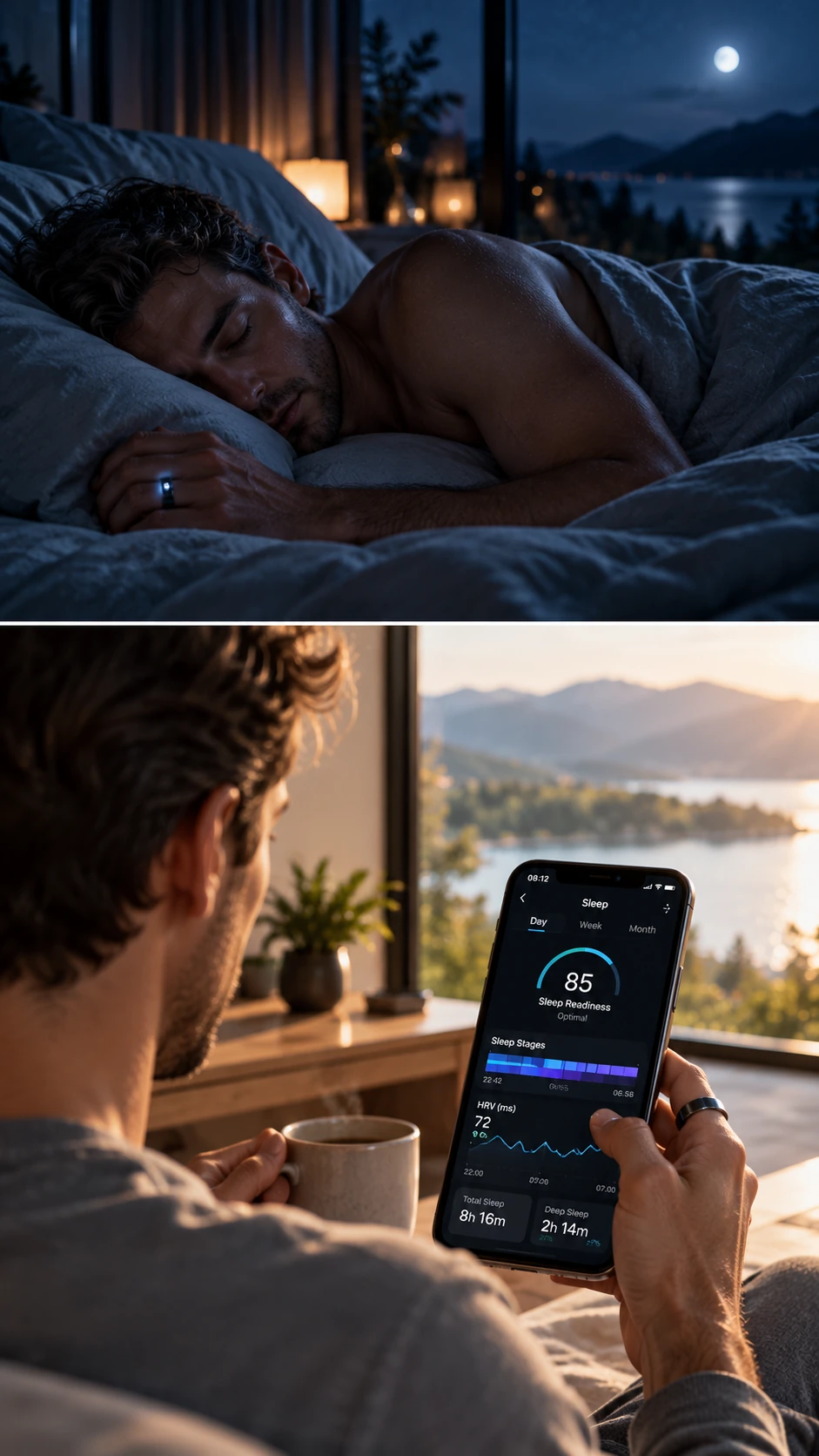 Tracking HRV and Slow-Wave metrics allows you to quantify how thermal cooling and evening supplements impact your biological recovery.
Step 1: Active Thermal Cooling (The Vasodilation Hack)
Keep your bedroom thermostat set to 65°F (18°C). Take a warm bath or hot shower 90 minutes before bed; when you step out of the hot water into a cool room, your peripheral blood vessels dump heat rapidly, triggering a sharp plunge in core body temperature that signals the brain to enter Deep Sleep.
Step 2: Neuro-Inhibitory Supplement Stacking
Incorporate clinical-grade inhibitory neurotransmitter precursors 60 minutes prior to bed to quiet sympathetic neural firing:
- Magnesium L-Threonate / Glycinate (300-400mg): Crosses the blood-brain barrier to activate GABA receptors.
- Apigenin (50mg): Binds to benzodiazepine receptors in the brain, reducing anxiety without sedation dependence.
- L-Theanine (200mg): Promotes alpha-wave activity and blunts evening cortisol spikes.
Check Out Our Comprehensive Guide to Clinical Deep Sleep Supplement Stacks
Step 3: Evening Glycemic Cutoff
Finish your final meal at least 3 hours before sleep. If you experience night-time hypoglycemia or elevated waking cortisol, opt for a small, fat-based snack (such as a spoonful of almond butter) rather than fast-acting carbohydrates.
Master Your Nightly Wind-Down with Our Full Better Sleep Architecture Blueprint
Physical Youth is Built in Stage N3
You cannot out-train, out-eat, or out-supplement a chronic deficit in Slow-Wave Sleep.
When you optimize your thermal environment, eliminate late-night metabolic interference, and support GABAergic signaling, you unlock the body's natural cellular fountain of youth: sustained, uninhibited Human Growth Hormone release.
Stop settling for low recovery scores. Turn on your slow-wave engine.
Scientific References & Reading List
-
Growth Hormone Secretion & Slow-Wave Sleep: Van Cauter, E., & Plat, L. "Physiology of growth hormone secretion during sleep." The Journal of Pediatrics 128(5 Pt 2), S32-S37 (1996). Read on PubMed (PMID: 8627466) | DOI: 10.1016/S0022-3476(96)70008-2
-
Growth Hormone Dependence on Sleep Onset: Davidson, J. R., Moldofsky, H., & Lue, F. A. "Growth hormone and cortisol secretion in relation to sleep and wakefulness." Journal of Psychiatry & Neuroscience 16(2), 96-102 (1991). Read Full Study on PubMed Central (PMC1188300) | Read on PubMed (PMID: 1911740)
-
Thermoregulation & Slow-Wave Sleep Initiation: Kräuchi, K. "How is the circadian rhythm of core body temperature regulated?" Clinical Autonomic Research 12(3), 147-149 (2002). Read on PubMed (PMID: 12269545) | DOI: 10.1007/s10286-002-0043-9
Disclaimer: The information provided is for educational purposes only and is not intended as medical advice. Always consult with a qualified healthcare professional before starting any new health protocol or sleep regimen.