
A Weight-Loss Drug Without Muscle Loss? UCN2 Shows a Remarkable Possibility
Evidence review & editorial synthesis
Imagine losing a substantial amount of body fat without sacrificing the muscles that help you walk, climb stairs, lift groceries, or stay physically independent as you age.
That is the possibility emerging from research into Urocortin 2 (UCN2), a naturally occurring peptide that scientists are modifying into longer-acting experimental drugs.
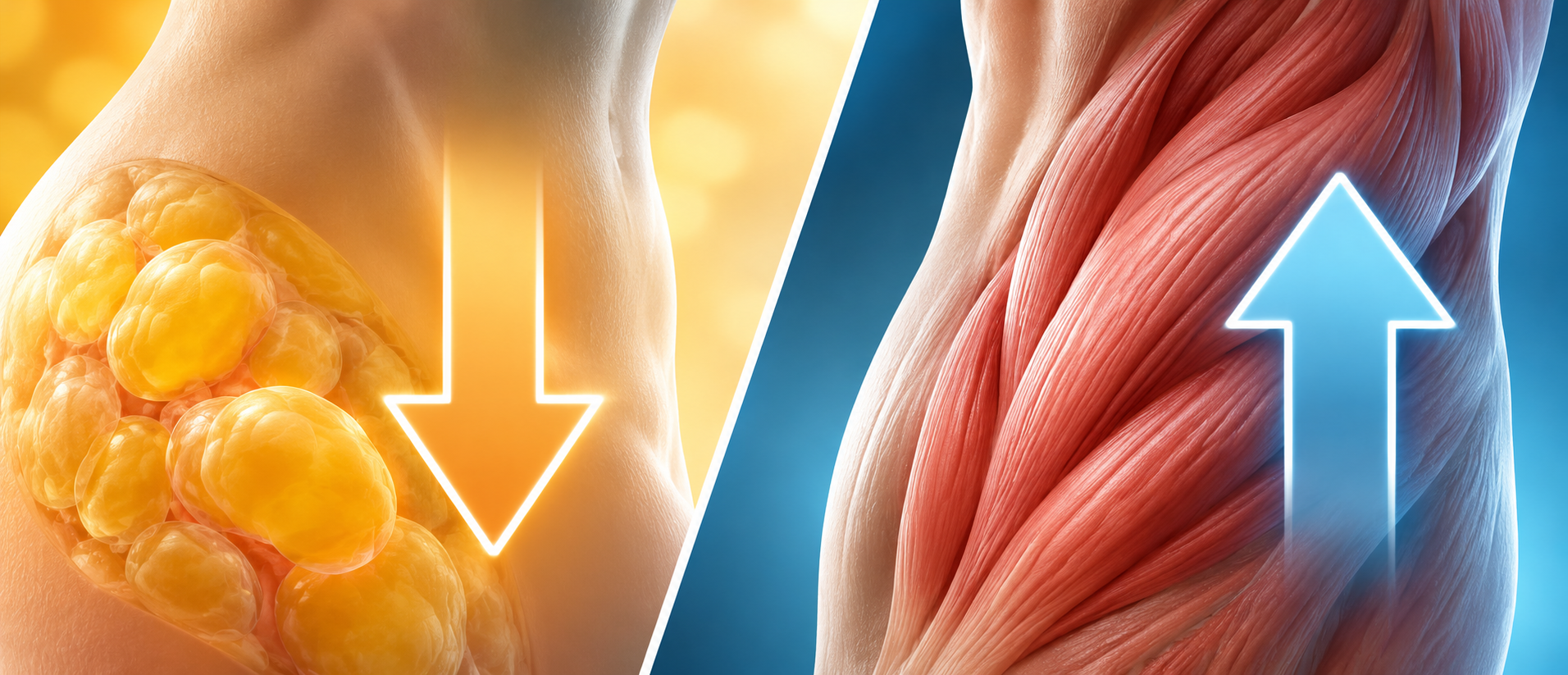
In a new study released on November 19, 2026, researchers found that a modified UCN2 peptide reduced fat mass while preserving muscle mass and improving muscle function in mice. The benefits were also observed when UCN2 was combined with powerful weight-loss drugs, including semaglutide and retatrutide.
The finding raises an intriguing question: What if the next generation of obesity medications did more than make people lighter? What if they helped people become leaner while protecting the strength they need to remain active and healthy?
The Hidden Trade-Off of Losing Weight
Modern obesity treatments can produce remarkable reductions in body weight. In a large Phase 3 trial, people taking the experimental triple-hormone drug retatrutide at 12 mg lost an average of 25.0% of their body weight over 80 weeks, compared with 3.9% in the placebo group.
But weight loss is not exclusively fat loss.
When body weight decreases substantially, some fat-free mass usually disappears as well. Fat-free mass includes skeletal muscle, alongside water, organs and other tissues. The amount of actual muscle lost varies, and decreases in lean mass do not automatically imply declining strength.
Nevertheless, retaining muscle matters. Skeletal muscle supports movement, metabolic function, balance and the ability to remain physically independent.
Consider someone who successfully loses 25 kilograms. That achievement may improve numerous aspects of health. But ideally, those kilograms would come predominantly from excess fat rather than the muscle needed for daily life.
For older adults, the distinction can be especially important. Losing excess fat may reduce the physical burden of obesity, while losing too much muscle could make everyday tasks more difficult.
A medication that separates these two processes could therefore offer something more meaningful than a smaller number on the scale.
UCN2 Appeared to Burn Fat While Protecting Muscle
The new experiments tested a modified, long-acting version of UCN2 that activates the corticotropin-releasing hormone receptor 2, or CRHR2.
This signaling pathway has important roles in skeletal muscle and energy metabolism.
Across several mouse models, the researchers reported a striking combination of effects: less body fat, preserved skeletal muscle mass and improved muscle function.
The treatment also appeared to influence how the animals used energy.
When people or animals eat less and lose weight, the body can compensate by reducing energy expenditure. This adaptation may make further weight reduction more difficult.
In the mouse experiments, UCN2 increased energy expenditure, prevented the decline associated with reduced feeding and promoted whole-body fatty acid oxidation.
The investigators also conducted pair-feeding experiments, in which food intake was matched between groups. These supported the conclusion that the benefits could not be explained simply by the animals eating less.
Perhaps most importantly, the effects were not limited to muscle size.
The researchers measured improved force production, suggesting that UCN2 influenced muscle function as well as body composition.
In mice with sarcopenic obesity, a combination of excess fat and poor muscle health, UCN2 reduced fat mass while increasing muscle mass, muscle protein synthesis and muscle function.
This is a particularly interesting result because sarcopenic obesity presents two problems at once: too much body fat and too little functional muscle.
Imagine Becoming Leaner Without Becoming Weaker
The potential implications go well beyond appearance.
For younger adults, preserving muscle during substantial weight loss could help maintain physical capacity and make it easier to remain active.
For older adults, the consequences could be even more significant.
Imagine an older person with obesity who struggles to get out of a chair, climb stairs or carry shopping bags. A future treatment that reduces excess fat while maintaining or improving muscle strength might help address both the excess weight and the weakness that can accompany poor muscle health.
Instead of becoming lighter but potentially more fragile, the person might become lighter while retaining the physical resources needed for everyday independence.
These outcomes have not been demonstrated in humans receiving UCN2. They illustrate the practical value that successful muscle-preserving weight loss could eventually provide.
The new study also revealed another intriguing possibility: combining UCN2 with established weight-loss mechanisms.
When the researchers combined UCN2 with semaglutide or retatrutide, the animals experienced particularly pronounced fat loss while maintaining lean and muscle mass and increasing force production. The reported force benefit remained detectable four weeks after treatment stopped.
This suggests that UCN2 might eventually complement powerful appetite-regulating medications rather than replace them.
One therapy could help produce substantial weight reduction, while another could potentially improve the composition and functional consequences of that reduction.
Such a combination could shift the goal of obesity treatment from simply losing the most weight to losing the right tissue while protecting the body's ability to move and function.
From Mouse Experiments to Human Testing
The new preprint is not the only research supporting this direction.
A separate study published in Molecular Metabolism in October 2026 investigated another modified UCN2 approach in obese rats and minipigs.
In rats, treatment reduced fat mass and increased lean mass. In minipigs, researchers reported increased lean mass and improved insulin sensitivity, although changes in total body weight and fat mass were comparatively modest.
These findings reinforce an important distinction: improving body composition does not necessarily require dramatic changes in overall body weight.
The field is also beginning to move into human testing.
Gubra initiated a Phase 1/2a clinical trial of its experimental UCN2 analogue, GUB-UCN2, in July 2026. The study specifically examines safety, body composition, muscle volume and physical function. Another UCN2 analogue, HM17321, is also in early clinical development.
These are related experimental compounds, not necessarily the identical peptide investigated in the November mouse study.
The findings remain preliminary. The new study is a non-peer-reviewed preprint, and it is unknown whether UCN2-based medications will safely preserve muscle or improve strength in humans. Long-term effects, cardiovascular safety and clinical effectiveness still require rigorous testing.
Even so, the research highlights an important possibility for obesity medicine.
The most meaningful advance may not be a drug that simply makes weight fall faster. It may be one that helps people lose unwanted fat while keeping the muscle that allows them to enjoy the benefits of becoming healthier.
Ultimately, successful weight loss should be about more than becoming lighter. It should also be about remaining strong.
Scientific References & Further Reading
- Anchor Study: “Modified Long-Acting UCN2 Promotes Fat Mass Loss While Preserving Skeletal Muscle Mass and Function in Mouse Models of Pharmacological Weight Loss and Sarcopenic Obesity.” (Vidal P, et al. bioRxiv preprint. November 19, 2026. DOI: 10.64898/2026.11.12.766237. Not peer reviewed.)
- Supporting Preclinical Research: “Differentiated obesity treatment: Pharmacological CRF2 agonism drives fat loss, skeletal muscle hypertrophy and improved glucose metabolism in preclinical obesity.” (Molecular Metabolism. Published online October 31, 2026. Preclinical rat and minipig research.)
- Human Weight-Loss Trial: “Retatrutide, a Triple Hormone Receptor Agonist, for Treatment of Obesity.” (New England Journal of Medicine. 2026. Randomized Phase 3 obesity trial.)
- Clinical Development: “Gubra announces initiation of ambitious Phase 1/2a clinical trial of lead asset GUB-UCN2 in obesity.” (Gubra. July 28, 2026. Clinical development announcement.)
- Additional Preclinical Evidence: “GUB-UCN2 as Monotherapy and in Combination with Semaglutide Increases Muscle Mass, Reduces Fat Mass, and Improves Metabolic Outcomes in Aged Diet-Induced Obese Rats.” (Diabetes. 2026;75(Supplement 1):1103-OR. Conference abstract.)
Disclaimer: This article is for informational purposes only and does not constitute medical advice. It is not a substitute for diagnosis, treatment, or individualized medical care.