
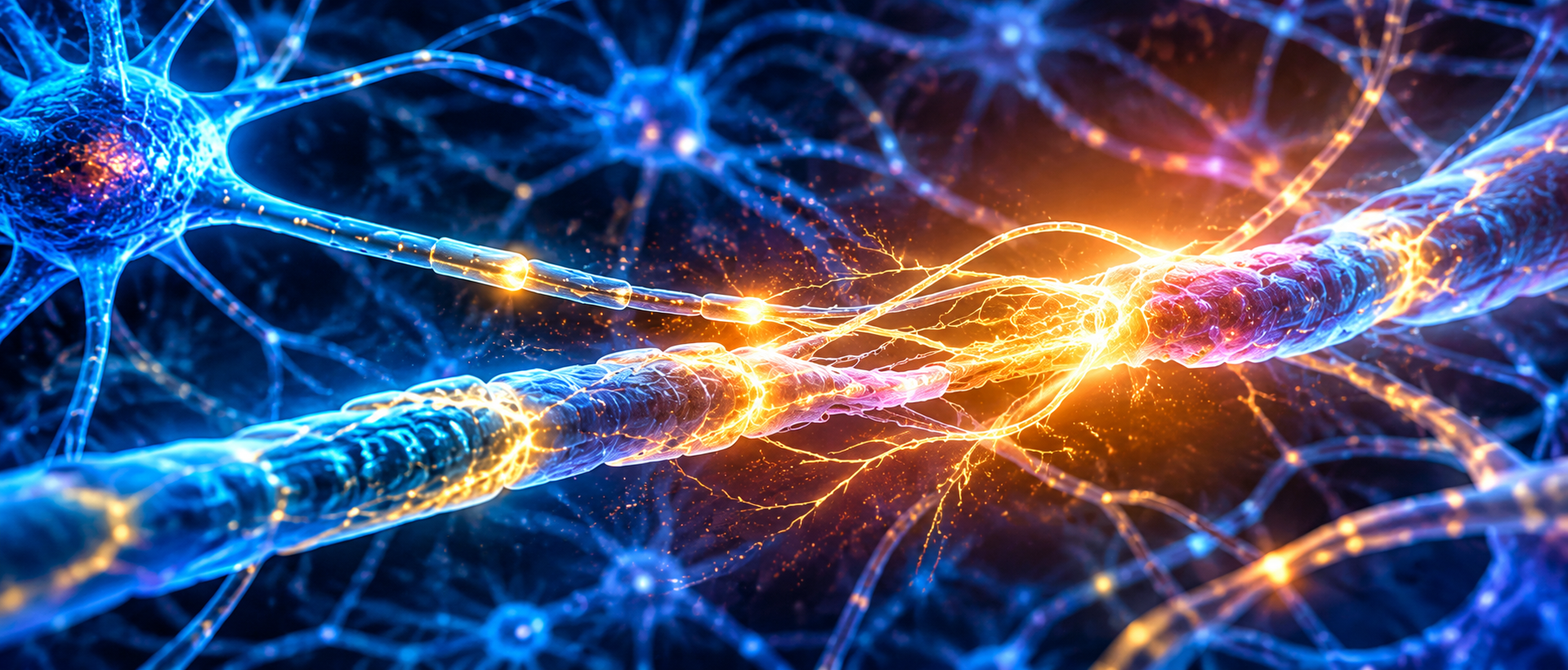
Could Paralyzed People Walk Again? Scientists Restore Nerve Growth and Partial Movement in Mice
Evidence review & editorial synthesis
Imagine losing the ability to walk after a devastating spinal cord injury, then one day receiving a treatment that helps damaged nerves grow again and restores some of the movement that was thought to be permanently lost.
For millions of people affected by spinal cord injuries, this remains an extraordinary hope rather than an available medical treatment. But a new study offers an important glimpse of how such a future might become possible.
In research published in The EMBO Journal in November 2026, scientists identified two molecular regulators that stimulated the regeneration of damaged nerve fibers in adult mice. Following severe experimental spinal cord injury, treated animals showed renewed nerve growth beyond the injury site and measurable improvements in movement and muscle strength.
The mice did not regain normal walking. Nevertheless, the results address one of the central obstacles in treating paralysis: the remarkable difficulty of getting injured nerve cells in the adult central nervous system to grow again.
Why Paralysis Is So Difficult to Reverse
The brain controls voluntary movement by transmitting signals through nerve pathways that descend into the spinal cord.
One of the most important is the corticospinal tract, which carries signals from the brain's motor cortex toward spinal circuits involved in movement.
When a severe spinal cord injury interrupts these connections, messages from the brain can no longer reach the muscles through their normal routes.
The problem is not simply that nerve fibers have been damaged. Unlike many tissues, adult neurons in the brain and spinal cord generally have very limited capacity to regenerate long, interrupted connections.
During early development, growing nerve cells possess powerful biological programs that allow their axons to extend across considerable distances and establish connections with other cells.
As the nervous system matures, much of that growth machinery becomes less accessible. Adult neurons become highly specialized for stable communication, but far less capable of rebuilding destroyed pathways.
This is why researchers have spent decades trying to understand whether dormant growth programs could somehow be switched back on.
The new study identifies two potentially important switches.
Scientists Reawakened the Nerve Cells' Growth Machinery
The researchers identified two transcription factors called NR2F1 and NR2F6.
Transcription factors help regulate which genes are active inside a cell. By changing these regulatory instructions, scientists can influence how cells behave.
The team discovered that NR2F1 and NR2F6 normally interact with genetic regulatory regions involved in neuronal development, but that their activity at these regions declines as neurons mature.
They then used viral vectors to increase expression of either factor in motor-cortex neurons of adult mice.
After experimental injuries to the corticospinal pathway, the results were striking.
Both transcription factors stimulated the growth of nerve fibers. In a severe thoracic spinal cord crush model, new corticospinal axons extended beyond the damaged region.
With NR2F1, statistically significant increases in regenerating fibers were detected at distances extending to 1.5 millimeters beyond the lesion. NR2F6 also promoted regeneration, although its effect was less extensive at the greatest measured distance.
These may sound like small distances. For a damaged spinal cord, however, encouraging mature nerve fibers to grow beyond a severe injury is an important biological achievement.
The researchers also discovered that the two factors worked through distinct molecular mechanisms.
NR2F1 reactivated programs involved in chromatin remodeling and the cellular structures required for growth. NR2F6 went further in reorganizing aspects of the cell's three-dimensional genome architecture, allowing developmental regulatory regions to become active again.
In effect, the researchers found ways to make mature nerve cells regain part of the growth capacity they normally possess much earlier in life.
The Most Encouraging Result: Movement Improved
Seeing damaged nerves regrow under a microscope is impressive. But the question that matters most to someone living with paralysis is much simpler.
Could the recovered nerve growth actually help restore movement?
In this study, the researchers found encouraging evidence that it might.
They monitored the hindlimb movements of mice after severe spinal cord injury, examining how the animals moved their legs while attempting to navigate a horizontal ladder.
Untreated injured mice displayed severely disrupted movement patterns.
The animals receiving NR2F1 or NR2F6 showed improvements in several important aspects of hindlimb control.
Their legs regained more effective backward movement and vertical lifting. In particular, they became better able to raise their feet rather than simply dragging them along the surface.
The treated animals also showed improved hip-rise measurements and greater grip strength compared with injured controls.
Importantly, the recovery remained incomplete. The mice still struggled with the forward-swing component needed for a normal stride, and their walking patterns were not fully restored.
Nevertheless, the combination of visible nerve fiber regeneration and partial functional recovery makes the findings more compelling than a laboratory observation of nerve growth alone.
It suggests that changing the internal growth programs of mature neurons may help address both the biological injury and some of its functional consequences.
Could This Eventually Help People Walk Again?
The long-term implications are profound.
Imagine a future in which a person with a severe spinal cord injury could receive a treatment that stimulates damaged nerve fibers to regrow and reconnect with appropriate spinal circuits.
Combined with rehabilitation, electrical stimulation or other repair strategies, such an approach might eventually help restore movements that previously appeared permanently lost.
For someone with major paralysis, even partial recovery could be life-changing.
Regaining enough leg control to assist with standing, transferring from a wheelchair, or taking supported steps could offer meaningful improvements in daily life. More extensive recovery, if it ever became possible, might allow some patients to walk again.
These outcomes remain future possibilities, not results demonstrated in people. Regrowing a nerve fiber is only one part of the challenge. The fiber must also reach an appropriate destination, establish useful connections and participate in coordinated movement.
The new findings are particularly relevant because they target a fundamental biological limitation rather than simply compensating for lost movement.
However, an important qualification separates the mouse experiments from a treatment for existing paralysis: the researchers delivered the genetic intervention seven days before causing the spinal cord injuries. They have not yet shown that administering it after an injury produces the same benefits.
The functional experiments also involved relatively few animals, and the long-term safety of manipulating these gene-regulatory pathways remains unknown. The research is therefore an early preclinical advance, not evidence that an effective human therapy is close.
Still, the study identifies new molecular targets and demonstrates that adult corticospinal neurons retain a capacity for regeneration that can be experimentally reactivated.
For a field long constrained by the nervous system's inability to repair its own damaged connections, that is an important step.
The possibility that one day matters most is not merely making injured nerves grow again. It is using that growth to help people recover the movements, independence and opportunities that paralysis has taken away.
Scientific References & Further Reading
- Anchor Study: “Nuclear receptor transcription factors promote axon regeneration in the adult corticospinal tract.” (Sahu Y, et al. The EMBO Journal. Published November 17, 2026. DOI: 10.1038/s44318-026-00957-z. PMID: 43045873.)
- Related Nerve Regeneration Research: “Promotion of corticospinal tract growth by KLF6 requires an injury stimulus and occurs within four weeks of treatment.” (Preclinical research on growth-associated transcription factors and corticospinal plasticity.)
- Counterevidence and Context: “Chronic activation of corticospinal tract neurons after pyramidotomy injury enhances neither behavioral recovery nor axonal sprouting.” (Experimental Neurology. 2026. Preclinical study.)
- Spinal Cord Repair Research: “Combinatorial Approaches to Restore Corticospinal Function after Spinal Cord Injury.” (eNeuro. 2025. Experimental research on corticospinal repair strategies.)
Disclaimer: This article is for informational purposes only and does not constitute medical advice. It is not a substitute for diagnosis, treatment, or individualized medical care.