
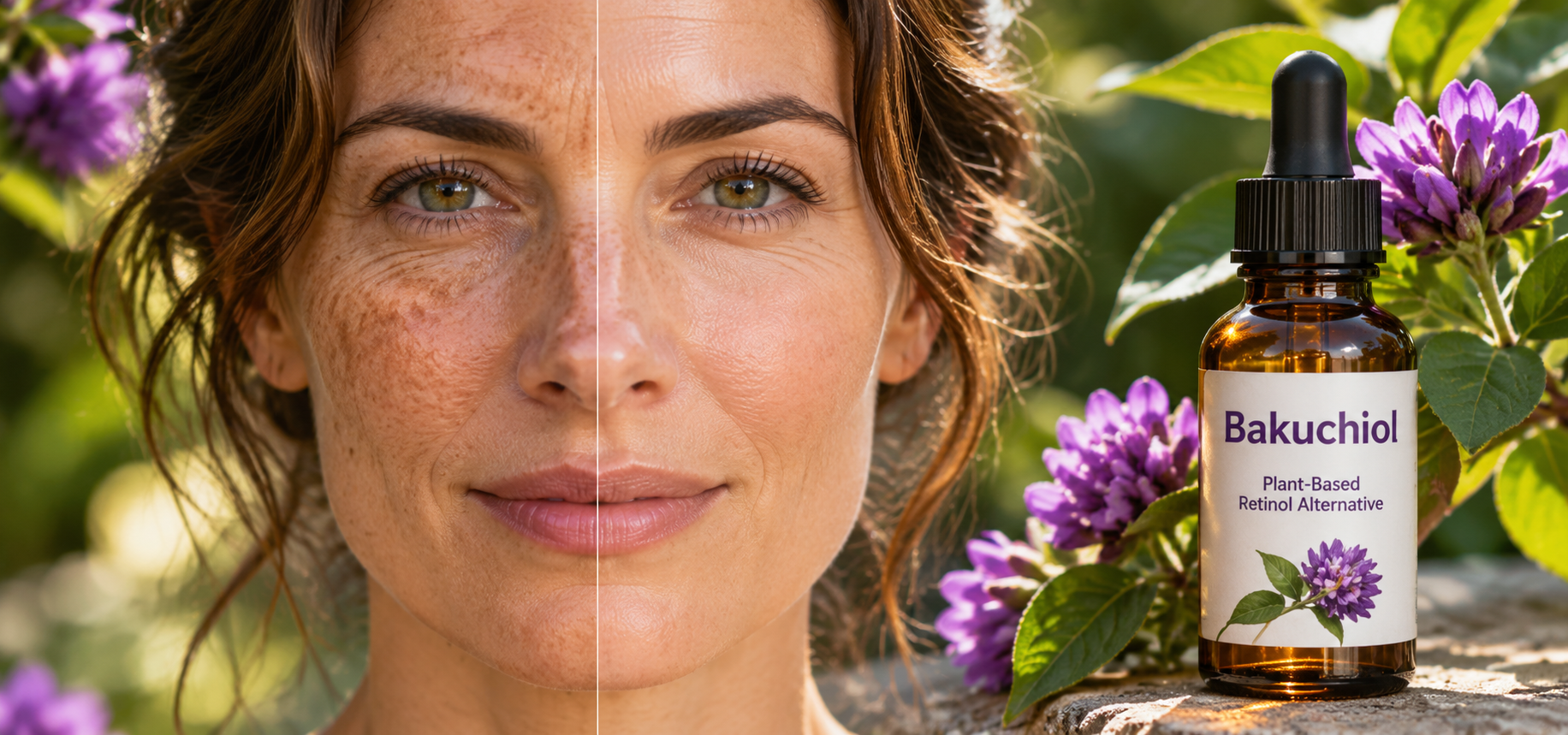
Bakuchiol vs. Retinol: How a Plant Compound Fades Dark Spots Without the Burn
Evidence review & editorial synthesis
Retinol has long dominated dermatology for smoothing fine lines and fading uneven pigment, yet many people abandon it within weeks because of redness, stinging, and peeling. A June 2026 double-blind, placebo-controlled trial in the Journal of Cosmetic Dermatology adds fresh clinical weight to a gentler alternative: topical bakuchiol, a purified compound extracted from the seeds of the babchi plant.
In the 84-day trial of 73 Chinese adults aged 32 to 60, participants who applied purified bakuchiol saw steady, measurable reductions in crow's feet wrinkles, facial hyperpigmentation, and visible pore size alongside brighter skin radiance compared with a placebo cream. Combined with an earlier head-to-head clinical trial against retinol, the data explain why dermatologists increasingly treat bakuchiol as a credible option for people whose skin rebels against vitamin A.
What the Clinical Trials Actually Measured
The June 2026 trial focused specifically on Asian skin, which tends to develop pronounced dark spots and uneven tone during photoaging. Using standardized cross-polarized facial imaging over 12 weeks, researchers tracked 37 adults using psoralen-depleted bakuchiol against 36 using an identical vehicle base. Crow's feet wrinkle severity fell by 2.6 percent at day 28, 3.9 percent at day 56, and 7.4 percent by day 84, while hyperpigmentation severity declined steadily across every follow-up visit and remained unchanged in the placebo group.
Those results align closely with a 12-week randomized, double-blind comparison in 44 adults published in the British Journal of Dermatology that pitted 0.5 percent bakuchiol twice daily directly against 0.5 percent retinol once nightly. Both groups reduced fine wrinkle surface area by roughly 20 percent with no statistical difference between them. On clinical grading for dark spots, 59 percent of participants in the bakuchiol group showed measurable improvement in hyperpigmentation compared with 44 percent in the retinol group, while reporting significantly less facial scaling and stinging.
Why Bakuchiol Spares the Skin Barrier
Despite often being nicknamed plant retinol, bakuchiol has no structural resemblance to vitamin A. Retinol converts into retinoic acid and binds directly to nuclear retinoid receptors in skin cells. That receptor activation accelerates cell turnover and collagen synthesis, but it also triggers the inflammatory cascade behind retinoid dermatitis, dryness, and flaking.
Bakuchiol operates through a separate route. As a meroterpene phenol, it modulates mitochondrial proteins called prohibitins, dampens pro-inflammatory messengers such as prostaglandin E2, and stimulates collagen-supporting pathways without activating nuclear retinoid receptors. Because it is also photostable and does not heighten ultraviolet sensitivity, users can apply it in both morning and evening routines alongside daily sunscreen, whereas conventional retinol degrades in sunlight and is restricted to nighttime use.
How to Choose a Formula That Matches the Studies
Clinical results depend heavily on formulation purity and concentration rather than marketing claims. Both the 2026 trial and earlier comparative research tested purified, psoralen-depleted bakuchiol rather than unrefined babchi seed oil, which can contain phototoxic compounds that irritate skin.
When evaluating a topical bakuchiol serum, look for standardized concentrations between 0.5 percent and 1 percent listed clearly on the label, packaged in opaque or airless bottles to protect active antioxidants from oxidation. Readers exploring how topical ingredients fit alongside broader strategies for collagen preservation and cellular senescence can also review the evidence on what actually slows skin and tissue aging.
What Still Remains Unproven
The human evidence base for bakuchiol remains much smaller than retinol's decades-long clinical track record, relying mainly on 12-week trials of 44 to 73 participants rather than multi-year studies. Although bakuchiol lacks retinoid-receptor binding, no dedicated clinical trials have established its safety during pregnancy or breastfeeding, so clinicians still advise caution in those groups.
For everyone else seeking to soften fine lines and fade stubborn sun spots without sacrificing barrier comfort, the clinical picture is clear: standardized bakuchiol delivers retinoid-comparable improvements over 12 weeks while letting sensitive skin stay calm enough to stick with daily treatment.
Scientific References & Further Reading
- Anchor Study: “Prospective, Double-Blind, Vehicle-Controlled Assessment of Topical Bakuchiol on Photoaging in a Chinese Population..” (Khan ZE, Chaudhuri RK, Dulai A, Tarmaster A, Pan L, Sivamani RK. J Cosmet Dermatol. 2026 Jun 18;25(6):e71000. doi:10.1111/jocd.71000. PMID: 43047082.)
- Head-to-Head Trial: “Prospective, randomized, double-blind assessment of topical bakuchiol and retinol for facial photoageing..” (Dhaliwal S, Rybak I, Ellis SR, Notay M, Trivedi M, Burney W, Vaughn AR, Nguyen M, Reiter P, Bosanac S, Yan H, Foolad N, Sivamani RK. Br J Dermatol. 2019 Feb;180(2):289-296. doi:10.1111/bjd.16918. PMID: 29947134.)
Disclaimer: This article is for informational purposes only and does not constitute medical advice. It is not a substitute for diagnosis, treatment, or individualized medical care.
As an Amazon Associate, Health Science Hub earns from qualifying purchases.