
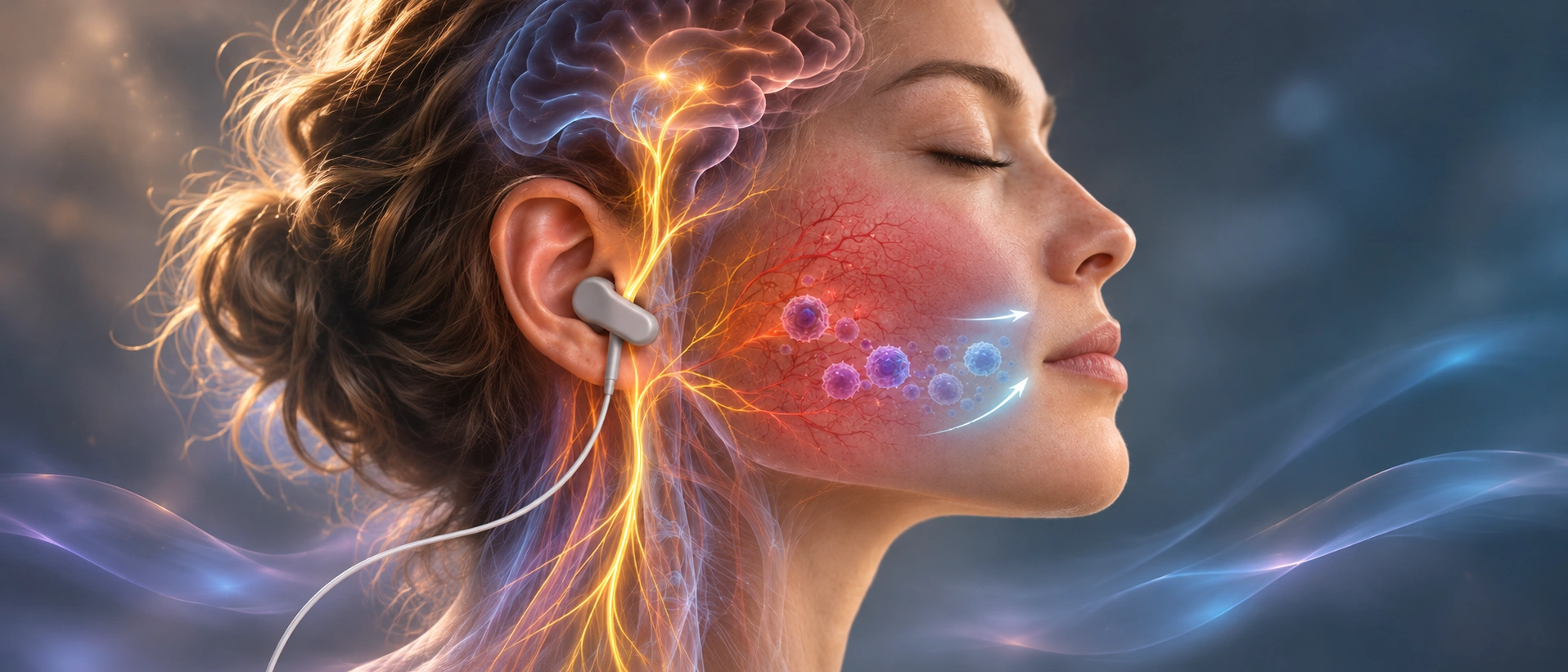
Can Stimulating a Nerve in Your Ear Calm Facial Redness? The New Science of Skin Inflammation
Evidence review & editorial synthesis
A persistent red face may have more to do with the nervous system than previously thought. In a randomized clinical trial involving 72 people with rosacea, gentle electrical stimulation near the ear reduced facial redness more effectively than sham stimulation. A separate 2026 trial involving 204 patients found that targeted ear acupressure improved treatment outcomes when added to standard rosacea care.
These findings give new weight to a surprising idea: inflammation in the skin can be influenced by neural signals originating far from the affected tissue.
A June 2026 review in Dermatology brings together the emerging science linking the vagus nerve, immune regulation and inflammatory skin disorders.
A Nerve in the Ear Changed Visible Facial Redness
Rosacea can make ordinary moments uncomfortable. A warm room, emotional stress or a sudden flush may leave the face visibly red. For some people, the redness persists long after the trigger disappears.
In a randomized, double-blind clinical trial published in JAMA Dermatology in 2025, researchers assigned 72 people with erythematotelangiectatic rosacea to active electrical stimulation of the auricular vagus nerve or sham stimulation.
Participants received their assigned intervention for 30 minutes daily over three weeks. The primary measurement was facial redness, rated by clinicians on a five-point severity scale.
After three weeks, the active-stimulation group had an average redness score of 1.56, compared with 2.47 in the sham group. The between-group difference was 0.92 points, a statistically significant improvement favoring active stimulation.
For people whose condition is dominated by persistent redness and flushing, that difference represents improvement in the visible symptom they most want to control.
The researchers also recorded improvements in anxiety and depressive symptom scores, alongside findings involving sleep problems, migraine and fatigue. Benefits in several measured outcomes persisted during follow-up.
The treatment targeted nerve signaling at the ear rather than applying a drug or cream directly to inflamed facial skin.
A Second Trial Adds an Unexpected Result
A randomized study published online in October 2026 investigated an even simpler intervention: pressure applied to a specific region of the outer ear.
Researchers enrolled 204 people with rosacea who were already receiving standard first-line treatment. Half received targeted auricular acupressure, while the others received a sham procedure at a different ear location.
After eight weeks, 56.9% of participants receiving active acupressure achieved the study's treatment-success threshold, compared with 35.3% receiving sham acupressure.
That means approximately 57 out of every 100 patients in the active group met the defined improvement target, compared with 35 out of 100 in the control group. The absolute difference was 21.6 percentage points, corresponding to a number needed to treat of approximately five.
The investigators also measured changes in inflammatory biomarkers, including TNF-alpha and interleukin-6, and reported improvements in vascular responses.
Crucially, this trial investigated mechanical ear acupressure as an addition to conventional treatment. It did not test electrical stimulation or establish equivalence between the two techniques.
Together, however, the trials make the broader question difficult to ignore: could neural pathways provide another way to influence persistent skin inflammation?
Why the Vagus Nerve Matters for the Skin
The vagus nerve helps connect the brain with organs involved in digestion, cardiovascular regulation and immune responses. One important biological mechanism associated with vagal signaling is the cholinergic anti-inflammatory pathway.
This pathway involves neural signals that can influence the release of inflammatory mediators. Acetylcholine-related signaling, for example, can suppress aspects of pro-inflammatory cytokine production.
The remarkable detail is that the vagus nerve does not need to connect directly to the skin to affect it. Changes in systemic immune signaling and neuroendocrine activity can influence inflammatory processes in distant tissues.
The June 2026 review by Nahm and colleagues describes this emerging neuroimmune framework and examines evidence involving psoriasis, atopic dermatitis, vitiligo, rosacea and seborrheic dermatitis.
In experimental mouse models of psoriasis and atopic dermatitis, vagus nerve stimulation reduced inflammatory markers. These findings extend the biological rationale beyond rosacea, although clinical evidence differs substantially between conditions.
Rather than treating each inflammatory skin disorder as an isolated local process, researchers are investigating how immune responses, stress-related neural circuits and the skin interact.
What This Means for Vagus Nerve Devices
Noninvasive nerve stimulation comes in several forms. Auricular devices deliver electrical pulses to selected areas of the external ear, while cervical devices stimulate through the skin of the neck. Their target locations and stimulation characteristics differ.
For readers exploring the technology, an auricular vagus nerve stimulator is the device category most closely aligned with the electrical intervention studied in the 72-person rosacea trial. Useful specifications to examine include the intended stimulation site, adjustable intensity, electrode contact design and clear manufacturer documentation.
These features help distinguish targeted auricular stimulation equipment from general-purpose massage gadgets and other wellness electronics.
The trial findings concern specific protocols, not consumer devices as a category. Researchers have not established that an arbitrary home stimulator delivers the same results, and electrical stimulation may be unsuitable for some people, including those with certain implanted electronic devices or cardiac conditions.
The most important development is scientific rather than commercial. Researchers are beginning to demonstrate that the nervous system can be a meaningful treatment target for a disease usually managed at the skin's surface.
If future trials confirm which patients, stimulation locations and protocols benefit most, dermatology may gain a new treatment strategy that works through neural regulation of inflammation. The first convincing signals are now visible in human rosacea trials.
Scientific References & Further Reading
- Anchor Review: “The Role of the Vagus Nerve and Its Stimulation in Modulating Inflammatory Skin Diseases and Other Dermatologic Conditions: From Mechanisms to Therapeutics.” (Nahm WJ, Falanga V, Kim KJ, Namgung E, Koo J. Dermatology. Published online June 12, 2026. doi:10.1159/000552415.)
- Human Randomized Trial: “Transcutaneous Auricular Vagus Nerve Stimulation Treatment for Erythematotelangiectatic Rosacea: A Randomized Clinical Trial.” (Li J, Wei J, Zhang M, et al. JAMA Dermatology. 2025;161(12):1229-1237. doi:10.1001/jamadermatol.2025.3796.)
- Additional Human Randomized Trial: “Device-Free Auricular Acupressure for Rosacea: A Randomized Clinical Trial.” (Xu B, Chu J, Wang Y, et al. JAMA Dermatology. Published online October 14, 2026. doi:10.1001/jamadermatol.2026.3999.)
- Preclinical Study: “Vagus Nerve Stimulation Reduces Cutaneous Inflammation and Proinflammatory Cytokines in Murine Models of Psoriasis and Atopic Dermatitis.” (Experimental Dermatology. 2026;35(6):e70297. doi:10.1111/exd.70297.)
- Clinical Case Report: “Improvement in facial seborrheic dermatitis following cervical transcutaneous vagal nerve stimulation.” (Published clinical case report indexed in PubMed, PMID 40538784.)
Disclaimer: This article is for informational purposes only and does not constitute medical advice. It is not a substitute for diagnosis, treatment, or individualized medical care.
As an Amazon Associate, Health Science Hub earns from qualifying purchases.