
The Human Body May Be Better at Regulating Itself Around Other People
Evidence review & editorial synthesis
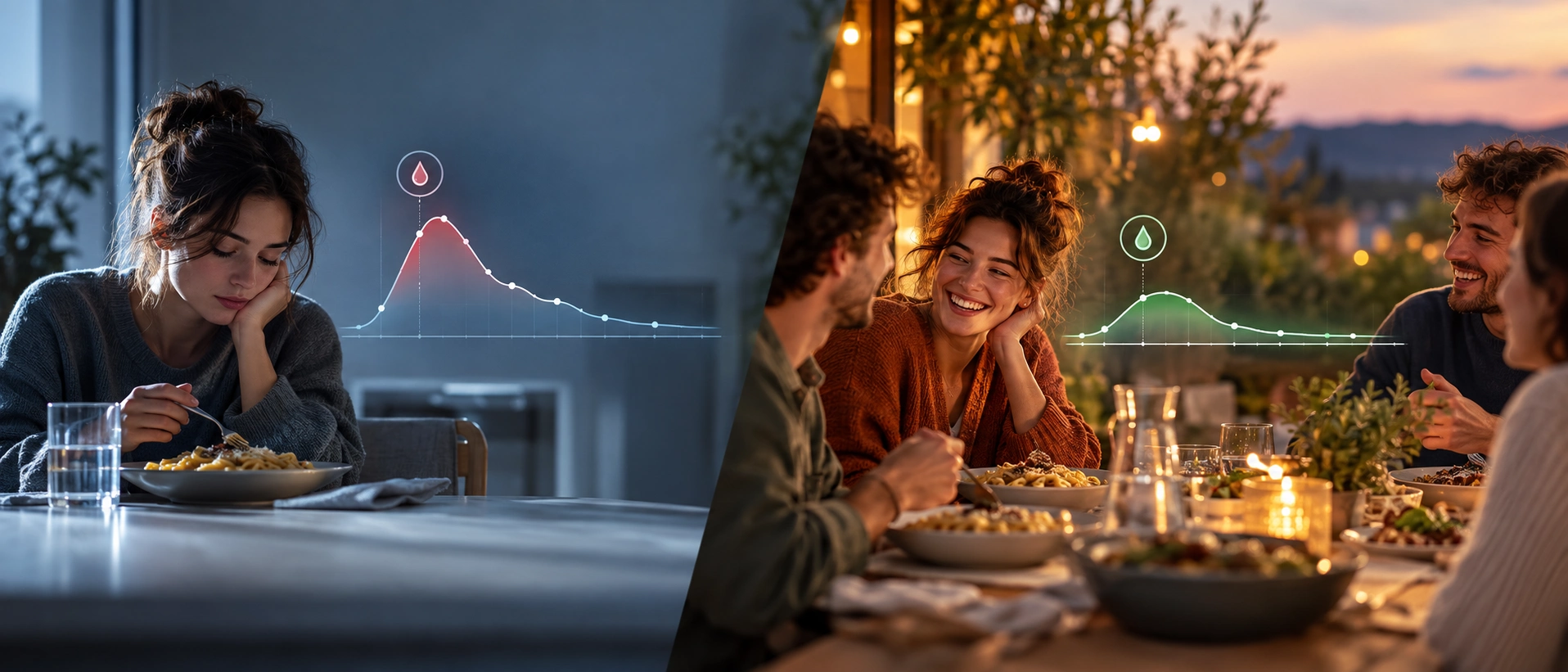
Two people can eat the same carbohydrate-rich meal and yet their bodies may not respond in quite the same way depending on whether they are alone or with someone close to them.
In a newly published series of preregistered experiments, researchers found that glucose regulation was more efficient in a social setting: blood sugar showed a smaller disturbance and returned toward baseline faster. The surprise was that the effect did not stop with metabolism. Social proximity also improved regulation during cold exposure and during psychological stress, including in infants.
The researchers call the phenomenon Social Physiology. Their larger idea is provocative: another person may not simply change how we feel. Their presence may change how much physiological work our own body has to perform to remain stable.
That possibility becomes much more interesting when placed beside decades of evidence showing that socially connected people tend to live longer and experience lower rates of several major diseases.
The effect reached far beyond blood sugar
The first experiment involved 108 participants undergoing a carbohydrate challenge. Compared with being alone, the social condition produced a smaller glucose perturbation and faster recovery.
If that had been the only result, the story might have remained an intriguing metabolic curiosity. Instead, the investigators tested the underlying idea in other systems.
During a cold challenge involving 116 participants, thermoregulation was more efficient in social proximity. During stress, sympathetic regulation showed the same general pattern in 115 adults. The researchers then observed a social advantage in a separate group of 56 infants.
That repetition across metabolism, temperature and autonomic stress regulation is what makes the result unusual. These systems perform different jobs, yet all are forms of homeostasis: the continuous effort required to keep the internal environment within useful limits when something pushes it away from equilibrium.
The implication is that social proximity could act as a surprisingly general input into that regulation.
Instead of thinking of the body as a self-contained machine that happens to enjoy company, Social Physiology asks whether other people are part of the environment the machine evolved to expect.
People with stronger social ties also tend to live longer
Long before these experiments, epidemiologists had noticed something difficult to ignore about social relationships.
A landmark meta-analysis combined 148 prospective studies involving 308,849 people. Those with stronger social relationships had an approximately 50% greater likelihood of survival over follow-up than people with weaker relationships. The association appeared across age, sex, baseline health and cause of death, and was strongest when researchers measured broad social integration rather than simply whether someone lived alone.
A much larger 2023 analysis of 90 prospective cohorts and more than 2.2 million people reached the same general conclusion from the opposite direction. Objective social isolation was associated with 32% higher all-cause mortality. Loneliness was associated with a smaller but still significant 14% increase.
That distinction matters. Isolation describes the objective structure of someone's social world. Loneliness describes the subjective feeling that desired connection is missing. A person can spend substantial time alone without feeling lonely, or be surrounded by people and still feel profoundly disconnected.
Neither body of evidence means that having more friends automatically extends life. Healthier people may find it easier to remain socially active, and social circumstances correlate with income, activity, smoking, healthcare access and many other variables. But the association has appeared often enough, and across enough populations, that social connection is increasingly treated as a serious health variable rather than a lifestyle footnote.
The associations extend to the heart and brain
The pattern is not limited to overall survival.
A meta-analysis of longitudinal studies found that deficient social relationships were associated with a 29% higher risk of developing coronary heart disease and a 32% higher risk of stroke.
Brain aging shows another striking association. A 2024 meta-analysis drawing on more than 600,000 people found loneliness associated with about 31% higher risk of all-cause dementia and 39% higher risk of Alzheimer disease. The association with vascular dementia was larger still.
Again, these are observational relationships, not proof that loneliness directly causes dementia or cardiovascular disease. But they raise an obvious question: what biological pathways could possibly connect relationships with organs as different as the heart, brain and metabolic system?
Possible explanations include chronic stress, sleep, physical activity, health behavior, access to practical support, autonomic regulation and inflammatory pathways. No single mechanism is likely to explain everything.
The new Social Physiology experiments introduce another possibility: perhaps some of the effect begins at a much more basic level, with the efficiency of physiological regulation itself.
What if being alone is not the body's true baseline?
This idea has an intellectual predecessor called Social Baseline Theory.
The theory argues that human brains evolved under conditions in which access to other people was normal. Close partners can share vigilance, resources, information, warmth, physical work and responses to danger. From that perspective, another reliable person is not merely pleasant company. They are a resource the nervous system can potentially incorporate into its calculation of how much effort is required from the individual.
That produces a counterintuitive possibility: perhaps being alone should not automatically be considered the neutral physiological condition.
For a deeply social species, isolation may sometimes require more individual regulation because every threat, energetic demand and environmental challenge must be handled without access to shared resources.
The new study pushes that logic into systems not normally considered social. Blood glucose does not sound like social behavior. Neither does thermoregulation. Yet both changed depending on social context.
That is the conceptual leap. Relationships may reach below psychology into the machinery of homeostasis itself.
Could social connection eventually become part of medicine?
There is a large distance between a laboratory effect and a clinical prescription. These experiments do not tell someone with diabetes to replace treatment with shared meals, nor do they establish that simply being near another person prevents disease.
But they create a new set of testable questions.
Does the identity of the other person matter? Is a trusted partner different from a stranger? Does emotional safety matter more than physical distance? Can video contact produce any of the same physiology? Are the effects larger in older adults, socially isolated people or patients whose metabolic or autonomic regulation is already impaired?
And perhaps most importantly, can repeated improvements in short-term regulation accumulate into measurable differences in disease risk over years?
If later studies answer some of those questions positively, the implications could extend into diabetes care, rehabilitation, geriatrics, hospital design, infant care and preventive medicine. Social context might eventually be treated less like background information and more like part of the biological environment surrounding treatment.
For now, the strongest conclusion is simpler and more intriguing. Decades of epidemiology tell us that socially connected people tend to fare better over the long term. These new experiments suggest one way that advantage might begin almost immediately.
The people around us may not merely change our experience of the world. They may change how efficiently our bodies hold themselves together.
Scientific References & Further Reading
- Anchor Study: “Social Physiology: Human homeostasis is more efficient in social proximity.” (Masalha M, Cohen M, Aloni M, Toledo E, Stahl E, Shachar D, Eliav O, Fuchs S, Atzil S. Science Advances. 2026. doi:10.1126/sciadv.aeg4937. Candidate abstract reports preregistered glucose, thermoregulation and sympathetic-regulation experiments in adults and infants. :contentReference[oaicite:5]{index=5})
- Social Relationships and Survival: “Social Relationships and Mortality Risk: A Meta-analytic Review.” (Holt-Lunstad J, Smith TB, Layton JB. PLoS Med. 2010;7:e1000316. Across 148 studies and 308,849 participants, stronger social relationships were associated with approximately 50% greater likelihood of survival. :contentReference[oaicite:6]{index=6})
- Isolation, Loneliness and Mortality: “A systematic review and meta-analysis of 90 cohort studies of social isolation, loneliness and mortality.” (Wang F, Gao Y, Han Z, et al. Nat Hum Behav. 2023;7:1307-1319. doi:10.1038/s41562-023-01617-6. :contentReference[oaicite:7]{index=7})
- Cardiovascular Disease: “Loneliness and social isolation as risk factors for coronary heart disease and stroke.” (Valtorta NK, Kanaan M, Gilbody S, Ronzi S, Hanratty B. Heart. 2016;102:1009-1016. Poor social relationships were associated with 29% higher CHD risk and 32% higher stroke risk. :contentReference[oaicite:8]{index=8})
- Loneliness and Dementia: “A meta-analysis of loneliness and risk of dementia using longitudinal data from >600,000 individuals.” (Luchetti M, Aschwanden D, Sesker AA, et al. Nat Ment Health. 2024;2:1350-1361. doi:10.1038/s44220-024-00328-9. :contentReference[oaicite:9]{index=9})
- Social Baseline Theory: “Social Baseline Theory: The Social Regulation of Risk and Effort.” (Coan JA, Sbarra DA. Curr Opin Psychol. 2015;1:87-91. doi:10.1016/j.copsyc.2014.12.021. :contentReference[oaicite:10]{index=10})
Disclaimer: This article is for informational purposes only and does not constitute medical advice. It is not a substitute for diagnosis, treatment, or individualized medical care.