
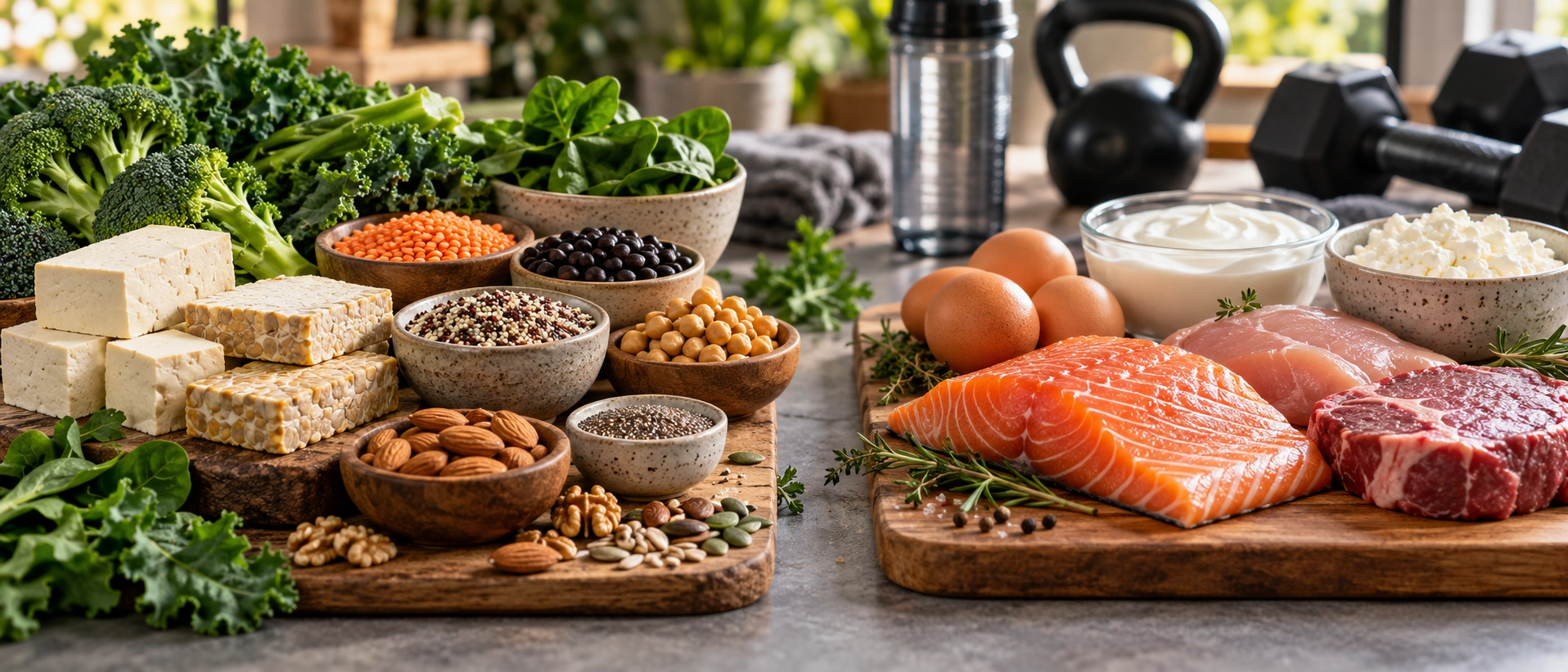
Plant vs. Animal Protein: What New 2026 Evidence Says About Muscle and Health
Evidence review & editorial synthesis
Plant protein or animal protein? For anyone trying to build muscle or stay strong with age, the argument often sounds surprisingly absolute.
A new 2026 systematic review suggests reality is more useful than either side's slogan. Across 31 studies, there was no universal winner. Animal protein sometimes performed better for muscle mass or bone outcomes, while plant protein performed well in other groups and outcomes. In several large studies, simply getting enough protein appeared more important than where it came from.
Stronger randomized evidence points in the same direction: protein source matters, but probably less than total intake, protein quality, age, and whether you actually train your muscles.
Why muscle matters more as you age
Muscle is not just about appearance or athletic performance. Losing muscle and strength with age contributes to frailty, poorer mobility, reduced physical function, and loss of independence.
That makes preserving muscle one of the more practical components of healthy aging.
The new review found a mixed picture. Animal protein was linked with better muscle preservation and bone mineral density in some studies. Plant protein was associated with lower sarcopenia or frailty risk in others, particularly in people with greater inflammatory burden.
A stronger 2025 meta-analysis of randomized trials helps clarify the comparison. Across 30 trials suitable for muscle-mass analysis, animal protein produced a small overall advantage. But among adults aged 60 or older, that advantage was no longer statistically significant. Plant and animal protein also produced no significant difference in pooled muscle-strength or physical-performance outcomes.
Even more strikingly, soy and milk protein produced essentially equivalent muscle-mass results across 17 randomized trials.
Animal protein does have a biological advantage
That does not mean every protein is identical.
Gram for gram, many animal proteins are easier for the body to use for muscle building. They tend to be highly digestible and richer in essential amino acids, particularly leucine, which helps trigger muscle protein synthesis.
That difference can become more relevant with age because older muscle develops anabolic resistance and responds less strongly to a given protein dose.
But protein quality is not an all-or-nothing property. Plant-based diets can compensate by providing enough total protein, using leucine-rich sources such as soy and legumes, combining complementary sources, or using concentrated plant proteins when useful.
Contemporary reviews suggest that when intake, energy availability, and amino-acid quality are optimized, long-term muscle gains from plant-based diets can approach those from animal-based diets.
For healthy older adults, commonly cited expert ranges start around 1.0 to 1.2 grams of protein per kilogram of body weight per day. For a 70-kilogram person, that is roughly 70 to 84 grams. Requirements can be higher with exercise, illness, or other circumstances.
Protein is building material. Training is the signal
The biggest mistake may be obsessing over protein source while ignoring resistance training.
A 2025 network meta-analysis covering 38 randomized trials and 2,610 adults aged 50 or older compared protein supplementation, resistance training, and their combination. Combining resistance training with protein performed better than protein supplementation alone for muscle mass and physical function.
Resistance training alone also clearly improved strength and physical function compared with protein supplementation alone.
That leads to a more useful question than simply plant versus animal: How much protein are you getting, is it high enough quality, and are you giving your muscles a reason to use it?
For someone already consuming enough high-quality protein, changing from one protein source to another may produce a smaller return than adding progressive resistance training.
Muscle is not the whole health story
Animal protein can be convenient for hitting leucine and essential-amino-acid targets, but the healthiest protein choice cannot be judged from muscle physiology alone.
A 2026 meta-analysis of nine prospective cohorts covering more than one million people found that replacing 3 to 5 percent of total calories from animal protein with plant protein was associated with about 9 percent lower all-cause mortality. Cardiovascular mortality was also lower, with stronger associations at the larger substitution level.
Those data are observational, so they cannot prove that plant protein itself prevents death. The food matters too. Replacing processed meat with beans is a very different comparison from replacing fish or yogurt with a highly processed vegan product.
Cost follows the same rule. There is no universal plant-versus-animal winner. A 2026 price review found traditional plant foods such as legumes to be relatively inexpensive across many settings, while manufactured plant-based meat and dairy alternatives averaged roughly 1.8 to 2 times the price of their conventional equivalents.
The practical conclusion is therefore less ideological than the protein debate often sounds.
Animal protein has a genuine gram-for-gram quality advantage. Plant protein can still support strong muscles when the diet supplies enough high-quality protein, and plant-rich food choices may offer advantages for long-term health. For healthy aging, the bigger priorities are likely adequate protein, good food choices, and regular resistance training rather than declaring one entire protein kingdom the winner.
Scientific References & Further Reading
- Anchor Study: “Plant versus animal protein intake and muscle mass, strength, and physical function in middle-aged and older adults: A systematic review.” (Maksuwan W, Chaiyasit K, Srisukthaveerat V, Saeheng T, Na-Bangchang K. Functional Foods in Health and Disease. 2026;16(10):889-902. doi:10.31989/ffhd.v16i10.2135.)
- Randomized Protein-Source Evidence: “Effect of Plant Versus Animal Protein on Muscle Mass, Strength, Physical Performance, and Sarcopenia: A Systematic Review and Meta-analysis of Randomized Controlled Trials.” (Reid-McCann RJ, Brennan SF, Ward NA, et al. Nutrition Reviews. 2025;83(7):e1581-e1603. doi:10.1093/nutrit/nuae200.)
- Resistance Training and Protein: “Comparison of the Effectiveness of Protein Supplementation Combined with Resistance Training on Body Composition and Physical Function in Healthy Elderly Adults.” (Tian H, Qiao W, Wen X. Journal of Nutrition. 2025;155(3):764-774. doi:10.1016/j.tjnut.2025.01.017.)
- Protein Quality and Leucine: “Sustaining Muscle, Cardiovascular Health, and the Environment: Is Plant-Based Protein the Key?.” (Cannito T, Ivetac A, Fiotti N, et al. Nutrients. 2026;18(9):1446. doi:10.3390/nu18091446.)
- Long-Term Health: “Isocaloric substitution of animal protein with plant protein and its impact on all-cause, cardiovascular, and cancer mortality: A systematic review and meta-analysis.” (Barrantes-Espinola G, Alberti P, Jaramillo-Morales E, Rodriguez A, López-Moreno M. Clinical Nutrition. 2026;61:106654. doi:10.1016/j.clnu.2026.106654.)
- Cost Context: “Prices and cost drivers of alternatives to animal-source foods: a scoping review and narrative analysis.” (Nordhagen S, Beal T, Herrero M, Neufeld L, Sokourenko K. Lancet Planetary Health. 2026;10(6):101485. doi:10.1016/j.lanplh.2026.101485.)
Disclaimer: This article is for informational purposes only and does not constitute medical advice. It is not a substitute for diagnosis, treatment, or individualized medical care.