Older Americans Are Using More Cannabis Than Ever. Is It Actually Good for Them?
Evidence review & editorial synthesis
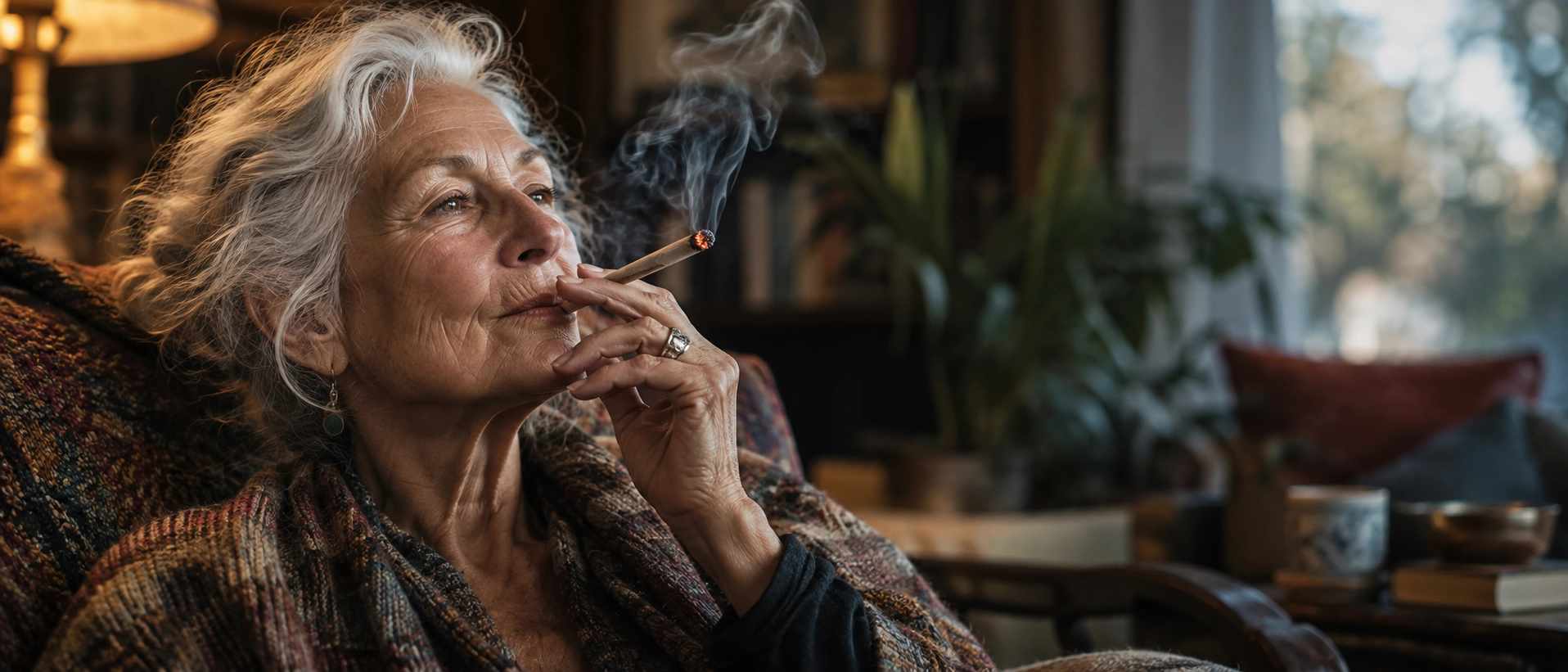
Cannabis use among older Americans has moved from unusual to increasingly mainstream.
A new nationally representative study estimates that 8.9% of US adults aged 65 and older used cannabis during the previous year. Among those users, 11.4% met diagnostic criteria for cannabis use disorder.
That matters because older adults increasingly use cannabis not simply to get high, but to manage pain, sleep problems, anxiety and other symptoms. Yet the scientific evidence that cannabis reliably delivers those benefits in older people remains surprisingly limited, while aging can make some of its adverse effects more consequential.
Nearly 1 in 10 older Americans now use cannabis
The new study analyzed four years of data from the US National Survey on Drug Use and Health, covering 21,189 adults aged 65 or older living outside institutions.
Past-year cannabis use was 8.9%.
That represents an enormous cultural shift. National survey data from the early 2000s put annual cannabis use among Americans aged 65 and older at well below 1%. It had already risen to about 2% by 2014, and recent national datasets now commonly put use in the mid-to-high single digits.
The way older adults consume cannabis also matters. In the new study, 65.8% of users smoked it, 40.5% ate or drank cannabis products and 15.4% vaped it. People could report more than one method.
Only 19.9% said a doctor had recommended any cannabis use.
So although medical reasons are an important part of the boom, most older users in this national sample were not simply following a physician-directed treatment plan.
About 1 in 9 users met criteria for cannabis use disorder
The most striking finding was not simply how many older adults were using cannabis.
Among people who had used it in the previous year, 11.4% met at least two DSM-5 criteria for cannabis use disorder, or CUD.
Most cases were mild: 76% of those with CUD fell into the mild category, 20.1% were moderate and 3.9% severe.
The most common signs were surprisingly familiar features of addiction rather than dramatic intoxication. Among older users with CUD, 74.4% met the criterion involving substantial time spent obtaining, using or recovering from cannabis, while 67.5% reported craving.
Risk rose sharply with patterns of heavy use. People using cannabis on at least 300 days a year had 3.7 times the risk of CUD compared with less frequent users. Smoking was associated with an even larger increase in the study's bivariable analysis.
Older adults with a recent mental illness also had nearly three times the risk of CUD.
None of these associations proves cannabis caused the underlying mental-health problems or dependence risk, but they show that cannabis addiction is not exclusively a young-person problem.
Many seniors use cannabis for pain and sleep. Does it work?
This is where the story becomes less straightforward.
Older adults commonly report using cannabis for chronic pain, poor sleep, anxiety and mood symptoms. In a 2025 study of older US veterans, pain was by far the most common medical reason for use, followed by mental-health concerns and sleep difficulties.
Some people clearly report feeling better after using it. A 2025 daily-life study of medical cannabis users aged 55 to 74 found that greater subjective intoxication was followed by short-term reductions in pain, anxiety and depression, and was associated with better sleep that night.
But observational symptom relief is not the same as proof of durable treatment benefit.
A 2025 systematic review specifically examined cannabis for depression, anxiety, pain and insomnia in older adults. Its conclusion was much less reassuring: the evidence base remains small, inconsistent and insufficient to determine how reliably cannabis improves these common symptoms in later life.
That distinction is important. Cannabis may help some individuals, yet the popularity of a treatment can grow much faster than the evidence supporting it.
Older bodies can make the side effects matter more
Cannabis does not become inherently toxic at age 65, but the consequences of impairment can change with age.
Older adults are more likely to take multiple medications, have cardiovascular disease, experience balance problems or have reduced physiological reserve. A side effect that is merely inconvenient in a younger adult can therefore become clinically important later in life.
A meta-analysis of 58 randomized trials involving 6,611 middle-aged and older adults found that THC-containing cannabinoid medicines increased adverse effects including dizziness, lightheadedness, sleepiness, balance and coordination problems, and disturbances in thinking or perception.
Several of these effects increased as THC dose increased.
That immediately raises practical concerns about falls, driving, confusion and interactions with sedating drugs. The evidence connecting cannabis directly to each of these outcomes in seniors is still incomplete, but the biological concern is straightforward.
Edibles create a different problem. Their effects arrive more slowly than inhaled cannabis, which can make redosing before the first dose has fully taken effect easier. Modern products can also contain far more THC than older users may remember from cannabis decades ago.
Did legalization create the boom?
Legalization is part of the background, but it does not provide a simple answer.
Older-adult cannabis use has risen during the same period in which medical and recreational cannabis became legal across much of the United States. A 2025 study of older veterans found current use was more common among those living in states with recreational legalization.
Legalization can increase access, normalize use and reduce perceived risk. But it is not the only explanation. Today's older population includes generations with much greater lifetime exposure to cannabis than previous cohorts, while commercial products, medical marketing and public attitudes have all changed at the same time.
Nor does rising use alone tell us whether legalization was a good or bad policy. Any serious judgment would have to weigh health outcomes alongside reduced criminalization, regulated access, medical availability, illicit markets and other social effects.
The more immediate health question is narrower and answerable: are older adults receiving a treatment whose benefits and risks they understand?
Right now, the answer appears to be: not always.
Cannabis may relieve symptoms for some older adults. But nearly one in ten now use it, one in nine users meet criteria for cannabis use disorder, and the evidence supporting many of the reasons seniors take it remains much thinner than its growing popularity suggests.
Scientific References & Further Reading
- Anchor Study: “Cannabis use and cannabis use disorder among older adults in the USA.” (Han BH, Eschliman EL, Palamar JJ, Triguero Roura M, Mauro PM. Addiction. 2026. doi:10.1111/add.70600. PMID:42802914.)
- Symptom Benefit Review: “Does Cannabis Use Reduce Symptoms of Depression, Anxiety, Pain, and Insomnia Among Older Adults? A Systematic Review.” (Kohlwes K, Jacob ME, Do J, et al. J Am Geriatr Soc. 2025;73(9):2917-2919. doi:10.1111/jgs.19605.)
- Adverse Effects Meta-Analysis: “Adverse events caused by cannabinoids in middle aged and older adults for all indications: a meta-analysis of incidence rate difference.” (Meta-analysis of 58 randomized trials involving 6,611 middle-aged and older adults. PMID:39602500.)
- Older Adult Epidemiology: “Epidemiology of Cannabis Use Among Middle-Aged and Older Adults in the U.S.” (Am J Prev Med. 2025. doi:10.1016/j.amepre.2025.108149. PMID:41101401.)
- Older Veterans Study: “Cannabis Use Among Older Adults.” (Pravosud V, et al. JAMA Netw Open. 2025.)
- Historical US Trends: “Trends and correlates of marijuana use among late middle-aged and older adults in the United States, 2002-2014.” (Han BH, Sherman S, Mauro PM, Martins SS, Rotenberg J, Palamar JJ. Addiction. 2017. PMID:28063338.)
Disclaimer: This article is for informational purposes only and does not constitute medical advice. It is not a substitute for diagnosis, treatment, or individualized medical care.