
A Brief HIV Antibody Treatment Kept a Virus Under Control for Nearly Six Years
Evidence review & editorial synthesis
Imagine receiving a short course of treatment for HIV and then living for years without needing medication to keep the virus under control.
For most people living with HIV today, continuous antiretroviral treatment remains essential. But scientists are investigating an extraordinary alternative: teaching the immune system to maintain control on its own.
In a study published in Proceedings of the National Academy of Sciences in November 2026, researchers reported that a brief antibody treatment helped macaques control an HIV-like virus for nearly 300 weeks, almost six years.
Even more importantly, the scientists discovered why one antibody variant produced this remarkable long-term effect while another, despite initially controlling the virus just as effectively, largely failed.
The findings reveal a potentially important mechanism for developing treatments that could one day achieve lasting HIV remission without continuous medication.
Nearly Six Years of Viral Control After Brief Treatment
The researchers studied macaques infected with SHIV, an experimental virus combining characteristics of simian immunodeficiency virus and HIV.
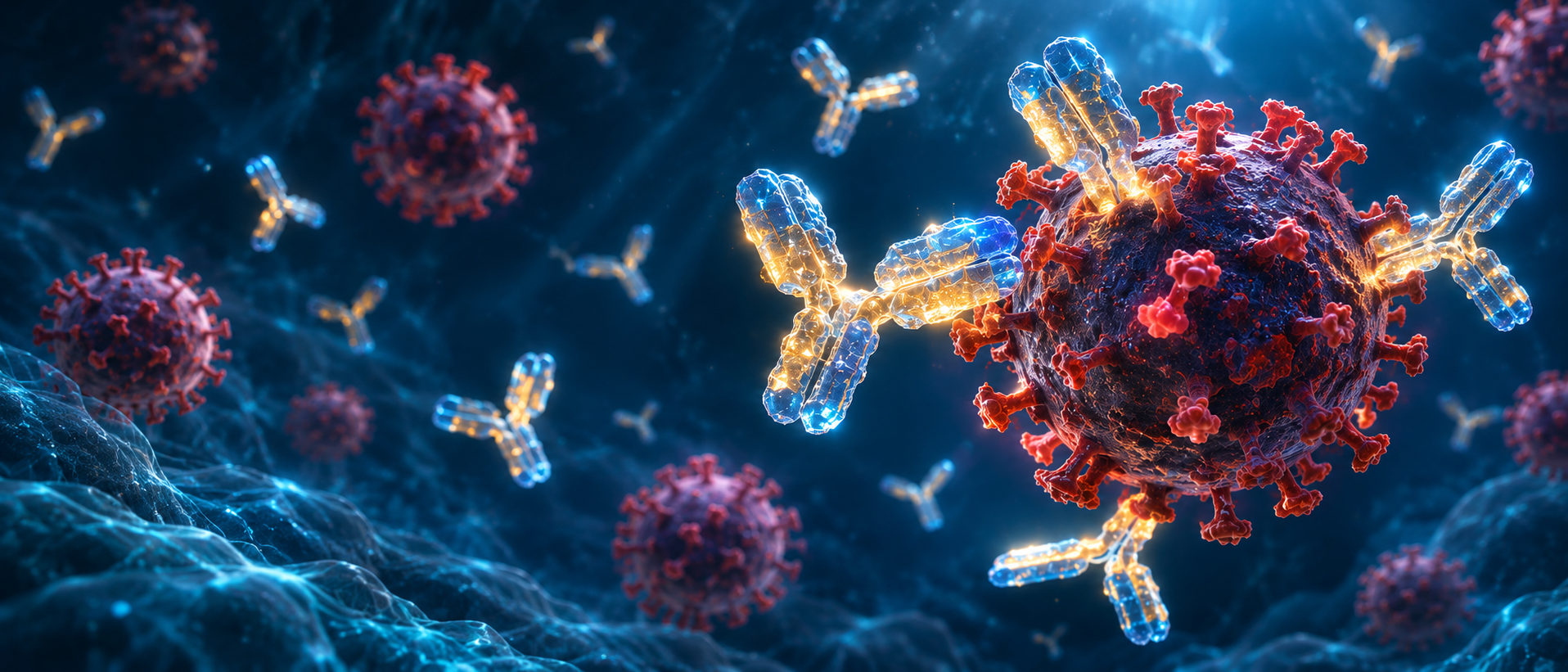
They tested different versions of a broadly neutralizing antibody called 3BNC117, which recognizes HIV-related viral structures and blocks infection of susceptible cells.
Both versions were designed to have comparable virus-binding ability, neutralizing activity and pharmacokinetics. Their crucial difference involved a part of the antibody known as the Fc region.
One variant could engage Fc gamma receptors on immune cells. The other lacked that ability.
Initially, both versions produced similar control of viral replication.
But their long-term effects were dramatically different.
Every evaluable macaque receiving the Fc-receptor-engaging antibody developed sustained viral suppression, lasting nearly 300 weeks in the longest follow-up. Only one of eight animals receiving the Fc-receptor-null variant achieved comparable long-term control.
The animals had received antibody treatment during the early phase of infection, not continuously throughout those years.
This distinction matters. Rather than requiring a constant supply of therapeutic antibodies, the successful treatment appeared to establish an immune response capable of maintaining viral control long after the original intervention.
For a field seeking ways to achieve HIV remission without lifelong therapy, the result is remarkable.
The Discovery: Antibodies May Train the Immune System
Why did two antibodies with similar direct antiviral effects lead to such different long-term outcomes?
The key appeared to be the interaction between the antibody's Fc region and receptors on immune cells.
Antibodies do more than attach to viruses. Their Fc regions can communicate with other components of the immune system, helping organize immune responses.
In the new experiments, this interaction proved essential for the reliable development of sustained viral control.
The researchers traced the effect to CD8 T cells, immune cells that can recognize and destroy infected cells.
The successful antibody variant promoted a distinctive antiviral CD8 response, including stronger virus-specific functions and persistent populations of selected T-cell clones.
The findings suggest that a temporary antibody intervention can leave behind a lasting immune imprint.
Scientists sometimes call this a vaccinal effect: the treatment does not merely neutralize a pathogen while the antibody is present, but also helps generate a more durable immune response.
This is the scientific advance at the heart of the study.
It identifies a feature that future antibodies might be engineered to strengthen, rather than relying on neutralization alone.
Human Research Is Already Showing Encouraging Results
The possibility of antibody-mediated HIV remission is not limited to animal experiments.
In the randomized Phase 2 RIO trial, researchers investigated two long-acting broadly neutralizing antibodies in 68 men living with HIV who had started antiretroviral treatment during early infection.
Under close clinical supervision, participants interrupted their regular HIV medication after receiving either antibody treatment or placebo.
At 20 weeks, 75% of participants assigned to antibodies had not experienced the trial's predefined viral rebound, compared with just 11% in the placebo group.
These are substantial differences in a carefully monitored human study.
The macaque experiments and the RIO trial used different antibody regimens and addressed different scientific questions. The RIO results do not prove that the six-year remission seen in animals is achievable in humans.
Nevertheless, together they provide an unusually compelling combination of evidence: human proof that antibody treatment can prolong drug-free viral control, and animal evidence identifying a molecular interaction that may help make such control more durable.
The long-term goal is sometimes called a functional cure.
Unlike a sterilizing cure, which would completely eliminate HIV, a functional cure would allow the virus to remain controlled without the need for continuous treatment.
For someone living with HIV, that could mean fewer medications, less treatment burden and greater freedom, while maintaining the health benefits of sustained viral suppression.
HIV Today: Far Less Dangerous Than Many People Realize
The encouraging news extends beyond experimental cure research.
Modern HIV treatment has already transformed a diagnosis that was once frequently fatal into a manageable chronic condition for many people.
A large analysis of people receiving long-term antiretroviral therapy in Europe and North America found that those with strong immune recovery could have a life expectancy only a few years below that of the general population.
Early diagnosis, consistent treatment and access to appropriate medical care remain essential. Not everyone with HIV has the same prognosis, and untreated infection can still be life-threatening.
There is also widespread misunderstanding about how HIV spreads.
HIV is not transmitted by hugging, shaking hands, sharing food, using the same toilet or ordinary social contact.
Sexual transmission is possible, but the probability from a single exposure varies greatly depending on the activity, the infected person's viral load and the use of prevention. For example, public-health estimates generally place the per-exposure risk of unprotected vaginal intercourse with a person who has transmissible HIV below that of receptive anal intercourse. Even relatively low individual risks can accumulate with repeated exposures.
One of the most important advances is the principle known as U=U, or Undetectable equals Untransmittable.
People living with HIV who maintain an undetectable viral load through effective treatment do not sexually transmit the virus to their partners.
Condoms, HIV pre-exposure prophylaxis and other prevention measures also provide effective ways to reduce risk. HIV remains a serious infection, but fear of ordinary contact with someone living with HIV has no scientific basis.
This reality is already dramatically different from the public perception of HIV during the early decades of the epidemic.
A Future Where HIV May No Longer Require Lifelong Treatment
The new antibody study offers a glimpse of what the next major advance might look like.
Imagine someone diagnosed with HIV receiving prompt treatment, achieving excellent viral control and eventually undergoing a carefully designed immune therapy that enables their own CD8 T cells to maintain suppression for years.
Instead of continuously suppressing viral replication with medication, clinicians might one day be able to establish durable immune control after a limited treatment course.
If such an approach became reliable and accessible, it could further transform the everyday experience of living with HIV.
There are still major obstacles. The longest remissions in the new study occurred in animals treated during acute infection. Researchers must determine whether comparable effects can be achieved in people with longstanding HIV, whether latent viral reservoirs eventually trigger rebound, and whether engineered antibodies can safely produce durable immune responses across diverse patients.
No functional cure has been established for routine clinical use, and the study does not provide a reliable timeline for one. People with HIV should never interrupt antiretroviral medication outside closely supervised research.
But the broader direction is deeply encouraging.
Effective therapy can already allow many people with HIV to live long, healthy lives and prevents sexual transmission when the viral load remains suppressed.
Now scientists are beginning to identify ways the immune system itself might maintain that control long after a brief treatment.
The ultimate achievement would not necessarily be removing every trace of HIV from the body. It could be making the virus so reliably controlled that it no longer requires a lifetime of medication.
After decades of progress, that possibility is becoming an increasingly concrete scientific objective.
Scientific References & Further Reading
- Anchor Study: “Durable CD8-mediated remission after brief anti-HIV-1 antibody treatment requires FcγR engagement.” (Bournazos S, Nishimura Y, Grace BAC, et al. Proceedings of the National Academy of Sciences. Published online November 17, 2026. DOI: 10.1073/pnas.2632384123. PMID: 43043696.)
- Human Clinical Trial: “Time to HIV rebound after infusion of long-acting broadly neutralising antibodies 3BNC117-LS and 10-1074-LS and analytical treatment interruption (the RIO trial).” (The Lancet HIV. 2026. Randomized placebo-controlled Phase 2 trial involving 68 adults.)
- Human Immunological Follow-up: “Broadly neutralizing antibodies in adult males living with HIV undergoing analytical treatment interruption: secondary and exploratory outcomes of the phase II randomized controlled RIO trial.” (Nature Medicine. 2026. Secondary and exploratory analyses.)
- Life Expectancy: “Life expectancy after 2015 of adults with HIV on long-term antiretroviral therapy in Europe and North America: a collaborative analysis of cohort studies.” (The Lancet HIV. 2023;10:e295-e307. Large international cohort analysis.)
- HIV Transmission and Prevention: “HIV Risk and Prevention Estimates.” (Centers for Disease Control and Prevention. Public-health estimates and transmission-prevention guidance.)
- Undetectable Equals Untransmittable: “Understanding How HIV is Transmitted.” (National Institutes of Health. HIVinfo public-health guidance.)
Disclaimer: This article is for informational purposes only and does not constitute medical advice. It is not a substitute for diagnosis, treatment, or individualized medical care.