
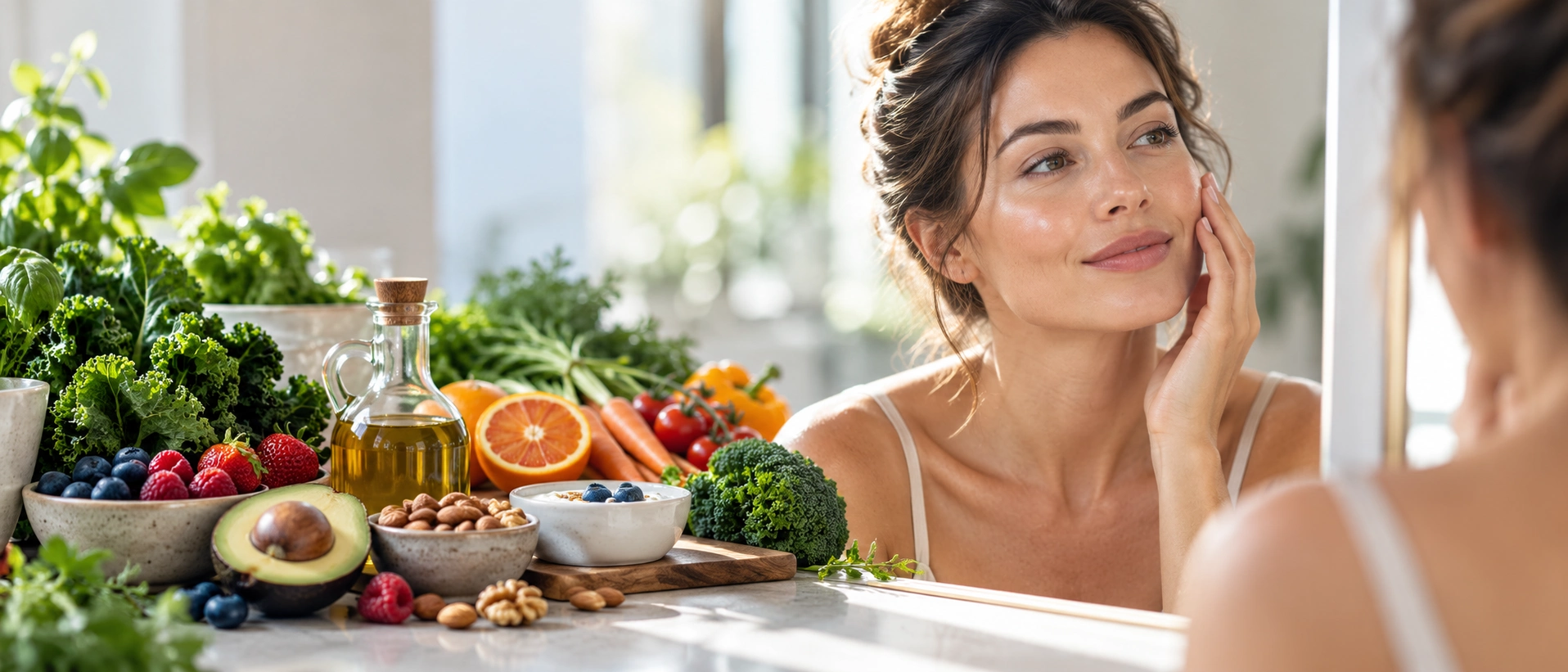
Can You Eat Your Way to Younger-Looking Skin? Here’s What the Evidence Says
Evidence review & editorial synthesis
The idea that you can eat your way to better skin sounds tailor-made for the wellness industry. But a growing body of controlled human research suggests that nutrition really can change some of the things people see in the mirror.
A recent meta-analysis combined 61 human studies examining wrinkles, hydration, redness, pigmentation, elasticity and skin-barrier function. Forty-seven of those studies were randomized controlled trials.
The result was not one magical anti-aging food. Different nutrients appeared to influence different aspects of skin aging, with some of the clearest signals coming from polyphenols, certain fats and fatty acids, collagen-based interventions and probiotics.
Diet can measurably change wrinkles and hydration
Wrinkles were one of the most interesting outcomes.
In the 61-study analysis, collagen-based interventions were associated with fewer wrinkles, with a pooled standardized effect size of -0.94. Lipids and fatty acids also reduced wrinkles, with an effect of -0.62, while polyphenols showed an effect of -0.48.
Hydration improved with several different intervention types. Collagen, lipids and fatty acids, polyphenols, and prebiotic or probiotic interventions all produced statistically significant improvements.
Polyphenols also reduced transepidermal water loss, a measure of how effectively the skin barrier prevents moisture from escaping. Lipids and fatty acids produced one of the stronger signals for improved elasticity.
These changes are not equivalent to turning a 55-year-old face into a 35-year-old one. They are changes in measurable characteristics that contribute to how aged skin looks and feels.
But they show something important: skin is not isolated from the rest of metabolism. What reaches it through the circulation can influence its structure, water retention, pigmentation and response to environmental stress.
Polyphenols may be one of the more interesting signals
Polyphenols are plant compounds found in foods such as berries, cocoa, tea, grapes, citrus fruits and many other fruits and vegetables.
Across the recent meta-analysis, polyphenol interventions improved multiple outcomes rather than only one. They were associated with fewer wrinkles, greater hydration and a stronger skin barrier.
Their proposed mechanisms include antioxidant activity, reduced inflammatory signaling and effects on skin lipids and microcirculation.
That does not mean a handful of blueberries functions like a cosmetic procedure. Many of the studies used concentrated extracts or defined doses that are difficult to reproduce exactly with ordinary food.
Still, the pattern fits older observational evidence. In a large Dutch population study, women who adhered more closely to healthy dietary guidelines had fewer facial wrinkles. A fruit-dominant dietary pattern was also associated with fewer wrinkles, while a pattern dominated by red meat and snacks was associated with more.
Because that study was observational, healthier diets may have traveled with healthier lifestyles. But the intervention literature makes the connection harder to dismiss entirely.
Fruit can even change the color of your skin
Diet can affect appearance in another surprisingly visible way.
Carotenoids are pigments found in foods including carrots, tomatoes, leafy greens and many colorful fruits. They accumulate in human skin.
In a longitudinal experiment, changes in fruit and vegetable consumption over six weeks produced measurable changes in skin redness and yellowness. The effect matched the light-absorption pattern expected from carotenoids rather than melanin.
When researchers showed altered skin coloration to observers, carotenoid-related changes could make faces appear healthier and, in some experiments, more attractive.
This is not tanning. It is a subtle shift in skin coloration produced by pigments arriving from the diet.
The newer meta-analysis likewise found carotenoid interventions particularly associated with reduced skin redness, although evidence for other anti-aging outcomes remains less consistent.
What about collagen supplements?
This is where the evidence becomes much more contentious.
The large 61-study analysis found impressive-looking pooled effects for collagen, including fewer wrinkles and better hydration. Other meta-analyses of randomized trials have also reported improvements in hydration and elasticity.
But a 2025 meta-analysis took an unusually important additional step. It separated 23 randomized collagen trials according to study quality and funding.
When all trials were combined, collagen appeared to improve wrinkles, elasticity and hydration. But in studies without pharmaceutical-company funding, those benefits disappeared. Higher-quality trials likewise failed to show significant effects across the main outcomes.
The authors concluded that the existing clinical evidence was insufficient to support collagen supplements as a treatment for skin aging.
That does not prove collagen does nothing. It means the apparently strong headline effect is much less secure once the quality of the evidence is examined.
For consumers, that is a useful distinction between a plausible treatment and a firmly established one.
Sugar, glycation and aging collagen
There is also a compelling biological reason diet could influence skin aging over much longer periods.
Collagen is a long-lived protein. Sugars and reactive carbonyl compounds can chemically bind to proteins through a process called glycation, eventually creating advanced glycation end products, or AGEs.
AGE cross-links can make collagen stiffer and more resistant to normal remodeling. Glycation can also promote oxidative stress and inflammatory signaling.
This mechanism is well established biologically, and AGE accumulation increases with age and conditions such as diabetes.
What remains less certain is how much AGE-rich food itself contributes to visible human skin aging. Dietary AGEs form particularly readily during high-temperature dry cooking such as grilling, roasting and frying, but human research on their long-term effects remains inconsistent. It would therefore be premature to market a low-AGE diet as a proven anti-wrinkle treatment.
So what should you actually eat for your skin?
The strongest practical conclusion is less exotic than the supplement industry might prefer.
A diet rich in colorful plant foods supplies carotenoids and polyphenols. Nuts, seeds, fish and other sources of unsaturated fats provide lipids involved in skin-barrier function. Adequate protein supplies the amino acids needed to maintain connective tissue.
That pattern resembles a broadly healthy diet more than a specialized beauty regimen.
And one intervention still matters more than any food: reducing excessive ultraviolet exposure. Diet may influence how well skin handles oxidative stress and retains moisture, but it does not make chronic UV damage disappear.
So can you eat your way to younger-looking skin?
To a modest degree, probably yes. Human studies now show measurable changes in wrinkles, hydration, elasticity, barrier function and even skin color. But the strongest lesson is not that one powder or superfood reverses aging. It is that the skin appears to reflect the nutritional environment of the body more than we once assumed.
Scientific References & Further Reading
- Anchor Review: “Diet and the skin: From clinical anecdote to evidence-based counselling.” (Vora R, Jadav KM. IP Indian Journal of Clinical and Experimental Dermatology. 2026. doi:10.18231/j.ijced.54694.1790573578.)
- Skin Aging Meta-Analysis: “Dietary interventions in skin ageing: a systematic review and meta-analysis.” (Journal of Physiological Anthropology. 2025. PMID:41174715.)
- Collagen Evidence Review: “Effects of Collagen Supplements on Skin Aging: A Systematic Review and Meta-Analysis of Randomized Controlled Trials.” (Myung SK, et al. Am J Med. 2025. PMID:40324552.)
- Photoaging Supplement Meta-Analysis: “Effectiveness of dietary supplements for skin photoaging in healthy adults: a systematic review and meta-analysis of randomized controlled trials.” (Systematic review and meta-analysis of 40 randomized controlled trials. PMID:40761858.)
- Healthy Diet and Facial Wrinkles: “A healthy diet in women is associated with less facial wrinkles in a large Dutch population-based cohort.” (Mekić S, et al. J Am Acad Dermatol. 2019. PMID:29601935.)
- Fruit, Vegetables and Skin Appearance: “You are what you eat: within-subject increases in fruit and vegetable consumption confer beneficial skin-color changes.” (Whitehead RD, Re D, Xiao D, Ozakinci G, Perrett DI. PLoS One. 2012;7(3):e32988. doi:10.1371/journal.pone.0032988.)
Disclaimer: This article is for informational purposes only and does not constitute medical advice. It is not a substitute for diagnosis, treatment, or individualized medical care.