
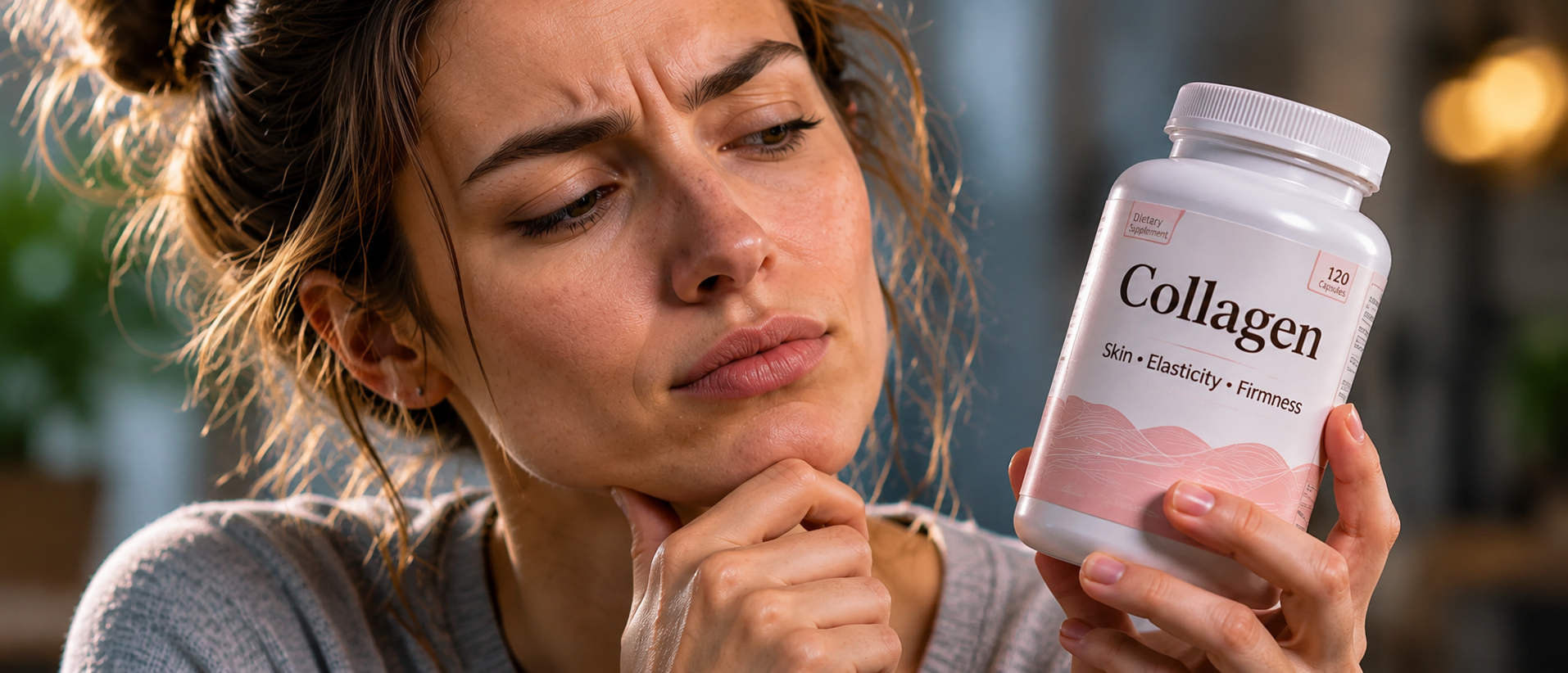
Are Collagen Supplements a Waste of Money? New Research Challenges Their Anti-Aging Claims
Evidence review & editorial synthesis
Every morning, millions of people stir collagen powder into coffee, water or smoothies, hoping to keep their skin smooth, firm and youthful.
But here is the uncomfortable question: Are collagen supplements actually worth the money?
A series of recent scientific reviews suggests that the anti-aging story may be considerably weaker than supplement marketing implies. Some pooled trials show improvements in skin hydration and elasticity. Yet when researchers separate higher-quality studies from weaker ones, examine industry funding or test whether unusually positive studies distort the results, much of the apparent wrinkle-reduction benefit becomes difficult to defend.
The Collagen Promise Meets a More Demanding Scientific Test
A July 2026 systematic review in the Journal of Cosmetic Dermatology pooled 35 randomized controlled trials involving 2,534 participants.
Its primary analyses initially looked encouraging. Compared with control groups, oral collagen improved instrument-measured skin hydration (standardized mean difference, or SMD, 0.44), elasticity (0.62) and skin-barrier function, reflected by lower transepidermal water loss (−0.39).
These are standardized statistical effects, not percentage improvements in appearance. Some findings suggested that changes in elasticity and moisture retention were more apparent after at least 12 weeks of supplementation than after shorter periods.
But the most commercially attractive claims—fewer wrinkles and visibly rebuilt skin—did not survive the authors' more rigorous sensitivity and multilevel analyses. Apparent improvements in wrinkle depth, roughness and dermal density were influenced by unusually powerful outlier studies and substantial differences between trials.
An even more challenging result came from a 2025 meta-analysis in The American Journal of Medicine. It evaluated 23 randomized trials involving 1,474 people and asked a question previous summaries had often neglected: what happens when studies are grouped by their quality and financing?
Although the combined results initially appeared favorable, the researchers found no statistically significant skin-aging benefits in the higher-quality trials or in studies without funding from supplement or pharmaceutical manufacturers.
Why the Latest Critique Is So Important
In September 2026, another paper went further. Rather than testing a new collagen product, its authors re-examined the statistical methods underpinning earlier collagen meta-analyses.
Their conclusion was stark: the current evidence does not justify recommending oral hydrolyzed collagen as a treatment for skin aging.
The critique highlighted differences between trial populations, collagen sources, doses and treatment durations, alongside methodological issues in how results had been combined and interpreted. The authors found no convincing dose-response relationship in their meta-regression analyses.
So is collagen a waste of money? That depends on the reason for buying it, the cost and how much weight one places on uncertain benefits. For wrinkle reduction specifically, a consumer should not expect a clinically proven transformation. For hydration, there remains a possible signal, but its size and reliability are debated.
What Actually Has Stronger Evidence for Younger-Looking Skin?
Daily sunscreen is one of them. In a randomized Australian study of 903 adults, researchers followed participants for approximately four and a half years. Those assigned to daily sunscreen use showed 24% less progression in measured skin aging than people using sunscreen at their discretion.
That 24% refers to a comparative measure of skin aging, not a literal 24% disappearance of wrinkles. Nevertheless, it is an unusually concrete long-term result showing that regular UV protection can slow visible photoaging.
For people who want to improve skin that is already sun-damaged, topical tretinoin has substantial evidence. Systematic reviews of randomized trials find that this prescription retinoid can improve fine facial wrinkles and certain other features of photoaged skin over time.
Tretinoin may cause irritation and is not appropriate during pregnancy. In Germany it requires a prescription, so suitability and use should be discussed with a clinician.
Ordinary moisturizers also deserve credit. By reducing water loss and improving the outer skin barrier, an appropriate moisturizer can make dry skin feel smoother and temporarily make fine lines appear less prominent. This is a meaningful cosmetic benefit, even if it does not reverse the underlying causes of aging.
Avoiding smoking provides another important protective advantage. Smoking is strongly associated with accelerated skin aging and facial wrinkles, even though the exact personal benefit from stopping cannot be calculated from a supplement-style trial.
Should You Keep Buying Collagen Powder?
If you enjoy collagen as a food ingredient or protein source, the debate over cosmetic benefits does not automatically make it worthless. But if the main reason for spending money is the promise of significantly younger-looking skin, the newest analyses offer good reason to reconsider expectations.
Suppose a supplement costs €25 a month. That would mean €300 a year devoted to a benefit that remains uncertain. This is an illustrative budget calculation, not a verified market price or a claim that every collagen product costs the same.
A more evidence-based skincare budget would usually prioritize suitable UV protection, effective moisturization and, where appropriate, proven topical treatments before expensive anti-aging supplements.
Another emerging area is the gut-skin axis. Recent clinical research suggests that particular oral probiotic strains may affect skin hydration and wrinkle scores. Those findings are interesting but preliminary, and they do not prove that probiotics outperform collagen or replace sunscreen. They are best seen as a separate field worth following.
After decades of beauty promises, the most reliable route to younger-looking skin may still be protecting it from damage and using treatments that have demonstrated measurable clinical benefits—rather than assuming that swallowing more collagen will rebuild the face from within.
Scientific References & Further Reading
- Updated Meta-Analysis: “Oral Collagen Peptides and Skin Rejuvenation: A Systematic Review and an Updated Meta-Analysis of Randomized Controlled Trials.” (Batool A, et al. Journal of Cosmetic Dermatology. Published July 15, 2026. DOI: 10.1111/jocd.71041.)
- Funding and Study Quality Analysis: “Effects of Collagen Supplements on Skin Aging: A Systematic Review and Meta-Analysis of Randomized Controlled Trials.” (Myung SK, Park Y. American Journal of Medicine. 2025;138:1264–1277.)
- Methodological Reassessment: “Hydrolyzed Collagen for Skin Aging Meta-Analyses Are Unreliable.” (Journal of Cosmetic Dermatology. First published September 28, 2026. DOI: 10.1111/jocd.71208.)
- UV Protection Randomized Trial: “Sunscreen and prevention of skin aging: a randomized trial.” (Hughes MCB, et al. Annals of Internal Medicine. 2013;158:781–790.)
- Topical Tretinoin Evidence: “Tretinoin for Photodamaged Facial Skin: Systematic Review and Meta-Analysis of Randomized Controlled Trials.” (Systematic review and meta-analysis of randomized trials. 2025.)
- Additional Retinoid Evidence: “Topical tretinoin for treating photoaging: A systematic review of randomized controlled trials.” (Systematic review. 2022.)
Disclaimer: This article is for informational purposes only and does not constitute medical advice. Individual skin treatment decisions should consider medical history, pregnancy status and professional guidance.