
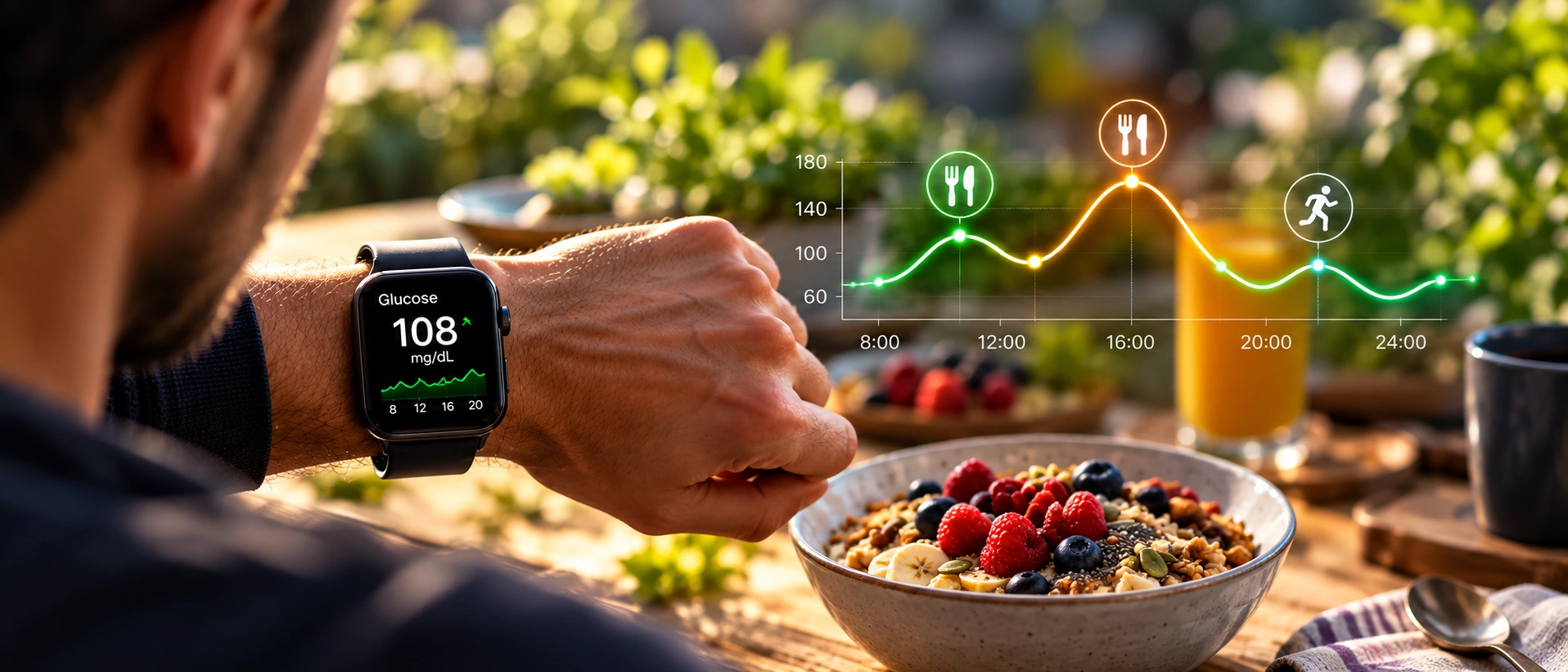
A Regular Smartwatch Helped Estimate Glucose Without Piercing the Skin
Evidence review & editorial synthesis
Continuous glucose monitoring normally requires something to enter the skin. A tiny filament measures glucose in the fluid between cells, and the sensor must eventually be replaced.
A new study points toward a very different possibility: perhaps the watch on your wrist could estimate glucose without measuring glucose directly at all.
Researchers followed 74 adults for two weeks while they wore a FreeStyle Libre 3 as the reference device, an advanced research wristband and a commercially available Fitbit Sense 2. Machine-learning models then tried to reconstruct the glucose values from the noninvasive physiological signals captured at the wrist.
The result was surprisingly promising. The best wearable model achieved an average error of about 21 mg/dL, while estimates based on the commercial smartwatch averaged about 23.5 mg/dL of error.
The watch did not actually sense glucose
That distinction is what makes the experiment interesting.
Researchers have pursued needle-free glucose monitoring for decades using light, spectroscopy, electromagnetic signals, sweat and other approaches. Many attempts effectively try to build a new glucose sensor that happens to work through the skin.
This approach is different. The Fitbit Sense 2 was not secretly detecting sugar molecules. Instead, machine learning searched for glucose-related information hidden within physiological patterns already measurable at the wrist.
Glucose changes occur alongside changes in the autonomic nervous system, circulation, skin responses, temperature, activity and other signals. Individually, none of these tells you a person's glucose concentration. Together and across time, however, they may contain a recognizable metabolic fingerprint.
The more sophisticated research wearable performed best. Its long short-term memory model reached a root-mean-squared error of 21.04 mg/dL, and 98.3% of predictions landed in zones A or B of the Clarke error grid, categories used to judge whether glucose errors are likely to be clinically acceptable or lead to problematic decisions.
Remarkably, the ordinary Fitbit data were not far behind, producing an RMSE of 23.49 mg/dL across the cohort.
Why removing the sensor could matter
Modern CGMs have transformed diabetes care, but they still require a disposable sensor inserted through the skin. Cost, sensor replacement, skin irritation and the simple inconvenience of wearing another device limit how widely continuous glucose tracking can be used.
If a future smartwatch could produce sufficiently accurate glucose information using hardware people already wear, the economics could change dramatically.
For diabetes, the long-term ambition is obvious: continuous information with less hardware and fewer consumables. The current experiment is nowhere near accurate or validated enough to replace a medical CGM for insulin dosing, but it shows that useful glucose information may be extractable without directly sensing glucose.
The opportunity could be even broader outside diabetes.
Someone at risk of metabolic disease might see that certain breakfasts repeatedly produce larger glucose excursions, that a walk after dinner changes the pattern, or that responses shift as weight, sleep or fitness change. Instead of wearing a CGM for a two-week experiment, metabolic feedback could theoretically run continuously in the background of a watch already being worn for years.
That could turn glucose from an occasional laboratory measurement into something closer to heart rate or sleep tracking.
Healthy people could use it differently
For someone without diabetes, exact medical-grade glucose values may not always be necessary to create useful feedback.
A system capable of reliably identifying relative changes could potentially answer simpler questions: Which meals produce my largest glucose responses? Does exercising after a meal blunt them? Do my responses change after poor sleep? Are previously normal patterns gradually becoming abnormal?
That creates obvious possibilities for personalized nutrition and early metabolic-risk detection. Instead of prescribing the same low-glycemic foods to everyone, an app could potentially learn an individual's responses and suggest meals that produce more favorable patterns.
There is an important boundary here. Healthy people do not need perfectly flat glucose curves, normal post-meal rises are part of normal physiology, and researchers are still determining how much additional health value CGM-style optimization provides in people without diabetes.
But inexpensive passive monitoring could make those questions much easier to study.
The remaining accuracy gap is the whole challenge
An average error around 21 to 23 mg/dL is impressive for a device that is not measuring glucose directly, but it is also large enough to matter medically.
A true glucose value of 70 mg/dL versus 95 mg/dL can mean something very different for someone using insulin. Rare extreme values are also precisely where a system cannot afford to fail.
That is why current medical CGMs are not about to disappear. The new model was tested in only 74 people, and much larger studies must determine how well it works across different ages, skin characteristics, glucose ranges, medications, exercise conditions and people with diabetes.
Yet the conceptual advance is compelling. A future smartwatch may not need to solve the extraordinarily difficult problem of sensing individual glucose molecules through intact skin. It may instead learn to recognize the physiological signature glucose leaves behind.
If that approach continues to improve, continuous metabolic tracking could eventually become something millions of people get from a watch rather than a sensor stuck into their skin.
Scientific References & Further Reading
- Anchor Study: “Noninvasive Interstitial Glucose Estimation Using Wearables and Machine Learning in Healthy Individuals and Individuals With Obesity: Observational Cohort Study.” (Schmelter F, Huang X, Heidmann A, et al. Noninvasive Interstitial Glucose Estimation Using Wearables and Machine Learning in Healthy Individuals and Individuals With Obesity: Observational Cohort Study. JMIR mHealth and uHealth. 2026;14:e91724. doi:10.2196/91724.)
- Earlier Proof of Concept: “Digital biomarkers for interstitial glucose prediction in healthy individuals using wearables and machine learning.” (Huang X, Schmelter F, Seitzer C, et al. Digital biomarkers for interstitial glucose prediction in healthy individuals using wearables and machine learning. Scientific Reports. 2025;15:30164. doi:10.1038/s41598-025-14172-z.)
- AI Glucose Monitoring Review: “AI-Based Noninvasive Blood Glucose Monitoring: Scoping Review.” (Chan PZ, Jin E, Jansson M, Chew HSJ. AI-Based Noninvasive Blood Glucose Monitoring: Scoping Review. Journal of Medical Internet Research. 2024.)
- Noninvasive Glucose Technology Review: “Non-Invasive Technologies in Wearable Glucose Monitoring: A Structured Overview for the Future.” (Non-Invasive Technologies in Wearable Glucose Monitoring: A Structured Overview for the Future. 2026.)
- Regulatory Context: “Do Not Use Smartwatches or Smart Rings to Measure Blood Glucose Levels: FDA Safety Communication.” (U.S. Food and Drug Administration. Do Not Use Smartwatches or Smart Rings to Measure Blood Glucose Levels: FDA Safety Communication. 2024.)
Disclaimer: This article is for informational purposes only and does not constitute medical advice. It is not a substitute for diagnosis, treatment, or individualized medical care.