
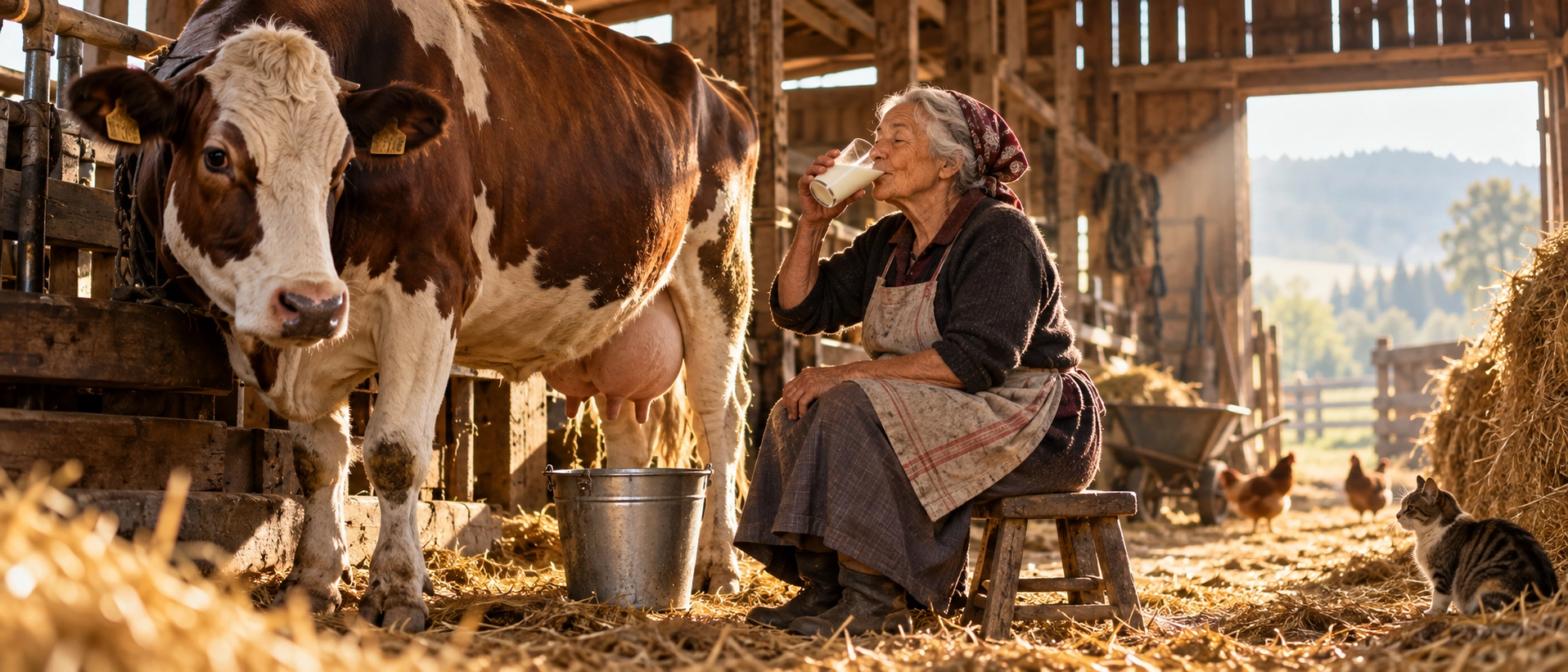
Raw Milk Is Having a Comeback. What New 2026 Guidance Says About Its Health Claims
Evidence review & editorial synthesis
Raw milk has a compelling sales pitch. It is less processed, closer to the farm and supposedly packed with nutrients, enzymes and beneficial microbes that pasteurization destroys.
A new 2026 policy statement from the American Academy of Pediatrics revisits those claims and arrives at a much less romantic conclusion: raw milk has no established overall health advantage that outweighs its additional infectious risk.
That does not mean pasteurization changes absolutely nothing. It means the changes that matter most are very different from what many raw-milk claims imply.
What does pasteurization actually do?
Pasteurization is controlled heating designed to kill disease-causing microorganisms. Depending on the process, milk is heated to a defined temperature for a defined period and then cooled.
The central trade-off is often presented online as safety versus nutrition, as though making milk safer necessarily strips away much of what makes it valuable.
That is not what the evidence shows.
Milk remains a source of protein, calcium, phosphorus and other nutrients after pasteurization. A systematic review examining vitamin changes did find reductions in several heat-sensitive vitamins, including B1, B2, vitamin C and folate. That is a real effect and should not be dismissed.
But the same review concluded that the overall impact on nutritional value was small, in part because milk contains relatively little of several affected vitamins to begin with. Pasteurization does not transform nutritious milk into an empty beverage.
What it changes far more dramatically is the number of viable pathogens capable of reaching the person drinking it.
Does raw milk contain something uniquely healthy?
Advocates commonly point to natural enzymes, beneficial bacteria and other heat-sensitive components as reasons raw milk should be healthier.
The difficulty is moving from biological possibility to demonstrated human benefit.
There is no good evidence that drinking raw milk improves health overall compared with drinking pasteurized milk. Nor has raw milk been established as a treatment for digestive problems, immune disorders or other diseases.
One area deserves more nuance: allergy and asthma.
Several observational studies of children raised around farms have found associations between consumption of farm or raw milk and lower rates of allergic disease. A systematic review concluded that a protective association was possible.
But children who consume farm milk are also exposed to different animals, microbes, environments, diets and lifestyles. Those factors are difficult to separate. An association therefore does not establish that pathogens and all, unpasteurized milk is the protective ingredient.
The finding is scientifically interesting. It is not currently a reason to recommend raw milk as allergy prevention.
Does pasteurized milk cause lactose intolerance or allergies?
These are two of the clearest myths.
Lactose intolerance occurs when a person does not produce enough lactase to digest lactose efficiently. Both raw and pasteurized cow's milk contain lactose. Pasteurization does not meaningfully remove or create it.
Raw milk therefore does not correct the biological cause of lactose intolerance, and pasteurization does not cause that deficiency.
Milk allergy is different. It is an immune reaction to milk proteins. But the relevant proteins are present in both raw and pasteurized milk. Heating can alter protein structure to some degree, yet there is no convincing clinical evidence that ordinary pasteurization turns otherwise harmless milk into an allergy-causing food.
The simple idea that raw milk retains a digestive enzyme that makes lactose disappear is also misleading. Cow's milk does not contain enough indigenous lactase to solve human lactase deficiency.
The part pasteurization is supposed to destroy
Raw milk can acquire microorganisms from fecal contamination, an infected udder, animal skin, the farm environment, milking equipment or later handling.
Among the organisms repeatedly associated with unpasteurized dairy are Campylobacter, Salmonella, shiga-toxin-producing E. coli, Listeria and Brucella.
Most foodborne infections cause gastrointestinal illness from which healthy adults recover. The reason public-health agencies take raw milk particularly seriously is the tail of the risk distribution.
Shiga-toxin-producing E. coli can cause hemolytic uremic syndrome and kidney failure. Campylobacter infection can rarely precede Guillain-Barré syndrome. Listeria during pregnancy can threaten the fetus and contribute to miscarriage, stillbirth, premature delivery or severe newborn infection.
Children, pregnant people, older adults and people with impaired immune systems are therefore at especially high risk of severe outcomes.
And clean farms do not eliminate the problem. Good hygiene can reduce contamination but cannot guarantee that every batch from an apparently healthy animal is free of pathogens.
A recent U.S. outbreak linked commercially distributed raw milk to Salmonella infections across several states. The median age of reported patients was only seven years, illustrating why the risk is not confined to careless backyard production.
A new concern: H5N1 in dairy cattle
The updated 2026 AAP guidance adds another reason the subject has returned to attention.
During the recent H5N1 outbreak in U.S. dairy cattle, infectious avian-influenza virus was detected in raw milk from infected animals. The AAP notes that virus can occur at high concentrations and can remain detectable in refrigerated raw milk.
That does not mean drinking raw milk has been proven to cause human H5N1 infection. No confirmed human infection from consuming raw milk had been established in the guidance.
But it changes the theoretical risk landscape. Pasteurization is designed precisely to reduce viable infectious agents in a food that can otherwise carry them from animals to people.
Is pasteurized milk perfect? No. Is raw milk healthier? The evidence says no
Pasteurization should not be turned into the opposite myth. It does not make milk sterile, does not make dairy appropriate for everyone and does not prevent spoilage once milk is mishandled. People with milk allergy still need to avoid the relevant proteins, and people with lactose intolerance may still need lower-lactose alternatives.
Nor is every biological difference between raw and pasteurized milk meaningless. Heat changes food. The interesting scientific question is whether those changes produce a clinically important health disadvantage.
So far, the evidence does not show one that compensates for the additional infection risk of raw milk.
That makes the central comparison surprisingly simple.
Pasteurization changes some heat-sensitive components modestly while preserving the major nutritional reasons people drink milk. What it is exceptionally good at removing is something most people do not want in their food: living pathogens capable of causing serious disease.
The most defensible interpretation of the current evidence is therefore not that raw milk is poison or that processing never changes food.
It is that the strongest health claims used to justify drinking raw milk have not been demonstrated, while the reason pasteurization was introduced in the first place remains very real.
Scientific References & Further Reading
- Anchor Policy Statement: “Consumption of Unpasteurized (Raw) Milk and Milk Products by Pregnant People and Children: Policy Statement.” (Ratner AJ, Sardi A, Corkins MR, et al. Consumption of Unpasteurized (Raw) Milk and Milk Products by Pregnant People and Children: Policy Statement. Pediatrics. 2026. doi:10.1542/peds.2026-079036.)
- Pasteurization and Nutrition: “A systematic review and meta-analysis of the effects of pasteurization on milk vitamins, and evidence for raw milk consumption and other health-related outcomes.” (Macdonald LE, Brett J, Kelton D, Majowicz SE, Snedeker K, Sargeant JM. J Food Prot. 2011;74(11):1814-1832. doi:10.4315/0362-028X.JFP-10-269.)
- Raw Milk Myths: “Raw Milk Questions & Answers.” (U.S. Food and Drug Administration. Raw Milk Questions & Answers.)
- Food Safety: “Raw Milk.” (Centers for Disease Control and Prevention. Raw Milk. Food Safety.)
- Recent Outbreak Evidence: “Outbreak of Salmonella Typhimurium Infections Linked to Commercially Distributed Raw Milk - California and Four Other States, September 2023-March 2024.” (Centers for Disease Control and Prevention. MMWR. Outbreak of Salmonella Typhimurium Infections Linked to Commercially Distributed Raw Milk.)
Disclaimer: This article is for informational purposes only and does not constitute medical advice. It is not a substitute for diagnosis, treatment, or individualized medical care.