
Microplastics Are Getting Into Our Bodies. Scientists Are Starting to Find Ways to Get Them Back Out.
Evidence review & editorial synthesis
For years, the microplastic story has moved in one unsettling direction: researchers keep finding tiny plastic particles in more parts of the human body. Blood. Lungs. Placenta. Arterial plaques. Stool and urine.
Now a more hopeful question is beginning to emerge. If plastic can get into us, can we get it back out?
There is no proven human microplastic detox. But several independent lines of research are beginning to reveal possible exit routes. Some particles naturally leave through the gut and urinary system. Certain probiotic bacteria can physically trap plastic inside the intestine and increase its excretion in animals. And in 2026, researchers demonstrated that therapeutic plasma exchange can reduce microplastics already circulating in human blood.
None is yet a complete solution. Together, however, they suggest that microplastic removal is becoming a real experimental field rather than just an environmental-health thought experiment.
The body already gets rid of some plastic
Not every particle we swallow becomes part of us.
Microplastics have repeatedly been detected in human stool, showing that at least some ingested material travels through the gastrointestinal tract and leaves the body. Plastic particles have also been detected in urine, indicating that some material entering the circulation can eventually reach an excretory route.
The harder question is how much escapes.
Particle size matters. Larger microplastics appear less capable of crossing intestinal barriers, while extremely small microplastics and nanoplastics are considered more capable of interacting with mucus, crossing cells and entering the circulation. Reviews of the field emphasize that particle chemistry, shape, size and surface properties all influence what happens after ingestion.
This means the intestine represents a potentially important interception point. If a particle can be trapped before it crosses the gut wall, it may simply leave with the feces instead of becoming a systemic problem.
That is where a surprising bacterium from kimchi enters the story.
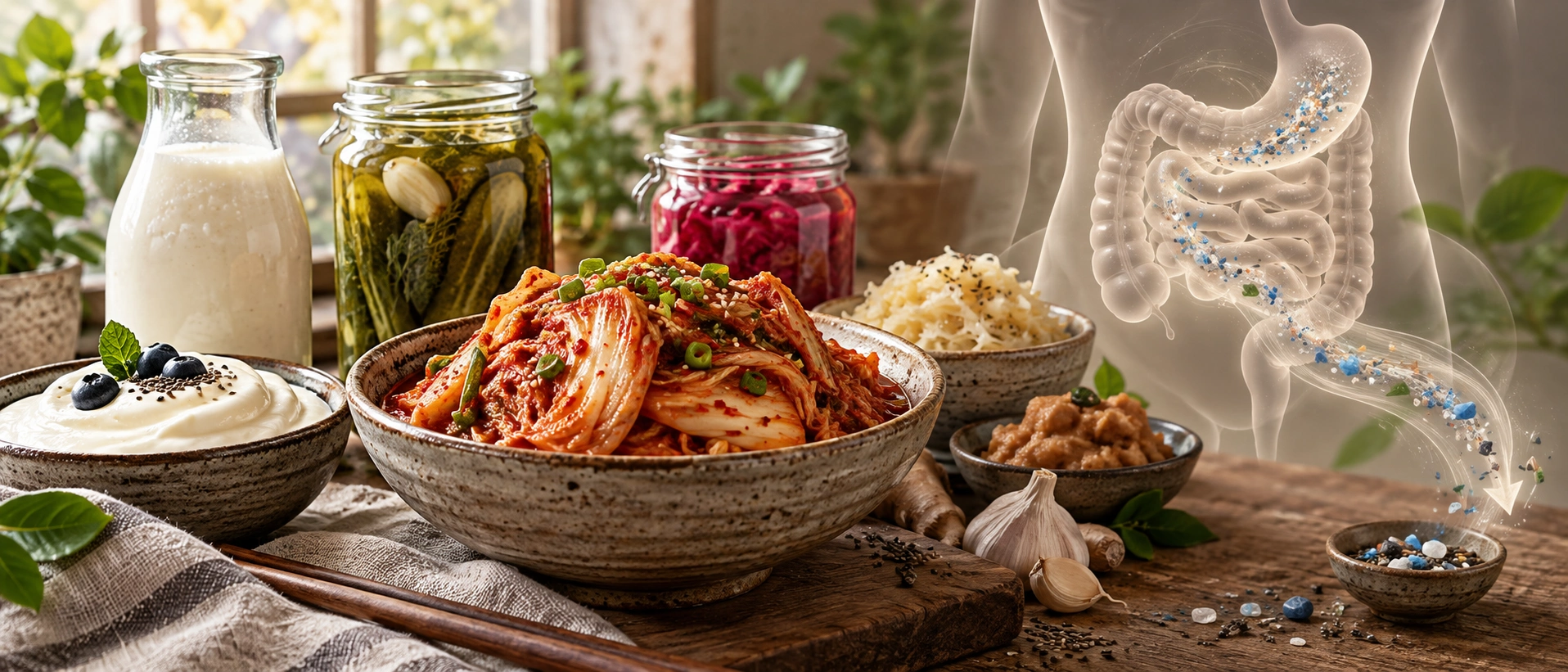
A kimchi bacterium more than doubled nanoplastic excretion in mice
Researchers at the World Institute of Kimchi isolated a strain of lactic acid bacterium called Leuconostoc mesenteroides CBA3656 and tested whether its cell surface could physically bind nanoplastics.
Under ordinary laboratory conditions, the bacterium showed strong binding. More importantly, it retained about 57% adsorption efficiency in simulated intestinal fluid, while another tested strain fell to just 3%.
The team then moved into germ-free mice.
Animals receiving CBA3656 excreted more than twice as much nanoplastic in their feces as untreated controls. The proposed mechanism is strikingly simple: bacterial surfaces grab onto plastic particles in the gut and carry them toward the exit.
This is not evidence that eating kimchi removes nanoplastics from people. The researchers used a particular isolated strain, controlled doses of polystyrene nanoplastic and germ-free mice. We do not yet know how the bacterium behaves inside the far more complicated human microbiome.
But it is not an isolated finding.
A separate research group previously screened 784 bacterial strains for their ability to bind 0.1 micrometer polystyrene particles. Two probiotic strains stood out. When given to mice, they increased polystyrene excretion by 34% and reduced the amount remaining in the intestine by 67%. One strain also reduced intestinal inflammation associated with the plastic exposure.
Two different research programs have therefore arrived at a similar concept: microbes might function as microscopic plastic-binding agents inside the gut.
Removing plastic that has already reached the blood is harder
Gut trapping could potentially reduce absorption of newly ingested particles. It does not answer the more troubling question of plastic that has already crossed into the body.
A 2026 study in the Journal of Clinical Apheresis offered the first direct human evidence that at least one circulating pool can be reduced.
Researchers measured blood microplastics before and after 174 therapeutic plasma exchange procedures performed in 114 people. Therapeutic plasma exchange removes a person's plasma and replaces it with another fluid, while returning blood cells to the circulation.
Circulating microplastic levels fell after the procedure, particularly when patients started with higher concentrations. The authors described it as the first demonstration that circulating microplastics can deliberately be reduced in humans.
There was also a remarkable complication: at low starting levels, the apparent benefit became harder to see because the plastic tubing of the apheresis system itself could release microplastics back into the bloodstream.
That detail captures the wider problem almost perfectly. We may eventually become capable of removing plastic from the body while still living in an environment filled with new sources of exposure.
Plasma exchange is also not a practical microplastic cleanse. It is an invasive medical procedure, the study did not test whether reducing blood particles improved health, and removal from circulating plasma does not prove that particles stored in tissues are extracted.
The real challenge is plastic already inside tissues
This may turn out to be the hardest frontier.
Human studies have detected microplastics and nanoplastics in multiple biological tissues and fluids. Smaller particles are especially concerning because laboratory and animal work suggests they have greater capacity to cross biological barriers.
Once particles leave the bloodstream and enter tissue, simply filtering plasma may not immediately retrieve them.
Researchers therefore need to answer several fundamental questions. Do tissue particles slowly move back into the circulation? Can immune cells transport them toward excretory organs? Are some polymers cleared faster than others? Can binding agents safely capture them? And are the particles that remain for years actually causing disease?
Even that final question is still being resolved. A 2026 systematic review of human studies found associations between higher microplastic burdens and inflammatory, cardiovascular, reproductive and gastrointestinal abnormalities, but also found substantial methodological heterogeneity and risk of confounding.
Removing plastic sounds intuitively desirable. Demonstrating that removal makes people healthier is the crucial next step.
What can someone realistically do today?
At present, there is no supplement, fermented food, drug or medical procedure established as a routine treatment for clearing microplastics from healthy people.
The most defensible strategy is therefore still to reduce ongoing exposure while the body uses whatever clearance routes it already possesses.
Researchers studying the gut have proposed minimizing heavily packaged and processed foods where practical and investigating diets rich in fiber, antioxidants and beneficial microbes. Those approaches may support intestinal health and potentially influence particle handling, but they are not proven detox protocols.
The probiotic research is more specific and potentially more exciting. Instead of vaguely trying to make the gut healthier, scientists could eventually identify bacterial strains engineered or selected specifically for their ability to grab particular plastics before they cross the intestinal wall.
Plasma technologies point toward an entirely different future: physically filtering contaminants already circulating inside us.
Neither approach is ready for routine use. But the scientific direction has changed.
The question used to be whether microscopic plastic could enter the human body at all. We now know that it can.
The next question is much more actionable: how much can the body remove on its own, and how much more could we eventually help it remove?
Scientific References & Further Reading
- Anchor Study: “Efficient biosorption of nanoplastics by food-derived lactic acid bacterium.” (Lee J, Lee MJ, Jung MJ, et al. Bioresour Technol. 2026;447:134234. doi:10.1016/j.biortech.2026.134234. PMID:41702519. The strain retained strong nanoplastic adsorption under simulated intestinal conditions and increased fecal excretion in germ-free mice. :contentReference[oaicite:4]{index=4})
- Probiotic Microplastic Removal: “Novel probiotics adsorbing and excreting microplastics in vivo show potential gut health benefits.” (Front Microbiol. 2025. doi:10.3389/fmicb.2024.1522794. PMID:39867494. Probiotic-treated mice showed 34% greater polystyrene excretion and 67% lower residual intestinal polystyrene. :contentReference[oaicite:5]{index=5})
- Human Removal Study: “Can Plasma Exchange Be Used to Lower the Circulating Burden of Microplastics in Human Patients?.” (Weinstein R, Stara Yuksel Z, Anderson C, et al. J Clin Apher. 2026;41:e70135. doi:10.1002/jca.70135. PMID:42169439. Circulating microplastics were measured across 174 therapeutic plasma exchange procedures in 114 patients and were reduced by treatment. :contentReference[oaicite:6]{index=6})
- Gut and Dietary Review: “Microplastics and Nanoplastics in the Human Intestine: A Review of Health Implications and Possible Dietary Interventions.” (Dávalos A, Martín-Santiago V, López de las Hazas MC. Adv Nutr. 2026;17:100624. doi:10.1016/j.advnut.2026.100624. PMID:41903888. :contentReference[oaicite:7]{index=7})
- Human Evidence Review: “Health impacts of micro- and nanoplastics in humans: systematic review of in vivo evidence.” (Tran HAA, Ng JJ, Tang DH, et al. Environ Health. 2026;25:26. Systematic review of 25 human studies emphasizing widespread detection but substantial methodological limitations. :contentReference[oaicite:8]{index=8})
Disclaimer: This article is for informational purposes only and does not constitute medical advice. It is not a substitute for diagnosis, treatment, or individualized medical care.