
Why Watching Sports May Be Good for Your Mental Health
Evidence review & editorial synthesis
Watching sports seems like one of the least active things a person can do. You sit down while somebody else runs, competes and wins.
Yet a growing body of research suggests sports spectatorship can be associated with fewer depressive symptoms, less loneliness and greater well-being. A newly published study has now reported fewer depressive symptoms among sports-watching adults with congenital heart disease, adding to similar findings in much broader populations.
The interesting question is no longer simply whether fans enjoy sport. It is why watching strangers compete can become so emotionally important that people organize weekends around it, call a team's victory "our" victory and gather by the tens of thousands to experience it together.
The answer may have surprisingly little to do with the final score.
Watching sports is linked to fewer depressive symptoms
One of the largest clues comes from 21,317 older adults in Japan.
Researchers asked how often participants watched sports in person and through television or the internet. Compared with people who did not watch, spectators were less likely to report depressive symptoms even after adjustment for their own exercise habits and multiple other factors.
The pattern was particularly striking for television and internet viewing. Compared with non-viewers, the prevalence ratios for depressive symptoms were 0.86 among occasional viewers, 0.79 among those watching one to three times per month and 0.71 among people watching at least weekly.
This was cross-sectional evidence, so it cannot show that turning on a football match prevents depression. People who are less depressed may simply have more interest in sport and more energy to follow it.
But the finding is not isolated.
In a UK sample of 7,249 adults, attending live sporting events was associated with greater life satisfaction, a stronger feeling that life was worthwhile and less loneliness. The effects were small, but they remained after adjustment for factors including age, health, employment and deprivation.
And in 2026, an analysis of 53,967 people across eight waves of the Chinese General Social Survey again linked routine sports viewing with greater subjective well-being.
Something about spectatorship appears repeatedly connected to how people feel about their lives.
A team can give you something humans deeply need: a 'we'
Part of the answer may be social identity.
Human identity is not purely individual. We define ourselves partly through groups: family, town, country, profession, religion, music scene, political community or football club.
A team offers an unusually clear group identity. There are colors, symbols, rivals, shared history, heroes, songs and a story that continues year after year. Supporting a club can transform anonymous strangers into people who immediately have something in common.
This also helps explain the strange grammar of fandom.
A supporter rarely says, "Eleven employees of the club I prefer defeated eleven employees of another organization." They say, "We won."
Psychologists have long described related behavior as basking in reflected glory. When the group becomes psychologically incorporated into the self, its success can provide a form of vicarious achievement.
But recent evidence suggests winning is only part of the reward.
A 2026 study of devoted football fans examined what happened when supporters sang, moved together and displayed shared symbols in the stands. Greater choreographed participation strongly predicted social identity and positive affect and was associated with emotional catharsis. Remarkably, whether the team actually won or lost did not significantly predict catharsis or subjective well-being in the model.
The ritual itself mattered.
A stadium is not just a place to watch
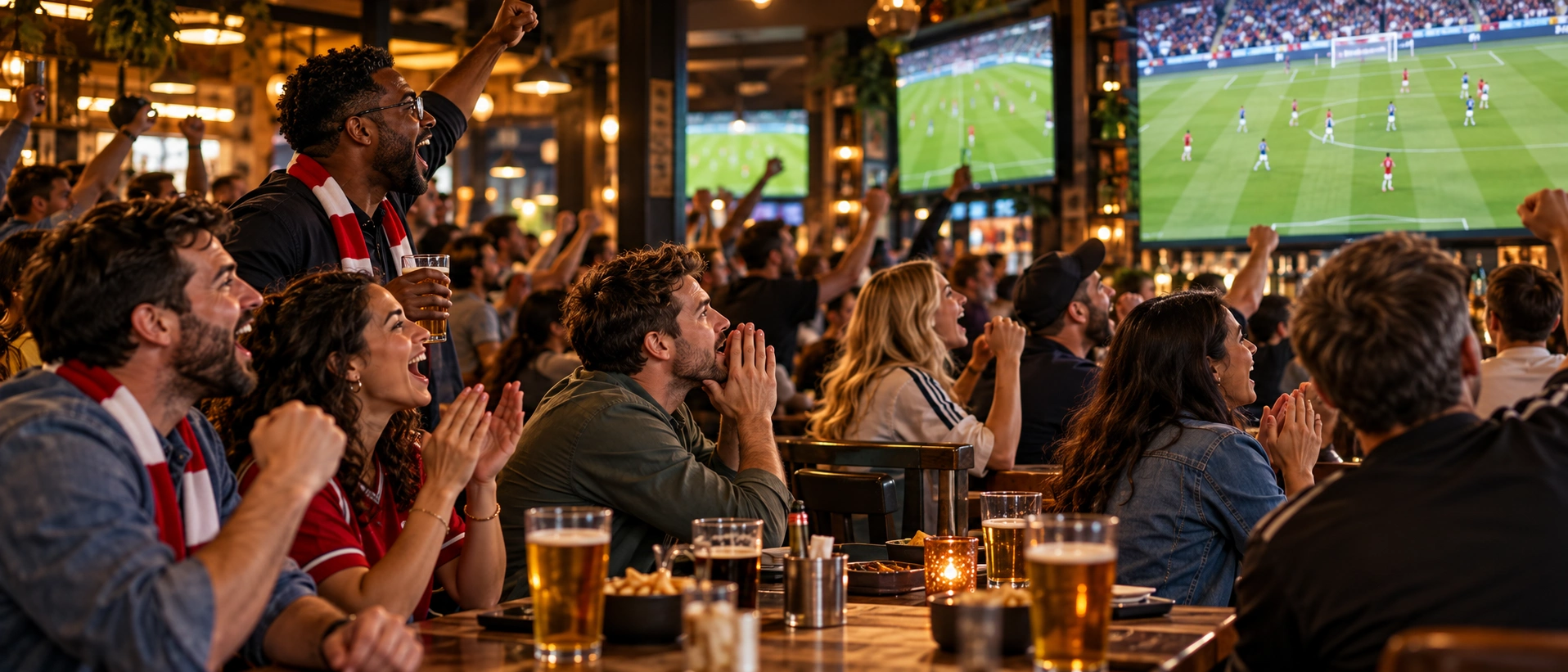
From outside, thousands of people chanting the same words, wearing the same colors and reacting simultaneously to a ball crossing a line can look irrational.
From a social-psychology perspective, it is an extraordinarily efficient machine for producing synchrony.
People stand together. Sing together. Jump together. Become silent together. Then erupt together.
For a few hours, attention is focused on the same unfolding story and thousands of separate nervous systems respond to many of the same emotional events.
That can produce an intense sense of belonging that ordinary daily life rarely provides.
The recent football study describes the stadium as a modern ritual space in which spectators become participants rather than passive observers. Shared movement, rhythm and symbolism strengthen the feeling of a collective identity.
This may be one reason live sport appears particularly relevant to loneliness. A person can enter a stadium surrounded largely by strangers and nevertheless be surrounded by people who know the same songs, recognize the same symbols and care about the same outcome.
For that afternoon, there is a ready-made community.
Even watching on television can create a ritual
A stadium is the most obvious version of this phenomenon, but the Japanese depression study suggests that physical attendance is not required.
Watching through television or the internet was also associated with fewer depressive symptoms, with the strongest association among those watching most frequently.
A television match can still provide many of the same psychological ingredients: anticipation before the game, suspense during it, emotional release afterward and conversation with other people who watched the same event.
People organize evenings around fixtures. Families watch together. Friends exchange messages during the match. Colleagues discuss it the following morning.
The psychological event therefore extends beyond the 90 minutes on the screen.
It also creates structure. There is something happening Saturday afternoon, Tuesday evening or next weekend. Anticipation itself can be rewarding, especially when daily life otherwise feels repetitive or socially sparse.
And sport offers something increasingly unusual in on-demand entertainment: genuine uncertainty. Nobody knows the ending.
Humans were gathering around arenas long before television
There is an intriguing historical parallel here, although it should not be pushed too far.
Ancient Roman amphitheaters were not modern football stadiums. Gladiatorial spectacles involved violence, political patronage and social hierarchies that make any direct equivalence misleading.
Yet historical research suggests Roman spectators also used public games for some remarkably familiar purposes: social interaction, group identification, community participation and the experience of spectacle itself.
The amphitheater brought large populations into a shared physical space and focused their attention on uncertain competition, heroes, rivals and intense collective emotion.
More than two thousand years later, humans still build enormous arenas, assign symbolic meaning to competitors and gather in crowds to watch uncertain contests unfold.
Perhaps spectacle persists partly because it reliably supplies psychological experiences that humans value: belonging, drama, shared emotion and temporary escape from ordinary life.
That last point is sometimes dismissed as mere distraction, the sporting equivalent of "bread and circuses." But temporary escape is not automatically unhealthy.
A match can interrupt work worries, illness, loneliness or mundane routine for two hours and replace them with a bounded story containing tension, hope, disappointment and resolution. Like films, music, novels or games, sport can provide psychological distance from ordinary problems without necessarily denying that those problems exist.
The same psychology can also turn against us
None of this means more fandom is always better.
The mechanisms that make sport powerful can also make it unhealthy.
If identity becomes excessively dependent on a team, defeats can dominate mood. Group identity can turn into hostility toward outsiders. Sports culture can become entangled with heavy drinking or gambling. Hours of television can replace physical activity. And escapism becomes less adaptive when it becomes a way of permanently avoiding problems rather than temporarily recovering from them.
That distinction may be the key.
Watching sports is not exercise, psychotherapy or a treatment for depression. The evidence remains mostly observational.
But dismissing spectatorship as people doing nothing while somebody else plays also misses something important.
For many fans, watching sport means anticipation, identity, conversation, ritual, emotional expression and connection to thousands or millions of other people following the same story.
The players may be doing the running.
Psychologically, the spectators may be doing much more than sitting still.
Scientific References & Further Reading
- Current Study: “Watching sports is associated with fewer depressive symptoms in adults with congenital heart disease.” (European Journal of Cardiovascular Nursing. 2026. doi:10.1093/eurjcn/zvag226. PMID:42798269.)
- Depressive Symptoms: “Watching sports and depressive symptoms among older adults: a cross-sectional study from the JAGES 2019 survey.” (Tsuji T, Kanamori S, Watanabe R, et al. Scientific Reports. 2021;11:10612. doi:10.1038/s41598-021-89994-8.)
- Loneliness and Well-being: “Attending live sporting events predicts subjective wellbeing and reduces loneliness.” (Keyes H, Gradidge S, Gibson N, et al. Front Public Health. 2023;10:989706. doi:10.3389/fpubh.2022.989706.)
- Population Well-being: “Watching sports events and residents' subjective well-being: evidence from the CGSS and the potential roles of health and social capital.” (Wei X, Zhao S. Front Psychol. 2026;17:1775253. doi:10.3389/fpsyg.2026.1775253.)
- Stadium Ritual and Social Identity: “Staging the stands: the ritual choreography of sports fandom and collective emotion regulation.” (He Y. Front Sports Act Living. 2026;8:1805368. doi:10.3389/fspor.2026.1805368.)
- Historical Context: “Spectator consumption practices at the Roman games.” (Minowa Y, Witkowski TH. Journal of Historical Research in Marketing. 2012;4:510-531. doi:10.1108/17557501211281851.)
Disclaimer: This article is for informational purposes only and does not constitute medical advice. It is not a substitute for diagnosis, treatment, or individualized medical care.