
Could Chronic Pain Be Interrupted at Its Source? Scientists Found a New Nerve Target
Evidence review & editorial synthesis
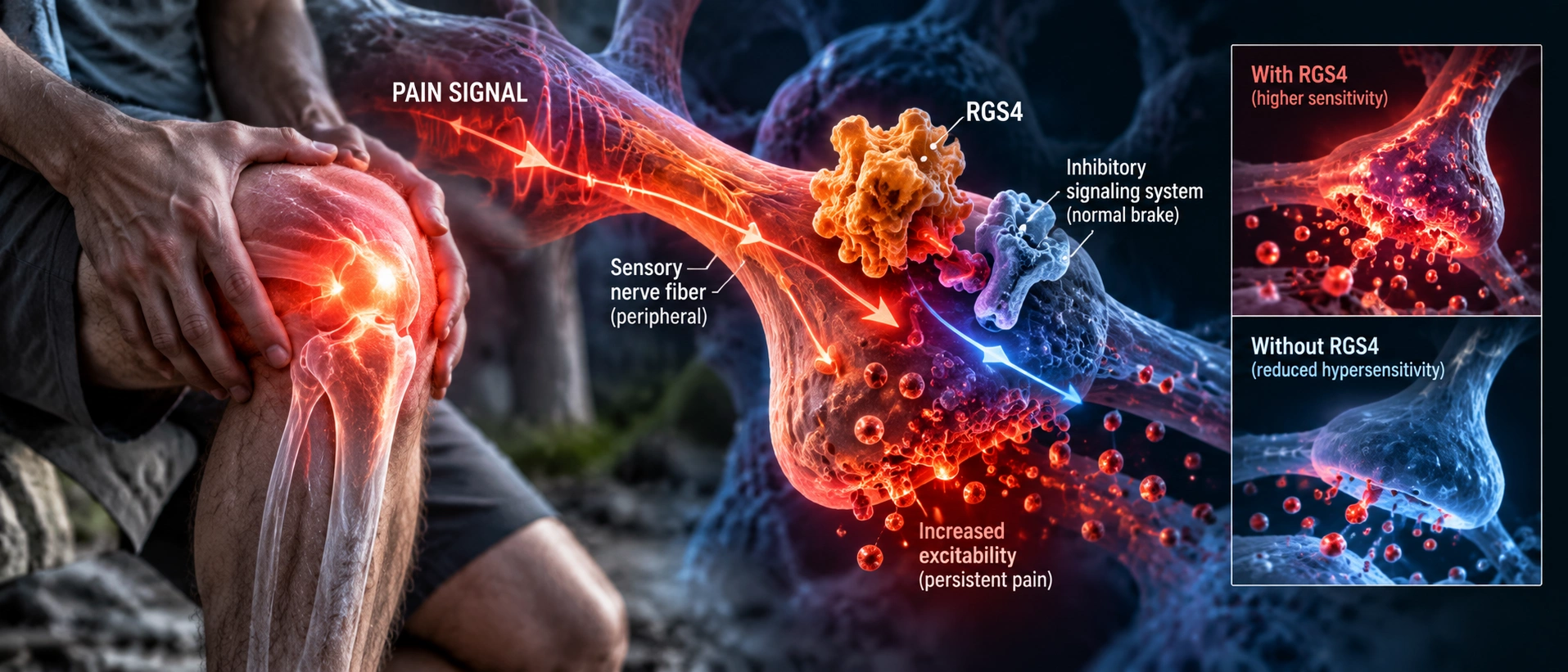
Why can pain remain long after the original injury should have healed? New research points to a molecular circuit inside sensory nerves that may help keep the nervous system stuck in a hypersensitive state. In mice, disrupting a protein called RGS4 reduced abnormal pain sensitivity across several injury models while leaving normal acute pain responses intact.
That does not make RGS4 a new pain medicine. But it raises a more ambitious possibility: future treatments might target part of the machinery that keeps chronic pain going rather than repeatedly trying to suppress the signals it produces.
Chronic pain can become a state of its own
Acute pain is useful. It warns that something is damaged and encourages protection while tissue heals.
Chronic pain is different. After nerve injury, sensory neurons, spinal circuits and brain networks can undergo lasting changes that increase their responsiveness. The original damage may no longer fully explain why relatively minor stimulation continues to hurt.
The scale of the problem is enormous. In U.S. survey data from 2023, 24.3 percent of adults reported chronic pain and 8.5 percent reported pain that frequently limited life or work.
Current treatments can help, but no single approach works for everyone. Opioids, anticonvulsants, antidepressants, anti-inflammatory drugs, injections, rehabilitation and other therapies also solve different parts of the problem. Some reduce incoming pain signals, some alter central processing, and some address an underlying injury or inflammation.
The new work asks a different question: what molecular changes help pathological sensitivity remain switched on?
A protein that helps keep sensory nerves hypersensitive
Researchers focused on RGS4, short for regulator of G protein signaling 4. RGS4 modifies signaling from many G protein-coupled receptors and is present in parts of the nervous system involved in pain.
In the new Science Signaling study, researchers manipulated RGS4 in dorsal root ganglia, clusters of sensory nerve-cell bodies that sit outside the spinal cord.
Removing RGS4 from a specific population of nonpeptidergic C-fibers was enough to reduce sensory hypersensitivity in several experimental injury models. The researchers examined peripheral nerve injury, postoperative pain, inflammatory pain and chemotherapy-induced nerve damage.
Increasing RGS4 could push sensitivity in the opposite direction.
That makes RGS4 more interesting than a molecule that merely rises or falls alongside pain. Manipulating it changed the pain-related behavior of the animals.
The most intriguing result: normal pain was still there
A useful chronic-pain treatment should ideally suppress pathological pain without eliminating pain's protective warning function.
That is one reason the new experiments stand out. Removing RGS4 reduced injury-related hypersensitivity without disrupting the mice's normal acute nociceptive responses.
The distinction is important. Completely disabling pain sensing would create its own danger because burns, injuries and other threats could go unnoticed.
Whether a drug could reproduce this separation in humans is unknown. Genetic deletion in a carefully selected population of mouse neurons is much more precise than giving a medication to a person.
But it provides a valuable therapeutic target: reduce the abnormal state while leaving normal protection intact.
How RGS4 may hold the pain system in that state
The researchers also identified a potential mechanism involving another protein called GINIP and the GABA-B receptor.
GABA-B signaling can reduce neuronal excitability. RGS4 and GINIP interact with related G-protein machinery, and the new experiments suggest that an imbalance between them can interfere with this braking system in pain-sensitive neurons.
Single-nucleus RNA sequencing after prolonged nerve injury also revealed changes involving Gabbr2, a gene encoding part of the GABA-B receptor, in the affected sensory fibers.
A useful way to picture the mechanism is not that RGS4 creates every pain signal. Instead, excessive RGS4 activity may help weaken one of the molecular brakes that normally keeps sensory neurons from remaining overly excitable.
Why targeting nerves outside the brain could matter
The dorsal root ganglia sit outside the brain and spinal cord. That creates an attractive pharmacological possibility.
Many effective pain medicines influence the central nervous system and can produce sedation, cognitive effects, tolerance, dependence or other unwanted effects depending on the drug. A pathway that could be targeted more selectively in peripheral sensory neurons might allow a different therapeutic profile.
That possibility is still hypothetical. RGS4 is not confined exclusively to pain neurons, and a real drug would need enough selectivity and appropriate distribution to influence the desired circuit without disrupting useful RGS4 functions elsewhere.
Still, human relevance is not purely speculative. Spatial transcriptomic work in human dorsal root ganglia has found RGS4 strongly expressed in several neuronal populations relevant to pain.
This is a drug target, not yet a drug
RGS4 has attracted pain researchers before. Earlier mouse work found that RGS4 levels increased during persistent neuropathic pain and that experimental RGS4 inhibition restored the fading analgesic effect of alpha-2 adrenergic drugs such as clonidine in a chronic pain model.
The new study advances the story by identifying a more specific cellular circuit and showing that RGS4 helps maintain hypersensitivity across several injury contexts.
But there is still a large gap between these experiments and a treatment patients could receive.
Researchers would need a drug that inhibits RGS4 appropriately, reaches the relevant sensory neurons, remains selective enough to avoid important off-target effects, survives toxicology testing and then demonstrates safety and meaningful pain relief in human trials.
None of that has happened yet.
Could chronic pain someday be interrupted before it becomes permanent?
The most consequential possibility goes beyond developing another analgesic.
If researchers can identify molecular changes that convert temporary injury signals into persistent hypersensitivity, those pathways might eventually offer opportunities to change the trajectory of pain itself. Depending on when such mechanisms become important, that could mean treating established chronic pain or perhaps intervening during the transition from acute to persistent pain.
The current study does not show that this can be done in people. It does show something more fundamental: in several mouse models, chronic hypersensitivity was not simply an irreversible consequence of old injury. Altering one regulatory pathway allowed abnormal sensitivity to recede.
That makes RGS4 less interesting as a newly discovered painkiller than as a clue to a larger goal: finding out what keeps chronic pain alive, and whether that state can eventually be switched back toward normal.
Scientific References & Further Reading
- Anchor Study: “The Gα-interacting protein RGS4 in dorsal root ganglia maintains molecular and behavioral maladaptations in murine pain models.” (Serafini RA, Giotti B, Luebbers A, et al. Science Signaling. 2026;19(958):eaed7175. doi:10.1126/scisignal.aed7175. PMID:42837443.)
- Research Context and Translation: “Researchers Discover Intracellular Circuit Responsible for Chronic Pain.” (Boston University Chobanian & Avedisian School of Medicine. October 6, 2026.)
- Earlier RGS4 Pain Evidence: “Analgesic Efficacy of α2 Adrenergic Receptor Agonists Depends on the Chronic State of Neuropathic Pain: Role of Regulator of G Protein Signaling 4.” (Neuroscience. 2021;455:177-194. doi:10.1016/j.neuroscience.2020.12.021.)
- Human Sensory Neuron Evidence: “The Targetable Human Nociceptome: 300-Plex Spatial Transcriptomics in Human Dorsal Root Ganglion for Analgesic Discovery.” (Shah SR, Sapio MR, Blivis O, Iadarola MJ, Mannes AJ. NIH Research Festival.)
- Chronic Pain Burden: “Chronic Pain and High-impact Chronic Pain in U.S. Adults, 2023.” (Lucas JW, Sohi I. NCHS Data Brief No. 518. 2024. doi:10.15620/cdc/169630.)
Disclaimer: This article is for informational purposes only and does not constitute medical advice. It is not a substitute for diagnosis, treatment, or individualized medical care.