
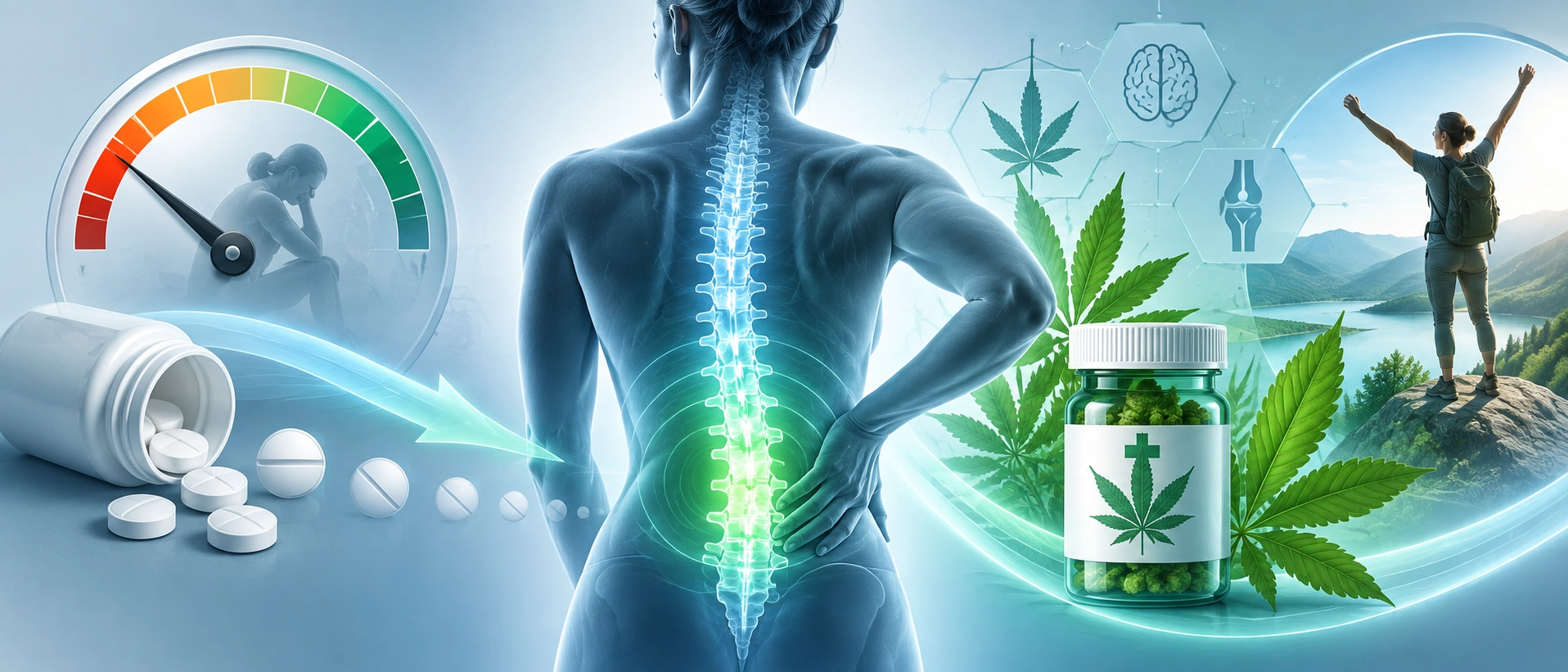
Ten Years on Medical Cannabis: Opioid Use Fell 90% and Severe Back Pain Nearly Disappeared
Evidence review & editorial synthesis
For people living with severe chronic back pain, the most frightening possibility is that the pain never really leaves and increasingly powerful medication becomes part of everyday life. A new 10-year study offers a dramatically different picture. Among patients who stayed in follow-up for the full decade, average opioid use fell by almost 90%, pain scores dropped from 8.7 to 1.4 out of 10, and disability improved substantially. The patients had all been cannabis-naive when they entered the study and had already spent years living with persistent low back pain.
The size of those changes is unusual enough to demand attention.
These were not people with mild back pain
Researchers followed 1,000 consecutive patients treated at a specialized orthopedic pain clinic beginning in 2015.
Their back pain had lasted an average of almost 10 years. Imaging confirmed conditions including spinal stenosis, disc degeneration, vertebrogenic low back pain and spondylolisthesis. Many had more than one spinal disorder.
They were also heavily medicated. At baseline, average pain was 8.6 out of 10 and average disability was in the moderate-to-severe range. Nearly 90% were taking tramadol or tapentadol, almost 79% were taking benzodiazepines, roughly 78% were using SSRIs and about one-third were taking gabapentinoids.
All had been using opioids for at least a year and had failed or responded inadequately to conventional treatments including physical therapy, NSAIDs and opioid medication.
The group therefore represented exactly the kind of patients for whom chronic back pain can become a long-term trap.
Opioid use fell by almost 90%
Of the original 1,000 participants, 638 completed all 10 years of follow-up.
Among those patients, average opioid consumption fell from 62.8 mg to 6.4 mg of morphine equivalents per day, a reduction of 89.8%.
More than nine in ten achieved at least a 50% reduction in opioid use. Forty-two patients, or 6.6% of the 10-year completers, stopped opioids entirely.
Interestingly, most of the opioid reduction happened early. Average use had already fallen dramatically after the first year and remained low thereafter.
That matters because reducing long-term opioid exposure can potentially reduce sedation, constipation, tolerance, dependence and overdose risk, especially in people who otherwise face years of continuous treatment.
Medical cannabis was not merely associated with substituting one drug for another. Several other medication classes also became far less common.
Tramadol and tapentadol use fell from 89.7% to 5.6%. Benzodiazepine use dropped from 78.8% to 5.3%. SSRI use fell from 77.7% to 5.8%, while gabapentinoid use fell from 31.3% to just 0.6%.
Those medication changes were driven clinically rather than by a study protocol requiring patients to stop them.
Pain fell from 8.7 to 1.4 out of 10
The pain results were even more dramatic.
Average pain intensity among the decade-long completers fell from 8.71 at baseline to 1.37 after 10 years, an 84.2% reduction.
By the end of follow-up, 96.6% had achieved at least the prespecified 30% improvement considered clinically meaningful. Nearly nine in ten had pain scores of 3 or lower, corresponding to mild pain or less.
Those numbers are striking because controlled cannabis trials generally report far smaller average improvements.
A large 2025 phase 3 trial involving 820 adults with chronic low back pain did establish that a standardized full-spectrum cannabis extract reduced pain significantly more than placebo. But the difference attributable specifically to treatment was much more modest than the change seen in this decade-long cohort.
That makes the current results unusual rather than impossible. They may represent a combination of a real treatment effect, long-term opioid reduction, gradual rehabilitation and the characteristics of patients who remained in treatment for many years.
Patients gradually regained function too
Pain relief appeared much earlier than functional recovery.
The Oswestry Disability Index fell from 52.9% to 36.8% over the decade, an improvement of 16.1 points. More than 62% of completers exceeded the threshold generally considered a meaningful functional improvement.
Most of that functional change appeared later in follow-up. Disability improved only modestly through the first five years before dropping more substantially between years seven and ten.
That pattern is intriguing because it resembles what might happen when someone has lived with severe pain for years. Removing pain does not immediately restore lost strength, mobility, confidence or conditioning. Those may take far longer to rebuild.
The study's authors suggest sustained pain relief may have allowed gradual physical reconditioning over time.
Cannabis use did not keep escalating
Another concern with long-term drug treatment is tolerance, where increasingly large doses are required to produce the same effect.
That pattern was not obvious here.
Cannabis use increased initially while patients established their dose, reaching around 39 grams per month by year two. It then remained relatively stable, averaging about 41 grams per month over the decade and reaching 47.5 grams at year ten.
Most patients used vaporized dried cannabis, while about one-third used oral oils. The average cannabinoid exposure favored THC over CBD by roughly four to one.
Treatment-related adverse events were recorded in 11.4% of visits, while serious psychiatric events were reported very rarely.
That does not establish that decade-long cannabis treatment is risk-free, but it is notable that the cohort did not show relentless dose escalation alongside the sustained improvements.
The results are far larger than controlled trials usually show
There is one important reason to avoid interpreting every percentage as a pure cannabis effect: there was no untreated comparison group.
More than one-third of the original cohort also did not complete all 10 years. People who remained in treatment may disproportionately represent those who were doing particularly well.
The researchers themselves emphasize that the magnitude of improvement is much greater than what randomized cannabis trials usually report.
But that does not make the decade-long observation uninteresting. Quite the opposite.
A thousand people entered the registry with severe, longstanding back pain and heavy medication use. Among the 638 who remained for the full decade, opioid exposure collapsed, average pain moved from severe to mild, several other medication classes became uncommon and functional disability improved meaningfully.
Even if observational effects exaggerate the size of the benefit, the pattern is difficult to dismiss as trivial.
The next question is no longer simply whether cannabis can reduce chronic back pain. Randomized evidence already suggests that it can. The more provocative question is whether carefully managed long-term medical cannabis can help a subgroup of severe chronic pain patients gradually escape the cycle of high pain, opioids and polypharmacy.
After 10 years of follow-up, that possibility looks considerably harder to ignore.
Scientific References & Further Reading
- Anchor Study: “Ten-year outcomes of medical cannabis for chronic low back pain: opioid reduction, pain relief, and functional improvement in 1,000 patients.” (Khatib M, Robinson D, Lavon E, et al. European Spine Journal. 2026. doi:10.1007/s00586-026-10290-y.)
- Randomized Trial: “Full-spectrum extract from Cannabis sativa DKJ127 for chronic low back pain: a phase 3 randomized placebo-controlled trial.” (Karst M, Meissner W, Sator S, et al. Nat Med. 2025;31:4189-4196. doi:10.1038/s41591-025-03977-0.)
- Supporting Evidence: “Opioid-sparing effects of medical cannabis or cannabinoids for chronic pain: a systematic review and meta-analysis of randomised and observational studies.” (Noori A, Miroshnychenko A, Shergill Y, et al. BMJ Open. 2021;11:e047717.)
Disclaimer: This article is for informational purposes only and does not constitute medical advice. It is not a substitute for diagnosis, treatment, or individualized medical care.