
The Hidden Drugs Inside Some 'Natural' Supplements
Evidence review & editorial synthesis
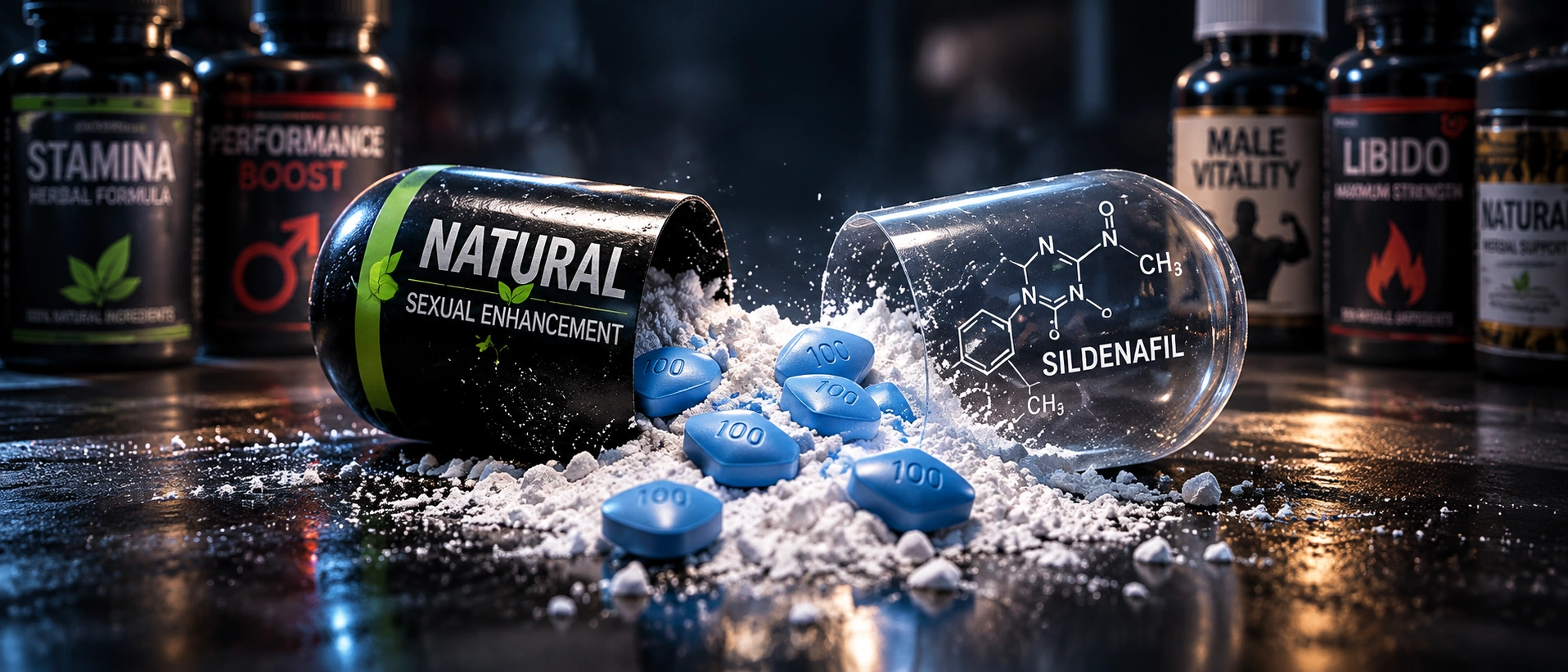
A supplement labeled 'natural' can sometimes work suspiciously well for a very simple reason: it contains a real drug that was never listed on the label.
A new targeted survey in Hungary tested 12 sexual-enhancement supplements considered particularly high-risk. Seven produced analytical signals consistent with undeclared sildenafil, the active drug in Viagra.
The quantities were not trivial. Sildenafil content ranged from 0.22 to 122 mg per unit. Three products contained amounts around the commonly prescribed 50 mg dose. Two exceeded 100 mg, the usual maximum recommended single dose of sildenafil.
That does not mean most supplements secretly contain Viagra. Researchers deliberately selected suspicious products, so the sample cannot be used to estimate prevalence across the market.
But the finding is part of a much larger and persistent problem.
The supplement may 'work' because it secretly contains a drug
Hidden sildenafil in sexual-enhancement products has been documented for years.
An analysis of FDA warnings from 2007 through 2016 identified 776 adulterated dietary supplements containing unapproved pharmaceutical ingredients. Almost half were marketed for sexual enhancement, about 41% for weight loss and nearly 12% for muscle building.
Among the adulterated sexual-enhancement products, sildenafil and closely related compounds dominated. Weight-loss products frequently contained sibutramine, a former obesity drug withdrawn from the US market because of cardiovascular safety concerns. Muscle-building products often contained synthetic steroids or steroid-like substances.
More than 20% of the 776 adulterated products contained more than one undeclared pharmaceutical ingredient.
This history is not merely old regulatory archaeology. FDA warnings and recalls throughout 2026 continue to identify supposedly natural or supplement-like sexual-enhancement products containing undeclared sildenafil and tadalafil. Other contemporary alerts involve undeclared anti-inflammatory drugs, corticosteroids, stimulants and additional pharmacologically active substances.
The paradox is obvious. A consumer buys a product because it claims to offer a natural alternative to medication. If it produces a dramatic pharmaceutical effect, that may sometimes be because the manufacturer quietly added the medication anyway.
Hidden Viagra is more dangerous than ordinary Viagra
Sildenafil is a well-characterized medicine. When prescribed appropriately, the dose is known, contraindications are considered and patients receive information about interactions and adverse effects.
An adulterated supplement removes those safeguards.
A person may have no idea that sildenafil is present, may not know whether the dose is 5 mg, 50 mg or more than 100 mg, and may take another erectile-dysfunction medication at the same time.
One particularly important interaction involves nitrates such as nitroglycerin. Combining nitrates with PDE5 inhibitors including sildenafil or tadalafil can cause a dangerous fall in blood pressure.
That matters because erectile dysfunction and cardiovascular disease often occur in overlapping populations. Someone deliberately avoiding prescription erectile-dysfunction treatment because of heart medication could unknowingly expose themselves to exactly the drug they were trying to avoid.
Adulteration can become even harder to predict when products contain several active drugs or chemically modified analogues for which considerably less safety information exists.
The highest-risk categories are not random
The recurring pattern across regulatory surveillance is revealing.
Hidden drugs cluster in products promising effects that consumers expect to feel quickly: stronger erections, rapid weight loss, dramatic muscle gain, strong pain relief or unusually powerful energy and performance effects.
Those are precisely the markets where adding an active pharmaceutical can make a mediocre product appear astonishingly effective.
That does not justify treating an ordinary creatine monohydrate, vitamin D tablet or mineral supplement as equivalent to an anonymous 'extreme male enhancement' capsule purchased from an unfamiliar overseas website.
Supplement risk is highly uneven.
The greatest caution is warranted when a product promises a rapid drug-like result, uses vague proprietary blends, makes unusually aggressive claims, lacks a traceable manufacturer or appears through sellers that can disappear as quickly as they appeared.
Why can these products reach consumers at all?
Supplements are regulated, but they are not regulated like medicines.
In Germany and the wider EU, food supplements are legally foods. The manufacturer or distributor is responsible for ensuring that the product is safe and compliant. There is no pharmaceutical-style approval process in which every supplement must first prove efficacy, safety and manufacturing consistency before entering the market.
Authorities perform surveillance and sample products already being sold. The German Federal Institute for Risk Assessment notes that this becomes particularly difficult with internet sales and sellers outside the reach of local food-control authorities.
That creates a fundamentally different system from prescription drugs. A medicine must clear a substantial premarket evidence threshold. A supplement can enter the marketplace first and become the subject of enforcement later if problems are detected.
For reputable manufacturers this does not mean quality is poor. It does mean that company quality systems, supply-chain control and independent testing matter more.
Can you actually reduce the risk?
There is no perfect consumer test for a capsule bought online, but several steps can meaningfully improve the odds.
First, treat products promising strong pharmaceutical-like effects as a separate risk category. Sexual enhancement, extreme weight loss, aggressive muscle building and unusually powerful pain-relief products repeatedly appear in adulteration warnings.
Second, prefer established manufacturers with a verifiable company identity, transparent ingredient quantities and products sold through normal regulated distribution channels rather than anonymous marketplace sellers or rapidly changing websites.
Third, independent certification is stronger evidence than a company's own quality statement. Programs such as NSF test certified products for label accuracy, contaminants and adulterants and periodically retest them. For sports supplements, certification can additionally screen for prohibited drugs and steroid-like substances.
A certificate of analysis, or COA, can also be useful, but only if it deserves trust. A meaningful COA should correspond to the actual batch being purchased, identify the laboratory, report what was tested and ideally come from an independent accredited laboratory. A generic PDF hosted by the seller saying 'passed' is much weaker evidence.
Finally, regulatory warning databases are worth checking when a product looks suspicious. Finding a product in a warning database is a clear reason to avoid it. Not finding it there is not proof of safety because regulators test only a fraction of products.
The practical lesson is not that supplements are inherently dangerous. It is that 'natural' is not a chemical analysis, and a supplement label is only as trustworthy as the manufacturing and verification system behind it.
The strangest risk may be the product that seems to work almost too well. Sometimes that is exactly the clue that what is inside the capsule is not what the front of the bottle says.
Scientific References & Further Reading
- Anchor Study: “Targeted market survey of undeclared sildenafil in high-risk sexual enhancement supplements marketed in Hungary.” (Nagy A, Vida RG, Lovász G, Fábián K, Pozsgai G, Fliszár-Nyúl E. Targeted market survey of undeclared sildenafil in high-risk sexual enhancement supplements marketed in Hungary. Journal of Consumer Protection and Food Safety. 2026. doi:10.1007/s00003-026-01630-7.)
- FDA Adulteration Analysis: “Unapproved Pharmaceutical Ingredients Included in Dietary Supplements Associated With US Food and Drug Administration Warnings.” (Tucker J, Fischer T, Upjohn L, Mazzera D, Kumar M. Unapproved Pharmaceutical Ingredients Included in Dietary Supplements Associated With US Food and Drug Administration Warnings. JAMA Network Open. 2018;1(6):e183337. doi:10.1001/jamanetworkopen.2018.3337.)
- Current FDA Surveillance: “Health Fraud Product Database.” (U.S. Food and Drug Administration. Health Fraud Product Database. Accessed October 2026.)
- German Regulatory Context: “Über Sinn und Unsinn von Nahrungsergänzungsmitteln.” (Bundesinstitut für Risikobewertung. Über Sinn und Unsinn von Nahrungsergänzungsmitteln. 2025.)
- Independent Supplement Certification: “Health Science Certification Program Basics.” (NSF. Health Science Certification Program Basics. NSF International.)
Disclaimer: This article is for informational purposes only. Regulatory standards and product availability differ by country. Consumers taking medication or managing medical conditions should discuss supplements with an appropriate healthcare professional.