
Scientists Have Already Reversed Signs of Aging: Epigenetic Reprogramming Is How
Evidence review & editorial synthesis
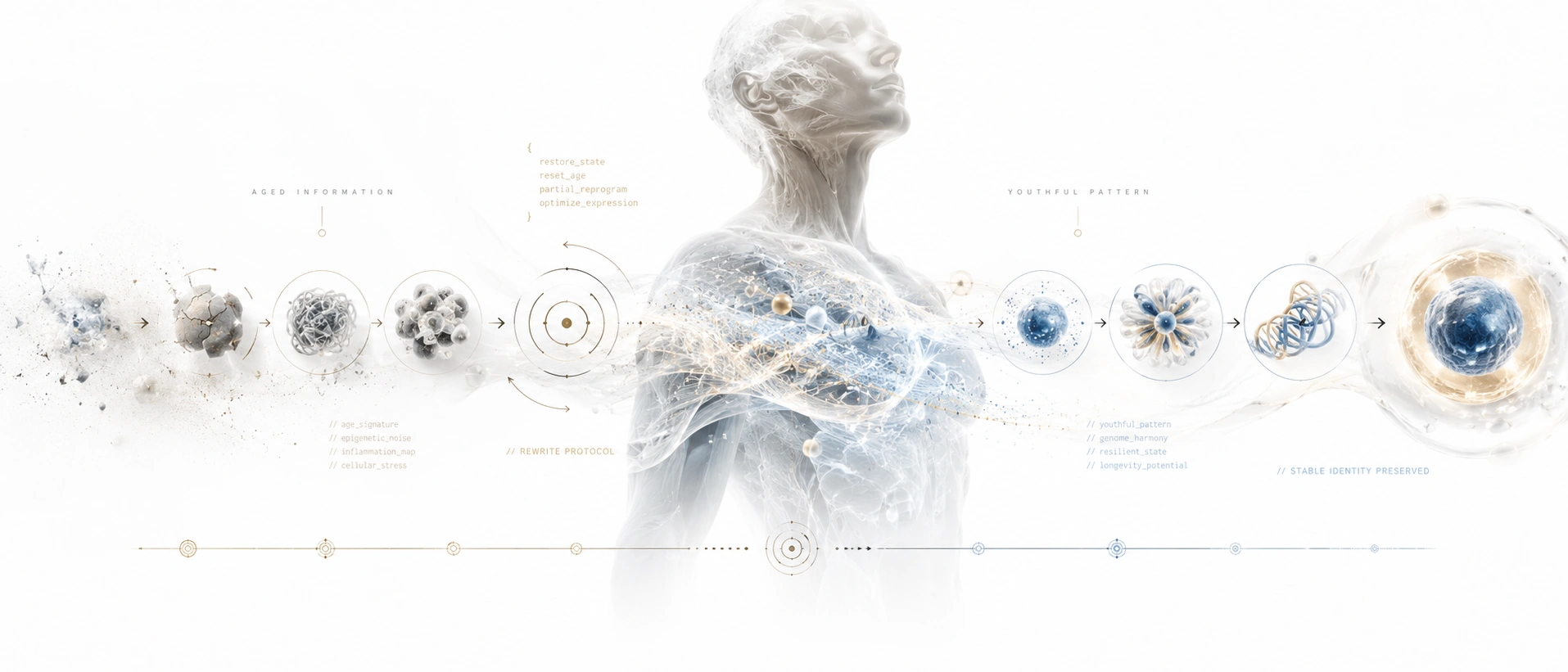
What if aging is not only damage that accumulates, but information that becomes corrupted? And what if some of that information can be reset?
This is the idea behind epigenetic reprogramming, one of the most radical areas in longevity science.
Researchers have already made old cells appear epigenetically younger. They have restored youthful gene-expression patterns in aged tissue, regenerated damaged nerves, reversed vision loss in mice, and extended the remaining lifespan of extremely old mice.
None of this is a proven anti-aging treatment for humans.
But the central idea is no longer science fiction:
At least some features of biological aging can be pushed in the opposite direction.
The Experiment That Changed the Aging Conversation
In 2016, researchers at the Salk Institute performed an experiment that helped redefine what rejuvenation might mean.
They used four genes known as the Yamanaka factors:
- Oct4
- Sox2
- Klf4
- c-Myc
Together, these factors can normally push mature cells all the way back toward an embryonic-like state.
That is powerful and dangerous.
Fully reprogram a skin cell, and it can stop being a skin cell at all. Inside a living body, uncontrolled reprogramming can produce tumors.
The researchers tried something different.
Instead of leaving the factors switched on, they activated them briefly in cycles: two days on, five days off.
The goal was not to erase the cell.
It was to make it younger without making it forget what it was.
The results were extraordinary. In a mouse model of premature aging, cyclic partial reprogramming improved multiple cellular and physiological signs of aging and extended lifespan. In older normal mice, it also improved recovery from muscle injury and metabolic stress.
The study was the first major in-vivo demonstration that partial reprogramming could push age-related biology toward a younger state.
That changed the question.
It was no longer simply:
Can an old cell become young again?
It became:
How far can we turn back the clock without turning the cell into something else?
Human Cells Became Younger Before Losing Their Identity
A crucial clue arrived a few years later.
Researchers followed human cells as they moved through the reprogramming process and measured their age using DNA-methylation-based epigenetic clocks.
The cells did not remain old until the final moment and then suddenly reset.
Their measured epigenetic age began falling progressively during the early stages of reprogramming.
Even more importantly, the decline in epigenetic age began before the cells fully lost their original identity.
This suggests there may be a biological window in which a cell can become younger without being completely erased.
That window is the entire dream of partial reprogramming.
Not:
Turn an old cell back into a stem cell.
But:
Reset some of the aging program, then stop.
Then Scientists Restored Vision in Old Mice
In 2020, the field produced an even more dramatic result.
Researchers removed c-Myc, the Yamanaka factor most closely associated with cancer risk, and delivered the remaining three factors, OSK, to retinal ganglion cells in mice.
The treatment did more than change a biomarker.
It:
- restored more youthful DNA-methylation patterns
- restored youthful gene-expression patterns
- promoted nerve regeneration after injury
- reversed vision loss in a mouse model of glaucoma
- improved vision in aged mice
The effects depended on enzymes involved in DNA demethylation, suggesting that the epigenetic changes were not merely decorative markers of rejuvenation.
They appeared to be part of the mechanism.
The researchers concluded that mammalian cells may retain a kind of hidden record of youthful biological information that can potentially be accessed again.
In other words, old tissue may not simply forget how to be young.
The instructions may still be there.
In Very Old Mice, Remaining Lifespan More Than Doubled
Then came one of the most provocative results yet.
In a 2024 study, researchers delivered an inducible OSK system to 124-week-old male mice using adeno-associated viral vectors.
These were not young mice being treated preventively. They were already extremely old.
The treated group showed:
- a 109% increase in median remaining lifespan
- improved frailty scores
- signs of improved healthspan alongside longer survival
That does not mean the mice lived twice as long from birth. Treatment began near the end of life, so the finding refers specifically to remaining lifespan after treatment.
It was also a preclinical gene-therapy experiment, not evidence that humans can currently undergo safe whole-body age reversal.
Still, the result is difficult to ignore.
A technology originally developed to reset cell identity had now been used in very old normal mice and was associated with both longer remaining life and better physical condition.
The study also found signs of epigenetic age reversal in human skin cells treated with OSK in the laboratory.
The aging clock, once again, appeared capable of moving backward.
The Real Challenge Is Not Starting the Reprogramming
It is stopping it.
Too little reprogramming may do nothing.
Too much may cause cells to lose their identity, behave unpredictably, or form tumors.
That makes the future of the field a control problem.
Researchers need to determine:
- which factors to use
- which tissues to target
- how long to activate them
- how often to repeat treatment
- how to deliver them safely
- how to prevent unwanted dedifferentiation
- whether rejuvenated biomarkers translate into longer, healthier human life
The most important breakthrough may not be discovering a new rejuvenation factor.
It may be learning exactly when to press the brake.
What Epigenetic Reprogramming Could Mean
Most longevity interventions try to slow damage.
Exercise may slow functional decline. Better metabolic health may reduce disease risk. Drugs and supplements may influence individual pathways.
Epigenetic reprogramming proposes something much more radical.
It asks whether cells can be instructed to recover a more youthful operating state.
That could eventually change how we think about:
- tissue regeneration
- neurodegeneration
- vision loss
- organ aging
- biological-age reversal
- age-related disease itself
The evidence is still overwhelmingly preclinical. There is no approved whole-body reprogramming treatment that can safely make humans younger.
But something fundamental has already happened.
Scientists have shown that aging signatures are not always fixed. Old cells can move toward younger molecular states. Aged tissue can recover lost function. And in mice, carefully controlled reprogramming has produced outcomes that would have sounded impossible not long ago.
The biggest idea in longevity science may no longer be slowing the clock. It may be learning how to turn it back.
Scientific References & Further Reading
-
Partial Reprogramming & Lifespan: “In Vivo Amelioration of Age-Associated Hallmarks by Partial Reprogramming.”
-
Epigenetic Age Reversal in Human Cells: “Partial Reprogramming Induces a Steady Decline in Epigenetic Age Before Loss of Somatic Identity.”
-
Vision Restoration & Youthful Epigenetic Information: “Reprogramming to Recover Youthful Epigenetic Information and Restore Vision.”
-
Lifespan Extension in Aged Mice: “Gene Therapy-Mediated Partial Reprogramming Extends Lifespan and Reverses Age-Related Changes in Aged Mice.”
Disclaimer: The information provided is for educational purposes only and is not intended as medical advice. Epigenetic and partial cellular reprogramming remain experimental technologies supported primarily by cell and animal research. There is currently no approved whole-body reprogramming treatment proven to safely reverse aging in humans. Reprogramming factors and experimental gene therapies may carry serious risks, including loss of cell identity, abnormal tissue growth, and tumor formation.