
Scientists Are Turning Bacteria Into Living Cancer Drugs That Make Chemotherapy Inside Tumors
Evidence review & editorial synthesis
Cancer treatment usually works from the outside in. A drug enters the bloodstream, travels through the body and hopefully reaches enough tumor cells before toxicity becomes limiting.
A very different strategy is beginning to emerge: send living bacteria into tumors and program them to manufacture the treatment there.
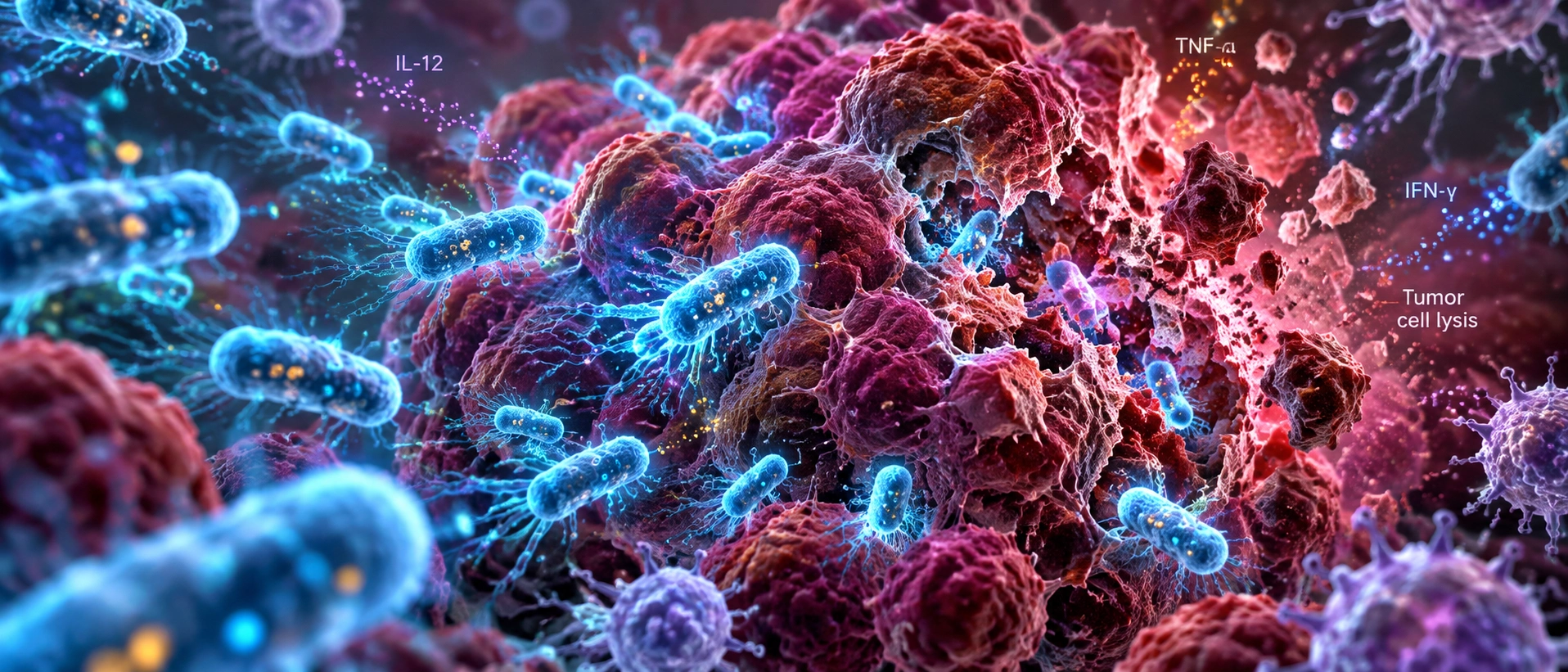
In a new mouse study, researchers engineered the probiotic strain Escherichia coli Nissle 1917 to perform three anticancer jobs at once. Inside tumors, the bacteria generated chemotherapy, released a powerful immune stimulant and blocked an immune checkpoint used by cancer cells to escape attack. The result was not only local tumor control, but signs of systemic antitumor immunity and lasting immune memory.
That sounds futuristic, but it belongs to a much larger story. Scientists are discovering that bacteria already influence how well the immune system fights cancer. Synthetic biology is now trying to turn that natural relationship into something programmable.
The bacteria became miniature drug factories
The new platform was designed around one of the biggest problems in oncology: getting powerful treatments into tumors without exposing the entire body to the same intensity of treatment.
The researchers equipped E. coli Nissle with cytosine deaminase. This enzyme converts the relatively inactive prodrug 5-fluorocytosine into 5-fluorouracil, a classic chemotherapy drug.
The idea is simple but powerful. Instead of delivering active chemotherapy everywhere, give the precursor and let bacteria concentrated inside the tumor manufacture more of the active drug locally.
But the bacteria did not stop there.
They also produced an IL-15 superagonist designed to stimulate T cells and natural killer cells, two major components of antitumor immunity. And they produced a PD-L1-blocking nanobody, aimed at removing one of the brakes tumors use to suppress immune attack.
So one living platform combined three strategies: kill tumor cells, activate immune cells and prevent the tumor from shutting those immune cells down.
In mouse MC38 and B16-F10 solid-tumor models, the combination produced potent antitumor effects. Mechanistic experiments showed stronger activation of antigen-presenting cells, T cells and natural killer cells while suppressive pathways were reduced.
The most interesting effect may have happened away from the treated tumor
Killing one tumor is valuable. Training the immune system to recognize cancer throughout the body would be much more powerful.
The researchers therefore performed abscopal experiments, which test whether local treatment generates effects against tumors elsewhere in the body. They also rechallenged animals with cancer cells after treatment.
Both experiments pointed toward systemic antitumor immunity and durable immune memory.
That changes the conceptual role of the bacteria. They are not merely local chemotherapy dispensers.
A tumor damaged in the presence of strong immune stimulation can release cancer antigens. Antigen-presenting cells can process those molecular fingerprints and activate T cells against them. Those T cells can then circulate throughout the body.
In the long-term vision, the treated tumor could become something resembling a personalized cancer vaccination site: local tumor destruction reveals what the cancer looks like, while bacterial immune signals help teach the immune system to attack cells carrying the same signatures elsewhere.
That could be especially important for metastatic disease, where eliminating one visible tumor is not enough.
The new study demonstrates this principle only in mice, but it makes the larger therapeutic idea easy to see.
Our natural microbiome already influences cancer immunity
Engineered bacteria did not appear from nowhere as an oncology strategy. Researchers have spent more than a decade discovering that naturally occurring microbes can alter cancer immunity.
A landmark mouse study found that Bifidobacterium was associated with stronger spontaneous antitumor responses. Giving the bacteria orally improved tumor control, and combining Bifidobacterium with PD-L1 blockade produced an especially strong effect.
Human studies later connected gut microbiome composition with responses to immune checkpoint inhibitors. Akkermansia muciniphila, Bifidobacterium and other organisms have repeatedly appeared in this literature, although there is no single universally beneficial cancer microbiome.
The mechanism is biologically plausible. Microbes produce metabolites and immune signals that influence dendritic cells, T cells, inflammatory pathways and the tumor microenvironment. Some bacteria appear to make the immune system more capable of recognizing and attacking tumors, while others can contribute to inflammation, carcinogenesis or treatment resistance.
The microbiome therefore behaves less like a simple list of good and bad bacteria and more like another layer of the immune system's environment.
That is why researchers are now asking whether it can be deliberately manipulated during cancer treatment.
Changing the microbiome has already produced signals in patients
Some of the most striking early human evidence comes from patients whose melanoma had already stopped responding to anti-PD-1 immunotherapy.
In one clinical study, researchers transferred gut microbiota from patients who had responded to immunotherapy into 15 patients with resistant melanoma, then restarted anti-PD-1 treatment. Six experienced clinical benefit.
A separate phase 1 study treated 10 patients with immunotherapy-resistant metastatic melanoma. Three responded, including one complete response and two partial responses.
These were small studies, not definitive proof. But they showed something that would once have sounded extraordinary: changing microbes in the gut can coincide with measurable changes inside a distant tumor and may help restore sensitivity to cancer immunotherapy in some people.
A 2026 meta-analysis covering 36 clinical cohorts and 2,746 patients found encouraging signals for microbiome-modulating approaches such as probiotics and fecal microbiota transplantation alongside checkpoint inhibitors. The authors also stressed that the data remain heterogeneous and dominated by early or non-randomized studies.
So nobody can yet prescribe a universal cancer probiotic.
But the biological relationship between microbes and cancer therapy is becoming increasingly difficult to dismiss.
The next step is not just choosing bacteria. It is programming them.
That is what makes the new study especially interesting.
Traditional microbiome medicine asks which naturally occurring microbes help or hurt. Synthetic biology asks a more ambitious question: what if we give bacteria entirely new jobs?
A future engineered bacterium might be programmed to colonize only hypoxic tumor tissue, sense molecular signals unique to cancer, manufacture several drugs locally, release them only after reaching a density threshold and then destroy itself once its task is complete.
Different bacterial strains could carry different payloads. One might activate T cells. Another could manufacture an antibody fragment. Another could convert a harmless precursor into chemotherapy. Others could release cytokines, tumor antigens or gene-editing components.
At the same time, a patient's natural microbiome could potentially be profiled to predict whether checkpoint therapy is likely to work and then modified using diet, defined bacterial communities or microbiota transplantation.
The resulting cancer treatment would look very different from today's model.
Instead of one drug spreading throughout the entire body, treatment could become a coordinated ecosystem: the patient's own microbiome shaping immunity, engineered bacteria operating inside tumors and circulating immune cells hunting cancer cells that remain elsewhere.
That future remains speculative. Bacteria can mutate, trigger dangerous inflammation, escape their intended location or be cleared before they work. Manufacturing and controlling living medicines is much harder than manufacturing a conventional molecule.
But the basic idea is no longer science fiction.
The microbiome has already shown that microbes can influence whether cancer immunotherapy succeeds. Early human trials suggest that changing microbial communities can sometimes alter treatment response. And now engineered bacteria are being given increasingly sophisticated therapeutic programs.
The long-term possibility is striking: one day, some cancer drugs may not simply be injected into patients. They may be grown inside living cells that know where to go and what to make when they arrive.
Scientific References & Further Reading
- Anchor Study: “Engineered probiotics for tumor-targeted combination chemoimmunotherapy.” (Yang Z, Im J, Chen N, et al. Sci Transl Med. 2026. doi:10.1126/scitranslmed.ady2289. PMID:42748218. Candidate metadata and abstract supplied in the HSH source prompt. :contentReference[oaicite:5]{index=5})
- Bifidobacterium and Tumor Immunity: “Commensal Bifidobacterium promotes antitumor immunity and facilitates anti-PD-L1 efficacy.” (Sivan A, Corrales L, Hubert N, et al. Science. 2015;350:1084-1089. doi:10.1126/science.aac4255. PMID:26541606. :contentReference[oaicite:6]{index=6})
- Akkermansia and Checkpoint Therapy: “Gut microbiome influences efficacy of PD-1-based immunotherapy against epithelial tumors.” (Routy B, Le Chatelier E, Derosa L, et al. Science. 2018;359:91-97. doi:10.1126/science.aan3706. PMID:29097494. :contentReference[oaicite:7]{index=7})
- FMT Clinical Trial: “Fecal microbiota transplant overcomes resistance to anti-PD-1 therapy in melanoma patients.” (Davar D, Dzutsev AK, McCulloch JA, et al. Science. 2021;371:595-602. doi:10.1126/science.abf3363. PMID:33542131. :contentReference[oaicite:8]{index=8})
- FMT Phase 1 Trial: “Fecal microbiota transplant promotes response in immunotherapy-refractory melanoma patients.” (Baruch EN, Youngster I, Ben-Betzalel G, et al. Science. 2021;371:602-609. doi:10.1126/science.abb5920. PMID:33303685. :contentReference[oaicite:9]{index=9})
- Engineered Bacteria Field Review: “The emerging landscape of engineered bacteria cancer therapies.” (Ballister ER, Michels A, Vincent RL, et al. Nat Biotechnol. 2025;43:672-676. doi:10.1038/s41587-025-02623-x. :contentReference[oaicite:10]{index=10})
Disclaimer: This article is for informational purposes only and does not constitute medical advice. It is not a substitute for diagnosis, treatment, or individualized medical care.