
Dental Fear Affects About 1 in 7 Adults. VR Can Help, and the Fear Itself Is Treatable
Evidence review & editorial synthesis
For some people, going to the dentist is mildly unpleasant. For others, the fear is strong enough to delay treatment for months or years.
That makes dental anxiety much more than discomfort. A global meta-analysis estimated that about 15.3% of adults experience dental fear or anxiety, while 3.3% have severe fear. Avoidance can then create a vicious cycle: a person delays care, dental problems worsen, treatment becomes more invasive, and the next visit becomes even more frightening.
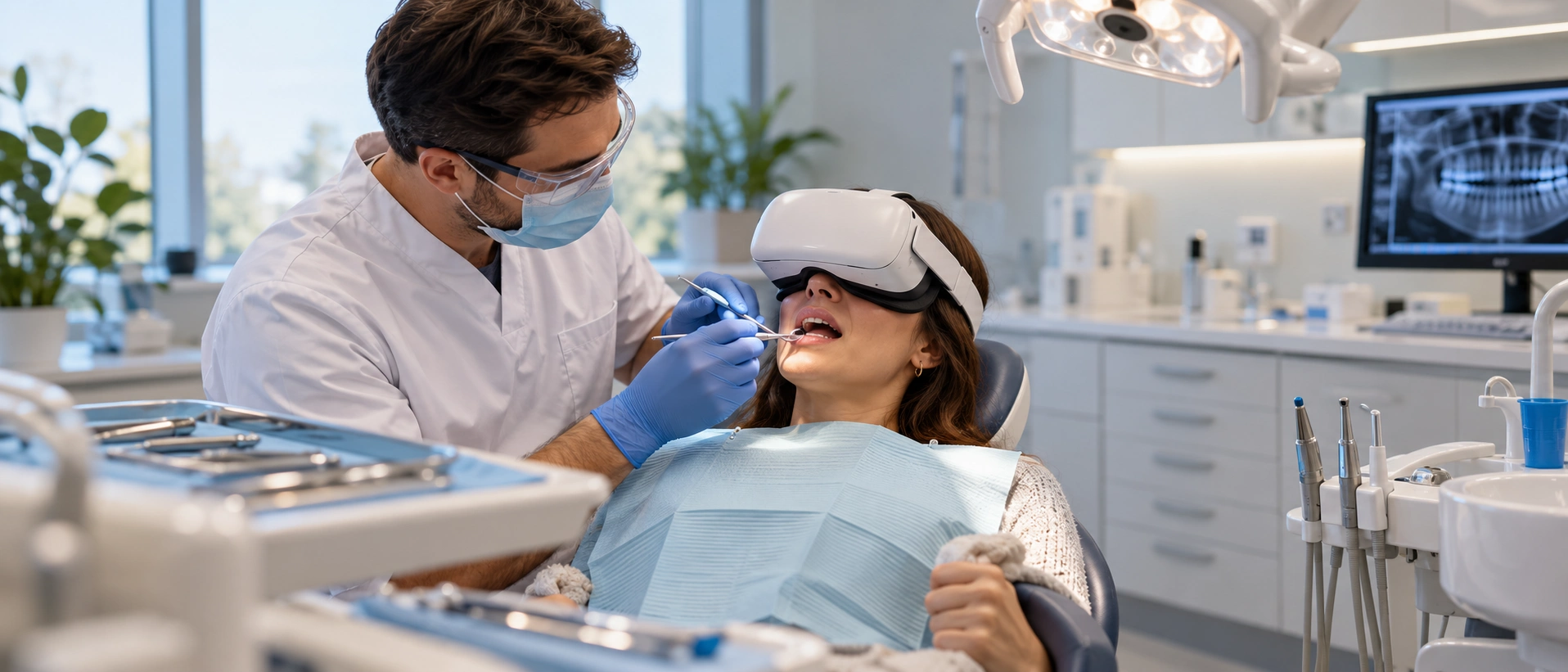
A new meta-analysis suggests one surprisingly simple tool can help during the appointment: virtual reality.
VR can make the appointment feel easier
Researchers reviewed randomized controlled trials in which adults used virtual reality during dental treatment. Twelve studies were included in the systematic review and nine entered the meta-analysis, representing 1,272 patients.
Compared with conventional care, VR significantly reduced anxiety. The standardized effect size was -0.69, which is generally considered a moderate effect.
Patients also reported slightly less pain, and their heart rates were about five beats per minute lower on average. Blood pressure and oxygen saturation did not change significantly.
The likely explanation is not mysterious. Dental treatment combines several potent attention-grabbing stimuli: the sound of drilling, anticipation of pain, unfamiliar sensations and the feeling of having little control while someone works inside the mouth.
Immersive VR competes for attention. Instead of staring at a ceiling while anticipating every movement, the patient can be visually and mentally occupied by another environment.
That makes VR attractive because it is non-drug, reusable and easy to stop instantly.
The evidence is not completely settled. The new review reported substantial heterogeneity, and a 2024 review of randomized trials did not find convincing evidence for VR distraction. The newer data therefore strengthen the case for VR, but do not establish it as the best treatment for severe dental fear.
Dental fear is common enough to keep people away
The scale of the problem is easy to underestimate.
A worldwide meta-analysis covering 72,577 adults estimated that 15.3% had some degree of dental fear or anxiety, 12.4% had high fear and 3.3% had severe fear.
Actual avoidance varies considerably between populations, but it can be substantial. In a Norwegian study of younger adults, 30.5% of respondents said they had at some point avoided even booking a dental appointment because of fear. Another 14.7% reported cancelling an appointment because they were afraid.
This produces what researchers have called a vicious cycle of dental fear.
Someone avoids preventive care because they are anxious. A small cavity becomes larger. Gum disease progresses. Pain eventually forces a visit. The required procedure is then more invasive than the routine treatment that was avoided, reinforcing the belief that dental visits are painful and frightening.
Breaking that cycle can therefore improve both psychological and oral health.
A sedative can help with one visit, but CBT can treat the fear
The best strategy depends on the goal.
If somebody needs to get through a procedure tomorrow, reducing anxiety during that procedure may be enough. If somebody has avoided dentists for ten years, the more important goal is changing the fear itself.
A large 2024 review of randomized trials makes this distinction particularly clear.
For acute anxiety during oral surgery, hypnosis reduced anxiety with a small effect and moderate-certainty evidence. Benzodiazepines also reduced acute anxiety, with an effect size of about -0.43, although the certainty of that evidence was lower.
This helps explain why a carefully prescribed one-time sedative can be useful for a highly anxious patient. But sedation does not teach the brain that dental treatment can be tolerated without sedation, and benzodiazepines bring familiar drawbacks such as sedation, impaired coordination and interactions with other depressant drugs. They require medical or dental supervision and practical precautions such as not driving afterward when clinically indicated.
For chronic dental anxiety, cognitive behavioral therapy performed better as a long-term strategy. The same review found a moderate reduction in persistent dental anxiety with CBT, with an effect size of -0.65. Psychotherapy and CBT specifically also reduced dental phobia.
CBT usually combines several elements: examining catastrophic expectations, learning coping strategies and gradually confronting feared dental situations instead of avoiding them.
Remarkably, even one session can matter
Dental phobia does not always require months of psychotherapy.
In one randomized trial, people with dental phobia had avoided dental care for an average of 11.4 years before treatment. They received either one session or five sessions of exposure-based treatment.
Both approaches reduced avoidance, and 77% of participants sought dental care during the following year.
More recently, a randomized trial involving 499 adults tested a one-hour online CBT program. It included psychoeducation, cognitive restructuring and exposure exercises. Participants receiving the program had lower dental anxiety than controls, with benefits continuing through follow-up.
That is an important practical point. Someone who has avoided the dentist for years does not necessarily have to choose between enduring extreme fear and entering a long course of psychotherapy before receiving dental care.
Short, focused interventions can sometimes be enough to restart ordinary treatment.
What is the best option?
There is no single winner because the methods solve different problems.
VR is appealing for distraction during treatment. It requires no sedative drug and can reduce anxiety while the procedure is happening.
Hypnosis also has evidence for reducing acute anxiety and may suit people who respond well to guided attention and suggestion.
A benzodiazepine or conscious sedation can make a difficult appointment possible when fear is intense, but these approaches are tools for managing the procedure rather than necessarily eliminating the phobia.
CBT and exposure are the best-supported choices when the real problem is persistent fear and avoidance. They aim to change what happens before the next appointment as well as during it.
For severe cases, these approaches do not have to compete. A dentist experienced with anxious patients might combine communication, a stop signal, effective local anesthesia, distraction or VR and, when appropriate, sedation. CBT can address the underlying fear over a longer horizon.
The most important message is that dental fear is not something a patient simply has to tolerate forever.
For one person, the bridge back to treatment might be a VR headset. For another, it might be one carefully planned sedated appointment. For someone who has avoided dentistry for years, a short course of exposure-based CBT may change the problem much more fundamentally.
Fear can keep people out of the dental chair. It can also be treated.
Scientific References & Further Reading
- Anchor Study: “The Effect of Virtual Reality on Anxiety and Pain in Adult Dental Treatment: A Systematic Review and Meta-Analysis.” (Cao W, Liu J, Xu N, et al. J Stomatol Oral Maxillofac Surg. 2026. doi:10.1016/j.jormas.2026.103013. PMID:42801915.)
- Global Prevalence: “Estimated prevalence of dental fear in adults: A systematic review and meta-analysis.” (Silveira ER, Cademartori MG, Schuch HS, Armfield JA, Demarco FF. J Dent. 2021;108:103632. doi:10.1016/j.jdent.2021.103632.)
- Treatment Meta-Analysis: “Interventions to reduce adult state anxiety, dental trait anxiety, and dental phobia: A systematic review and meta-analyses of randomized controlled trials.” (Steenen SA, Linke F, van Westrhenen R, de Jongh A. J Anxiety Disord. 2024;105:102891. doi:10.1016/j.janxdis.2024.102891.)
- Dental Avoidance: “Exploring avoidance of dental care due to dental fear and economic burden: A cross-sectional study in a national sample of younger adults in Norway.” (Åstrøm AN, Agdal ML, Sulo G. Int J Dent Hyg. 2024;22:148-157. doi:10.1111/idh.12657.)
- One-Session Exposure: “One- vs. five-session treatment of dental phobia: a randomized controlled study.” (Haukebø K, Skaret E, Öst LG, et al. J Behav Ther Exp Psychiatry. 2008;39:381-390. doi:10.1016/j.jbtep.2007.09.006.)
- Online CBT Trial: “Online Cognitive-Behavioural Intervention to Manage Dental Anxiety: A 12-Month Randomised Clinical Trial.” (Randomised clinical trial of a one-hour online CBT intervention for dental anxiety. 2025. PMID:40514778.)
Disclaimer: This article is for informational purposes only and does not constitute medical advice. It is not a substitute for diagnosis, treatment, or individualized medical care.