
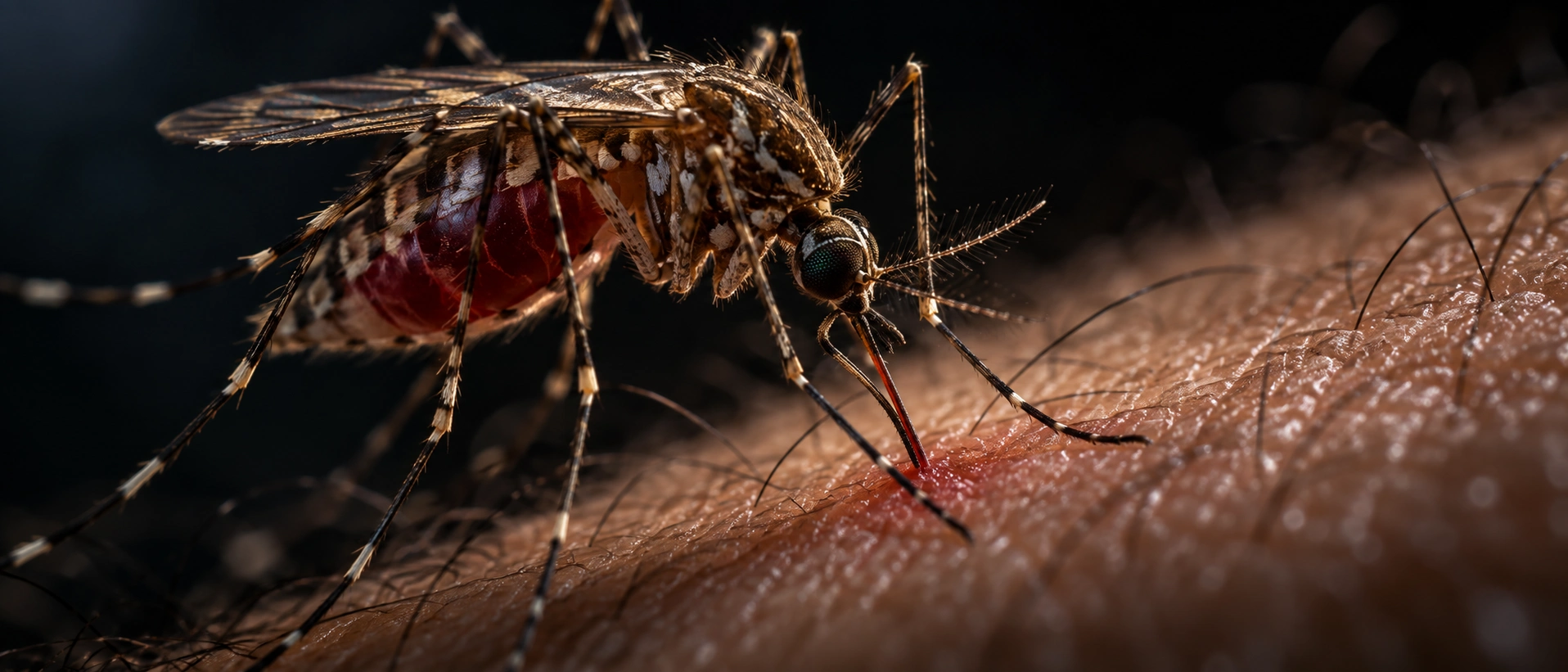
Could We Soon Live in a World Without Malaria Mosquitoes?
Evidence review & editorial synthesis
Few animals inspire less sympathy than the mosquito.
It whines around bedrooms, leaves itching bites and, in parts of the world where malaria remains endemic, can carry something far worse.
In 2024, the World Health Organization estimated 282 million cases of malaria and 610,000 deaths. About 95% of those deaths occurred in Africa, and roughly three quarters of malaria deaths in the region were among children younger than five.
This is why mosquitoes are often called the deadliest animals on Earth.
Now researchers are exploring a possibility that would have sounded like science fiction only a few decades ago: rather than endlessly killing mosquitoes one by one, what if we could alter the rules of inheritance inside a dangerous mosquito population and make the population suppress itself?
CRISPR gene drives are designed to do exactly that.
The world's deadliest animal is dangerous because of what it carries
Mosquitoes do not rank first because their bites are physically lethal. Their danger comes from the pathogens they transmit.
Malaria alone caused an estimated 610,000 deaths in 2024. Mosquitoes also transmit dengue, yellow fever, Japanese encephalitis, West Nile virus and other diseases.
In 2024, WHO received reports of more than 11,000 dengue deaths during the largest recorded global dengue epidemic. WHO also estimates yellow fever may cause tens of thousands of deaths in a typical year, while Japanese encephalitis causes thousands more.
That makes mosquito-borne disease mortality exceptional even before every pathogen is added together.
Comparisons with other dangerous animals illustrate the scale, although there is no single scientifically definitive ranking because the estimates come from different years and use different definitions.
A rough non-human comparison looks something like this:
- Mosquitoes: at least 610,000 deaths from malaria alone in 2024, plus deaths from dengue, yellow fever, Japanese encephalitis and other infections.
- Snakes: WHO estimates roughly 81,410 to 137,880 deaths from snakebite each year.
- Dogs: rabies kills an estimated 59,000 people annually, and around 99% of human rabies infections are transmitted by dogs.
- Freshwater snails: they transmit the parasites responsible for schistosomiasis. WHO's current central estimate is about 14,353 deaths annually, although the true burden remains uncertain and some historical estimates have been far higher.
- Other disease vectors such as sandflies and triatomine bugs: these transmit leishmaniasis and Chagas disease, which together cause thousands to tens of thousands of deaths annually.
The comparison also illustrates something important: some of humanity's most dangerous animals are not predators. They are biological delivery systems for pathogens.
Gene drives deliberately break the 50:50 rule of inheritance
Normally, if a mosquito carries one engineered copy of a gene and one normal copy, each offspring has roughly a 50% chance of inheriting the engineered version.
That is a problem if the goal is to change an entire wild population. The modification can simply disappear over generations.
A CRISPR gene drive changes the odds.
The engineered DNA contains CRISPR machinery that recognizes the corresponding normal chromosome. In reproductive cells, it cuts the normal version and can cause the cell to copy the gene-drive sequence into that location.
Instead of ending up with one engineered copy and one normal copy, the mosquito can effectively become a carrier of two engineered copies.
The result is super-Mendelian inheritance: rather than being transmitted to around half the offspring, experimental gene-drive constructs can reach transmission rates above 90% and, in some systems, approach 99%.
That creates an unusual possibility. A genetic trait that would normally disappear can instead spread through a population over successive generations.
Scientists have already made laboratory mosquito populations collapse
One of the most striking demonstrations targeted a gene called doublesex in Anopheles gambiae, one of Africa's major malaria vectors.
The gene has an important role in female development and fertility.
As the gene drive spreads, mosquitoes inheriting disruptive copies from both parents produce females whose reproductive development is severely impaired. Males can continue carrying the drive into subsequent generations, while the number of fertile females falls.
In large indoor cages designed to reproduce more realistic mosquito behavior than conventional laboratory cages, the gene drive spread through age-structured mosquito populations.
Once its frequency became very high, egg production collapsed.
All four experimental mosquito populations carrying the drive were eventually eliminated, with complete suppression occurring about 245 to 311 days after release.
Control populations continued producing thousands of eggs.
That is a remarkable result. Scientists did not have to sterilize every mosquito individually. They introduced a genetic element that propagated through reproduction until reproduction itself became the population's weak point.
Another option is not to kill the mosquitoes at all
Population suppression is only one version of the idea.
A second strategy is called population modification or population replacement.
Instead of spreading infertility, researchers can attempt to spread genes that make mosquitoes poor hosts for Plasmodium, the parasite that causes malaria.
The mosquitoes could continue to exist, mate and occupy their ecological niche, but their ability to transmit malaria would be dramatically reduced.
In principle, this offers a completely different route to disease elimination: do not remove the vector, remove its ability to function as a vector.
Which strategy ultimately proves more practical may vary by mosquito species and environment.
But we are not about to eliminate every mosquito
The phrase "a world without mosquitoes" is catchy but biologically misleading.
There are more than 3,500 known mosquito species.
Only a fraction transmit important human diseases, and an even smaller subset is responsible for much of the malaria burden. Target Malaria notes that only three to four African Anopheles species account for a large share of malaria transmission on the continent.
Gene drives can also be designed to be highly species-specific because they target particular DNA sequences and spread through sexual reproduction within compatible populations.
The realistic goal is therefore not a mosquito-free planet.
It is something much more targeted: dramatically suppress a handful of highly efficient malaria vectors in regions where they cause enormous human mortality.
That could be enough to matter enormously.
Malaria transmission is a chain. A mosquito must bite an infected person, support development of the parasite and later bite another susceptible person. If the density or competence of the vector falls sufficiently, transmission can become difficult to sustain.
Computer models of gene-drive deployment across ecologically diverse parts of West Africa suggest that suppression drives could produce large reductions in vector abundance, malaria prevalence and clinical cases, although the predicted effect varies substantially by location.
So why have we not released them already?
Because the defining advantage of a gene drive is also the reason for extraordinary caution.
It is designed to spread.
A conventional genetically modified sterile mosquito has a built-in biological endpoint. It mates, fails to produce viable descendants and disappears.
A self-sustaining gene drive is intended to move through generations and potentially across connected populations.
That changes the risk calculation.
Researchers need to understand how far it could spread, whether resistant mosquito variants could evolve, whether the drive could move between closely related populations, how reducing one vector might alter ecological communities and what would happen if an unexpected phenotype emerged.
The study published in Communications Biology on September 26, 2026 adds another piece to that safety puzzle.
Researchers examined gene activity across engineered Anopheles gambiae carrying CRISPR gene-drive systems. Sex and diet explained most of the variation in the mosquito transcriptome, but the researchers also found genotype-specific changes in a subset of genes.
Some altered transcripts were associated with chromatin organization, immune function and protein degradation.
That does not mean the gene drive produced a dangerous mosquito. It means an engineered cassette can have molecular consequences beyond the single intended genetic target, reinforcing the need to characterize the whole organism before field deployment.
Researchers are even working on a genetic brake
One of the most interesting developments is the attempt to create an emergency control system for gene drives themselves.
Researchers have engineered Anopheles mosquitoes that produce an anti-CRISPR protein capable of interfering with the Cas9 machinery used by a drive.
In large-cage experiments, anti-CRISPR mosquitoes inhibited gene-drive spread.
It is not a universal undo button, and releasing a second engineered organism to control the first introduces its own complexities. But it demonstrates an important principle: gene-drive research is not only about making genetic systems spread. It is also about learning how to constrain them.
The technology is closer than science fiction, but not yet field-proven
Genetically modified mosquitoes have previously been released in controlled field studies using technologies that do not contain self-sustaining gene drives.
Gene-drive mosquitoes are different.
As of September 2026, Target Malaria states that no gene-drive mosquito has ever been released into the wild.
WHO recommends a phased development pathway resembling the logic used for new medical interventions: laboratory evaluation, increasingly realistic contained testing, carefully controlled field studies and progressively stronger evidence before broader deployment.
Regulatory preparations are also becoming more concrete. In August 2026, WHO opened consultation on a proposed quality-assurance mechanism for the production of modified mosquitoes.
That should not be mistaken for approval of gene-drive releases. But it shows how the field is moving from a purely theoretical technology toward the infrastructure that would be needed if countries eventually decide to test or deploy such systems.
The target is malaria, not mosquitoes
The most spectacular version of this story is a future without mosquitoes.
The scientifically realistic version is more interesting.
A relatively small number of mosquito species help maintain one of humanity's deadliest infectious diseases. CRISPR now offers a mechanism capable, at least in laboratory populations, of spreading a reproductive weakness through those mosquitoes until their population collapses.
Meanwhile, other genetic strategies may allow mosquitoes to survive while becoming unable to transmit the parasite effectively.
Neither approach has yet shown that it can safely stop malaria transmission in the wild.
But the laboratory proof of principle is already striking: humans can now engineer genetic information that does not merely alter one animal, but attempts to propagate itself through an entire population.
If the ecological and safety problems can be solved, the reward would be enormous.
Not a planet without mosquitoes.
Potentially, a world in which hundreds of thousands fewer people die because of them.
Scientific References & Further Reading
- Current Study: “CRISPR-based gene drive systems alter the transcriptome in Anopheles gambiae mosquitoes.” (Bravo R, Nguyen C, Pham TB, et al. Communications Biology. 2026. doi:10.1038/s42003-026-11019-9.)
- Global Malaria Burden: “World malaria report 2025.” (World Health Organization. World malaria report 2025.)
- Population Collapse Experiment: “Gene-drive suppression of mosquito populations in large cages as a bridge between lab and field.” (Hammond A, Pollegioni P, Persampieri T, et al. Nature Communications. 2021;12:4589. doi:10.1038/s41467-021-24790-6.)
- African Deployment Modelling: “The potential of gene drives in malaria vector species to control malaria in African environments.” (Nature Communications. 2024;15:8976. doi:10.1038/s41467-024-53065-z.)
- Gene-Drive Control: “Anti-CRISPR Anopheles mosquitoes inhibit gene drive spread under challenging behavioural conditions in large cages.” (Nature Communications. 2024;15:952. doi:10.1038/s41467-024-44907-x.)
- Current Development Status: “Common questions about gene drive, answered.” (Target Malaria. 2026.)
- WHO Testing Framework: “Guidance framework for testing genetically modified mosquitoes, second edition.” (World Health Organization. 2021.)
- Modified Mosquito Regulation: “Pilot – Quality Assurance Mechanism for Modified Mosquito Production.” (World Health Organization. 2026.)
- Snakebite Burden: “Snakebite envenoming.” (World Health Organization. Updated September 17, 2026.)
- Rabies Burden: “Rabies.” (World Health Organization.)
Disclaimer: This article is for informational purposes only and does not constitute medical or environmental-policy advice.