
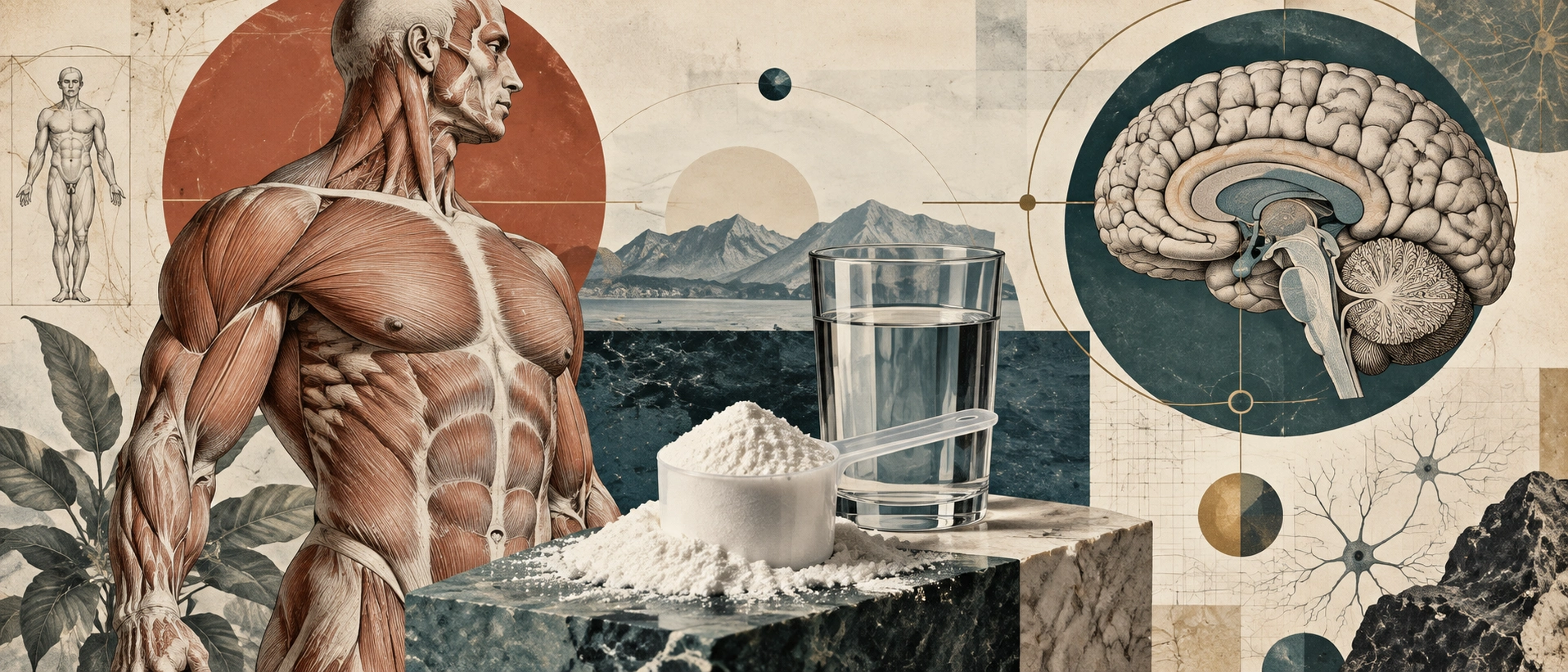
Creatine Added Lean Mass and Improved Memory Measures Even Without Exercise
Evidence review & editorial synthesis
Creatine has spent decades being treated as a gym supplement. A new human trial makes that label look increasingly outdated. After 12 weeks, sedentary adults aged 45 to 65 who took 10 grams of creatine monohydrate per day without joining a structured exercise program gained about 1.1 kilograms of DXA-measured lean tissue. They also improved muscular strength and endurance, while several tests of memory and cognitive processing moved in a favorable direction.
The bigger message is hard to miss: at least some of creatine's effects do not require a weight room.
Creatine produced measurable gains without training
Researchers at Texas A&M University enrolled 73 healthy sedentary adults between 45 and 65 years old. Sixty-four completed the 12-week study.
Participants first chose whether they wanted to remain in a non-exercise condition or enter a combined exercise and calorie-reduction program. Within those conditions, they were assigned in a double-blind fashion to either creatine monohydrate or placebo.
The creatine dose was substantial: 5 grams twice daily, or 10 grams per day.
The non-exercise creatine group gained approximately 0.99 kg of lean tissue after six weeks and 1.1 kg after 12 weeks. The placebo group showed essentially no comparable gain. Strength and muscular endurance also improved with creatine despite the absence of structured training.
That does not mean the participants suddenly built 1.1 kg of contractile muscle. DXA measures lean soft tissue, and creatine increases water stored inside muscle cells, so some of the change may reflect hydration as well as new tissue. But the accompanying improvements in strength and endurance make the finding more interesting than a scale effect alone.
The brain signal may be just as interesting
Creatine helps cells rapidly regenerate ATP through the phosphocreatine system. Skeletal muscle stores most of the body's creatine, but the brain also relies on creatine-dependent energy buffering.
In the new trial, adults taking creatine without exercise improved on several selected cognitive tasks. These included delayed word recall, word recognition and reaction time during picture-recognition testing, pointing toward possible improvements in memory and processing speed.
The result fits part of the broader literature. A 2024 meta-analysis of 16 randomized trials involving 492 adults found a significant positive effect of creatine on memory, with additional signals for attention time and processing speed. The evidence for memory was rated moderate certainty.
But cognition is also where restraint matters most. The same meta-analysis found no significant improvement in overall cognition or executive function. Another systematic review concluded that cognitive results across creatine studies remain equivocal. In the new trial itself, several cognitive tests did not improve, and the authors explicitly describe the individual cognitive findings as exploratory.
So this is not evidence that creatine broadly makes the brain younger. It is evidence that a supplement already known for muscular bioenergetics produced measurable changes on several memory-related outcomes in a population entering midlife and older age.
Exercise still made the package stronger
The headline finding is that creatine did something without structured exercise. That should not be confused with exercise becoming unnecessary.
Participants combining creatine with resistance and cardiovascular training plus a calorie-reduction diet gained about 1.27 kg of lean tissue after 12 weeks while also achieving a larger reduction in body-fat percentage than the comparison groups.
This fits years of stronger evidence showing synergy between creatine and resistance training. A meta-analysis of 22 trials involving 721 older adults found that adding creatine to resistance training produced approximately 1.37 kg more lean tissue than training with placebo and improved both chest-press and leg-press strength.
More recent pooled research has reached a similar conclusion: creatine can amplify at least some of the muscle and strength adaptations produced by resistance exercise in aging adults.
The new result therefore expands the story rather than overturning it. Exercise remains one of the most powerful interventions for maintaining muscle and function with age, but creatine may exert useful effects even when training is absent or limited.
Ten grams a day is an important detail
The trial did not test the familiar 3-to-5-gram daily maintenance dose often used by recreational athletes. It used 10 grams per day throughout the study.
That distinction matters particularly for cognition. Brain creatine appears harder to raise than muscle creatine, and researchers have increasingly investigated whether higher or longer dosing is required to meaningfully affect the central nervous system.
The 10-gram regimen was reported as well tolerated during the 12-week intervention. Broader safety evidence is also reassuring in healthy adults. A recent meta-analysis found that supplementation can cause a modest increase in blood creatinine, which is an expected consequence of creatine metabolism, while showing no significant reduction in glomerular filtration rate.
People with kidney disease or other medical conditions should still discuss supplementation with a clinician rather than assuming evidence from healthy adults applies to them.
Creatine is becoming a healthy-aging story
The most interesting shift may be cultural rather than biochemical. Creatine was once discussed almost entirely in terms of bigger lifts, faster sprints and bodybuilding. That framing is becoming too narrow.
Loss of lean tissue and strength becomes increasingly important with age because it affects mobility, independence and resilience. At the same time, maintaining cognitive performance becomes a central concern for many adults entering their 50s and 60s.
A cheap compound capable of influencing both systems is therefore unusually interesting.
This trial is too small and too short to establish creatine as a treatment for sarcopenia or cognitive decline. The cognitive findings need replication, and the lean-mass gain should not be equated automatically with new muscle fibers.
But the central result remains striking: after only 12 weeks, creatine supplementation produced measurable improvements in lean tissue, strength and several memory-related outcomes even among people who did not enter a structured exercise program.
For a supplement famous for what it does in the gym, what it did outside the gym may be the more interesting story.
Scientific References & Further Reading
- Anchor Study: “Effects of creatine supplementation with and without exercise and diet intervention on body composition, cognitive function, and markers of health in middle-aged and older adults.” (Chun J, Liu Y, Kibler GL, et al. J Int Soc Sports Nutr. 2026;23(sup1):2716273. doi:10.1080/15502783.2026.2716273.)
- Supporting Evidence: “The effects of creatine supplementation on cognitive function in adults: a systematic review and meta-analysis.” (Xu C, Bi S, Zhang W, Luo L. Front Nutr. 2024;11:1424972.)
- Supporting Evidence: “Creatine supplementation research fails to support the theoretical basis for an effect on cognition: Evidence from a systematic review.” (Behav Brain Res. 2024;114982.)
- Supporting Evidence: “Effect of creatine supplementation during resistance training on lean tissue mass and muscular strength in older adults: a meta-analysis.” (Chilibeck PD, Kaviani M, Candow DG, Zello GA. Open Access J Sports Med. 2017;8:213-226.)
- Supporting Evidence: “The impact of creatine supplementation associated with resistance training on muscular strength and lean tissue mass in the aged: a systematic review and meta-analysis.” (Liu S, et al. Eur Rev Aging Phys Act. 2025;22:26.)
- Supporting Evidence: “Effect of creatine supplementation on kidney function: a systematic review and meta-analysis.” (Systematic review and meta-analysis of creatine supplementation and renal-function outcomes.)
Disclaimer: This article is for informational purposes only and does not constitute medical advice. It is not a substitute for diagnosis, treatment, or individualized medical care.