
A Copper Drug Helped the Brain Flush Out Alzheimer’s Proteins
Evidence review & editorial synthesis
Alzheimer’s is often described as a disease of buildup. Toxic proteins accumulate. Neurons struggle. Memory fades.
But what if one of the most important questions is not only why the brain produces damaging proteins, but why it stops clearing them?
A new study points to a striking possibility: the brain’s own waste-removal machinery may be repairable.
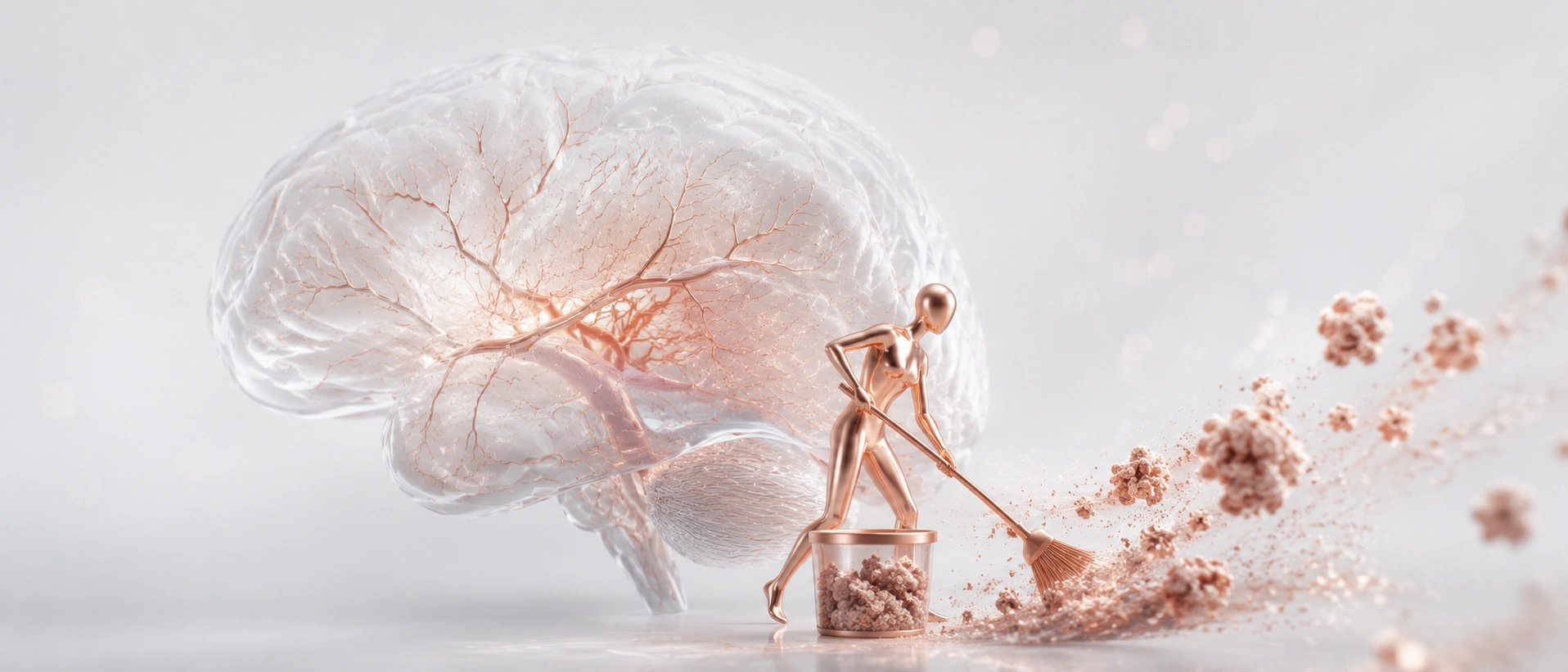
At the center is a copper-delivering compound called Cu(ATSM). In preclinical Alzheimer’s research, it appeared to restore part of the brain’s ability to move amyloid-beta out through the blood-brain barrier.
That is the provocative part.
This is not just another “anti-amyloid” story. It is a brain-cleanup-system story.
The Brain Has Waste Pumps
The brain is protected by the blood-brain barrier, a highly selective interface that controls what enters and leaves the central nervous system.
One of its important molecular gatekeepers is P-glycoprotein, often shortened to P-gp.
P-gp acts like a transport pump. It helps push certain molecules out of the brain and back toward the bloodstream. One of the molecules it helps clear is amyloid-beta, the protein strongly associated with Alzheimer’s pathology.
In Alzheimer’s disease, this pump system can become weaker.
That matters because a weakened clearance system could trap more amyloid-beta inside the brain. The result is not just production of toxic protein; it is failed removal.
In other words:
The brain’s trash may not only be piling up because too much is being made. It may be piling up because the exit system is breaking down.
What the Copper Drug Did
The compound tested in the study was Cu(ATSM), a copper-based molecule already of interest in neurological research.
In an Alzheimer’s disease mouse model, researchers reported that Cu(ATSM) increased the abundance of P-gp clearance pumps at the blood-brain barrier. Over 56 days, the treatment was associated with lower levels of toxic amyloid-beta and improved spatial learning.
The reported numbers were hard to ignore:
- P-gp abundance increased by about 24%
- toxic amyloid-beta was reduced by about 42%
- spatial learning improved by nearly 44%
That does not mean Alzheimer’s has been solved.
But it does make the mechanism exciting.
Instead of trying only to attack plaques after they form, this approach asks a different question:
Can we restore the brain’s ability to remove the proteins before they keep accumulating?
Why This Could Matter for Alzheimer’s Treatment
Most Alzheimer’s treatment discussions focus on amyloid plaques, tau tangles, inflammation, or neuron death.
This study pushes another target into the spotlight:
the blood-brain barrier as an active cleanup organ.
If brain clearance systems can be repaired, future Alzheimer’s therapies may not be limited to removing amyloid directly. They could aim to improve the biological machinery that moves waste out of the brain in the first place.
That could open several future directions:
-
Clearance-based Alzheimer’s drugs
Instead of only blocking or removing toxic proteins, drugs could enhance the brain’s export systems. -
Blood-brain barrier repair
Alzheimer’s may be partly a disease of neurovascular dysfunction, meaning the brain’s vessels, barrier cells, and transport systems become therapeutic targets. -
Combination therapies
A future treatment might pair amyloid-lowering drugs with compounds that improve clearance, vascular function, or cellular stress resistance. -
Earlier intervention
If clearance failure begins before severe cognitive decline, repairing it earlier could become a preventive strategy, at least in theory.
That last point is especially important.
The future of Alzheimer’s prevention may not be only about stopping toxic proteins from forming.
It may also be about keeping the brain’s cleanup systems functional before they fail.
This Is Not “Take Copper”
The word “copper” makes this easy to misunderstand.
This study does not mean copper supplements prevent Alzheimer’s. It does not mean people should take copper to clear amyloid-beta. Too much copper can be harmful, and metal biology in the brain is complex.
Cu(ATSM) is a specific experimental compound designed to deliver copper in a controlled biochemical context.
That distinction matters.
The interesting idea is not “copper is good.”
The interesting idea is:
a targeted copper-delivering compound may influence a damaged clearance system at the blood-brain barrier.
That is a much more precise, much more scientifically interesting claim.
What This Could Mean Beyond Amyloid
If this line of research holds up, the implications may reach beyond one protein.
Brain aging is not only about amyloid-beta. It also involves vascular dysfunction, oxidative stress, inflammation, impaired protein handling, mitochondrial stress, and declining cellular resilience.
A treatment that improves blood-brain barrier function could theoretically affect more than amyloid clearance.
It might help researchers think about neurodegeneration as a system-level failure:
- waste clearance slows down
- blood-brain barrier transport weakens
- toxic proteins accumulate
- cells become more vulnerable
- inflammation and oxidative stress rise
- cognition begins to decline
That does not make Cu(ATSM) a miracle drug.
But it makes the target compelling.
The brain is not just a passive victim of toxic buildup. It has machinery for defense, export, and repair. Alzheimer’s may partly involve the collapse of that machinery.
The Catch
The current evidence is still preclinical.
The study was done in an Alzheimer’s disease mouse model, not in people with Alzheimer’s. Mouse models can reveal mechanisms, but they often fail to predict human clinical success.
That caveat is serious.
Still, this is exactly the kind of result that makes a Research Note worth reading: not because it proves a new cure, but because it reframes the disease.
Alzheimer’s may not be only a plaque problem.
It may be a clearance problem.
And if the brain’s cleanup system can be switched back on, even partly, that could become one of the more important ideas in the next generation of Alzheimer’s research.
The most exciting future Alzheimer’s therapies may not just attack what builds up in the brain. They may repair the systems that were supposed to clear it out.
Scientific References & Further Reading
-
Cu(ATSM), Blood-Brain Barrier Pumps & Alzheimer’s Model: “Cu(ATSM) Restores Blood–Brain Barrier Abundance of P-Glycoprotein and Improves Cognitive Function in the APP/PS1 Mouse Model of Alzheimer’s Disease.”
-
P-Glycoprotein and Brain Amyloid Clearance: “Cu(ATSM) Increases P-Glycoprotein Expression and Function at the Blood-Brain Barrier in C57BL6/J Mice.”
-
Research Summary: “Copper Drug Restores Memory and Clears Toxic Alzheimer’s Proteins.”
Disclaimer: This article is for educational purposes only and does not provide medical advice. Cu(ATSM) is an experimental compound in this context, and the Alzheimer’s findings discussed here come from preclinical research, not proven human treatment. This article does not recommend copper supplementation or any self-directed intervention for Alzheimer’s prevention or treatment.