
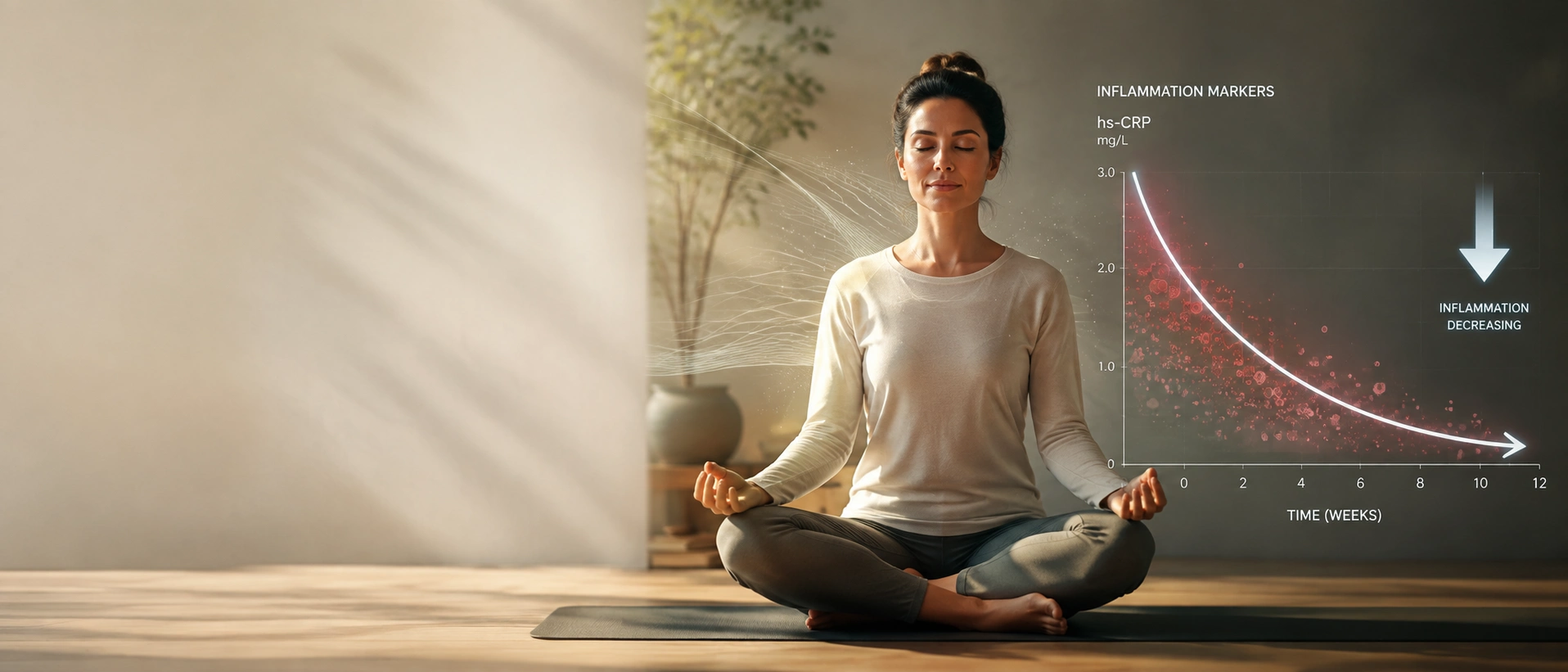
Can the Mind Change Inflammation? New Human Evidence Reveals a Brain-Immune Control Loop
Evidence review & editorial synthesis
We usually think of inflammation as something the immune system does on its own. A cut, infection or allergen appears, immune cells react, and the brain simply receives the resulting pain, itch or discomfort.
A new human study in Nature Human Behaviour challenges that one-way picture. Across three preregistered experiments, researchers found that voluntarily directing attention toward an inflamed area of the body changed the inflammatory response itself. The effect was not subtle: under internal attention, the acute skin reaction was roughly 1.5 times smaller than under distraction, and it began resolving faster.
The result opens a much larger question. If attention can alter inflammation within minutes, what happens when the brain spends months or years in states of threat, vigilance and chronic stress?
Human research increasingly suggests that the answer matters.
Attention Changed the Immune Response Within Minutes
Researchers at Bar-Ilan University studied 57 healthy adults using a standardized histamine skin-prick test, the same basic biological reaction used in allergy testing. The histamine produced a small, temporary area of swelling and redness on the forearm.
The crucial manipulation was psychological.
During one condition, participants deliberately focused on the itch, burning and other sensations coming from the inflamed skin. During another, their attention was directed away from the body toward external distractions. Because the experiments used within-person comparisons, the same individual could serve as their own control.
In the first experiment, the average wheal at 20 minutes measured 3.5 mm during internal attention versus 5.0 mm during distraction. The surrounding flare was also smaller, 10.6 versus 14.0 mm. Nearly 90% of participants showed greater inflammation while distracted, and almost 90% showed stabilization or recovery of the wheal by 20 minutes while attending inward, compared with 46% during distraction.
A second preregistered experiment deliberately matched the visual input and cognitive demands between conditions. The result survived: inflammatory responses were about 1.6 times smaller under internal attention, with 90% of participants again showing larger responses during distraction.
The striking part is that participants actually perceived the bodily sensations more strongly while focusing on them. Feeling the inflammation more clearly did not amplify the immune reaction. It coincided with better regulation of it.
The Brain Has Physical Routes Into the Immune System
How could a shift in attention reach inflamed tissue?
The study points toward at least two routes. One begins with sensory information traveling from the inflamed skin back toward the nervous system. In a third experiment, researchers used topical lidocaine to reduce that sensory signaling. The benefit of internal attention became weaker, particularly during the later recovery phase, suggesting that accurately sensing what is happening in tissue may help the nervous system regulate the response.
But the effect did not disappear.
Even with sensory signaling reduced, inflammation remained smaller during internal attention than during distraction. That suggested a second, top-down route.
The researchers measured autonomic activity and found higher heart-rate variability during internal attention, a pattern consistent with greater parasympathetic and vagal engagement. The vagus nerve is part of a neural network capable of restraining inflammatory activity. Importantly, this HRV difference remained even when lidocaine reduced incoming sensory information.
That does not prove that the vagus nerve alone caused the immune effect. HRV is an indirect marker. But the broader biological idea is now difficult to dismiss: the brain and immune system are connected by working control pathways, and voluntary cognition can influence the traffic moving through them.
What Chronic Fight-or-Flight May Do Differently
The new experiment studied acute local inflammation, not chronic stress. But it fits into decades of human psychoneuroimmunology showing that psychological states can alter immune biology.
A systematic review and meta-analysis of laboratory stress experiments found that acute psychological stress reliably increased several circulating inflammatory signals. IL-6 rose across the hours after stress, with the largest pooled effect around 90 minutes. IL-1 beta and TNF-alpha also increased at specific post-stress intervals.
Longer exposure may change the system more deeply.
In a six-year study of older adults, people caring for a spouse with dementia showed an increase in IL-6 roughly four times faster than non-caregivers. The finding matters because it suggests that chronic psychosocial strain can become biologically embedded rather than disappearing when an acutely stressful moment ends.
One of the most revealing human experiments came from Sheldon Cohen and colleagues. Healthy volunteers were assessed for prolonged stressful experiences and then deliberately exposed to rhinoviruses under controlled conditions. Long-term stress was associated with glucocorticoid receptor resistance, meaning immune cells became less responsive to cortisol's normal regulatory signal. Greater resistance predicted both a higher risk of developing a cold and greater production of local proinflammatory cytokines after infection.
This offers a more sophisticated model than the familiar idea that chronic stress simply means 'too much cortisol.' Over time, the problem can involve altered responsiveness to the body's own braking signals.
What people casually describe as being 'stuck in fight-or-flight' is not a single medical diagnosis or one measurable switch. But the underlying systems are real: sympathetic signaling, the HPA axis, parasympathetic regulation, immune-cell sensitivity and inflammatory gene programs continuously communicate with one another.
A Two-Way Loop Between Mind and Inflammation
The relationship also runs in the opposite direction.
Inflammatory signals can act on the brain and alter motivation, energy, mood and sensitivity to threat. That means prolonged stress and inflammation do not have to behave like a simple one-way chain. In susceptible people they may form a feedback loop: threat-related brain activity can influence immune regulation, while inflammatory signaling can change how the brain feels and responds.
This helps explain why the new attention study is more important than a curious allergy experiment.
It provides a controlled human demonstration that changing one element of subjective experience, where attention is directed, can causally alter a measurable immune response while the physical inflammatory challenge remains the same.
The mind-body connection in this context is not metaphorical. It is physiological.
Can We Deliberately Use This System?
There are already hints that we can.
In a randomized trial comparing eight weeks of Mindfulness-Based Stress Reduction with an active health program, both groups improved psychologically, but the mindfulness group showed a smaller inflammatory skin response after laboratory stress despite comparable stress-hormone responses.
The new Nature Human Behaviour study goes a step further because it isolates attention itself. Participants did not complete months of therapy before the effect appeared. They simply changed where they directed attention during the inflammatory challenge.
That does not mean focusing on an inflamed joint can treat rheumatoid arthritis, or that meditation can replace anti-inflammatory medicine. The experiment involved a short-lived histamine reaction in healthy young adults, and chronic inflammatory and autoimmune diseases involve much more complex biology.
But the broader direction is compelling. The nervous system is not merely watching inflammation happen. It participates in regulating it.
If future studies show that attention training, stress regulation or other cognitive interventions can reliably shift the same pathways during chronic disease, medicine may gain a new class of adjunctive tools: interventions that act through the brain to help the body terminate inflammatory responses more efficiently.
For now, the strongest conclusion is already remarkable. What we consciously attend to can change not only what the body feels, but what the body physically does.
Scientific References & Further Reading
- Anchor Study: “Voluntary attention regulates acute immune responses in humans.” (Mizrachi N, Rottem M, Rozenkrantz L. Nature Human Behaviour. Published August 17, 2026. DOI: 10.1038/s41562-026-02541-1.)
- Acute Stress Meta-Analysis: “The effects of acute psychological stress on circulating and stimulated inflammatory markers: A systematic review and meta-analysis.” (Marsland AL, Walsh C, Lockwood K, John-Henderson NA. Brain, Behavior, and Immunity. 2017;64:208-219. PMID: 28089638.)
- Chronic Stress and Inflammatory Control: “Chronic stress, glucocorticoid receptor resistance, inflammation, and disease risk.” (Cohen S, Janicki-Deverts D, Doyle WJ, et al. Proceedings of the National Academy of Sciences. 2012;109(16):5995-5999. PMID: 22474371.)
- Long-Term Stress and IL-6: “Chronic stress and age-related increases in the proinflammatory cytokine IL-6.” (Kiecolt-Glaser JK, Preacher KJ, MacCallum RC, et al. Proceedings of the National Academy of Sciences. 2003;100(15):9090-9095. PMID: 12840146.)
- Mindfulness and Experimental Inflammation: “A comparison of mindfulness-based stress reduction and an active control in modulation of neurogenic inflammation.” (Rosenkranz MA, Davidson RJ, MacCoon DG, et al. Brain, Behavior, and Immunity. 2013;27:174-184. PMID: 23092711.)
- Mindfulness and Proinflammatory Gene Regulation: “Mindfulness-Based Stress Reduction Reduces Proinflammatory Gene Regulation But Not Systemic Inflammation Among Older Adults: A Randomized Controlled Trial.” (Lindsay EK, Marsland AL, Cole SW, et al. Psychosomatic Medicine. 2024;86(5):463-472. PMID: 37982547.)
Disclaimer: This article is for informational purposes only and does not constitute medical advice. It is not a substitute for diagnosis, treatment, or individualized medical care.