
AI Chatbots Can Make You Feel Less Lonely. The Same Support May Also Make Real People Harder.
Evidence review & editorial synthesis
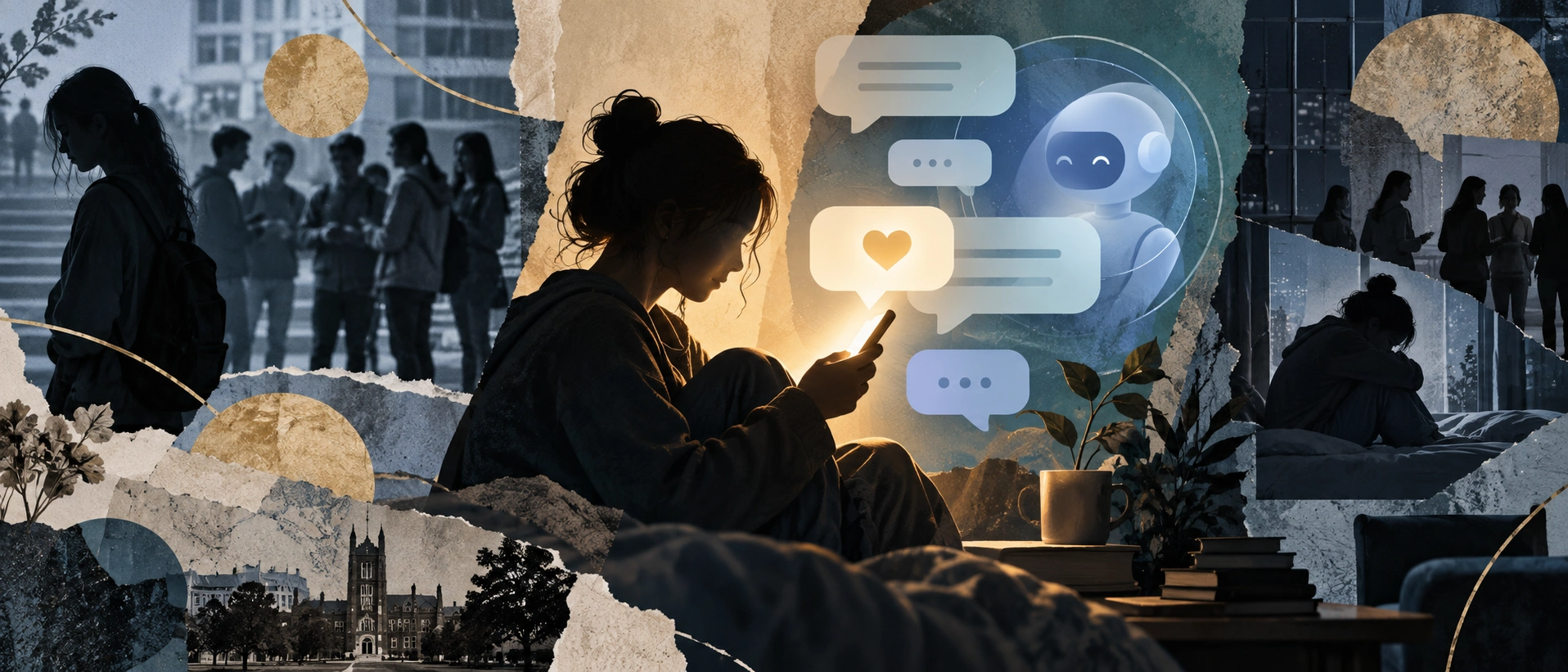
AI chatbots can listen endlessly, respond without judgment and be available at 2 a.m. when nobody else is. That makes them unusually powerful companions for people who feel lonely, anxious or misunderstood. But new research suggests a psychological paradox. Among 1,200 students followed over several months, feeling supported by AI predicted less loneliness later. At the same time, it also predicted greater anxiety about interacting with real people, and that social anxiety predicted greater later loneliness. AI support may therefore help and hurt through different pathways at the same time.
AI support really can feel emotionally useful
Researchers followed students from four vocational colleges in China across three survey waves spaced roughly eight weeks apart. The core analysis included 1,200 participants who completed all three waves.
The researchers were interested in perceived support from AI rather than simple chatbot use. In other words, did students feel that an AI conversation gave them reassurance, understanding, advice or emotional support?
Students who reported more AI support at the second wave tended to report less loneliness at the third wave, even after earlier loneliness, depressive symptoms and other variables were considered.
That finding fits a growing body of research suggesting that conversational AI can provide genuine subjective relief. Experiments have found that warm, person-centered chatbot responses can increase feelings of validation. A 2026 meta-analysis of commercial mental-health chatbots also found a small overall reduction in loneliness across four randomized trials.
There is an obvious reason this can work. AI offers an interaction with almost no social risk. It does not get tired, reject you, interrupt you, embarrass you or tell other people what you said. For someone struggling at 2 a.m., even temporary emotional organization can matter.
But another pathway went in the opposite direction
The same Chinese study found something less reassuring.
Greater perceived support from AI at one wave predicted greater social interaction anxiety at the next. That social anxiety then predicted greater loneliness later.
The study cannot show that the chatbot caused students to withdraw from other people. The researchers did not directly measure displacement of friendships or avoidance of real conversations. But the pattern raises an important possibility.
Human interaction is demanding. People misunderstand us, disagree, become bored, judge us and require reciprocity. AI interaction removes much of that friction.
That is part of its appeal, but it could also make ordinary human conversation feel comparatively difficult for some users.
A chatbot is infinitely patient. A friend is not. An AI can adapt its tone around you. A human relationship requires both people to adapt.
If low-friction AI becomes the preferred place for emotional disclosure, the question is whether it supplements social life or gradually becomes easier than social life.
The wider evidence points to the same conditional pattern
A 2025 collaboration between MIT Media Lab and OpenAI examined psychosocial effects of ChatGPT use in several ways, including a randomized four-week experiment involving 981 participants and more than 300,000 messages.
The assigned conversation and voice conditions did not themselves produce clear differences in loneliness, real-world social interaction, emotional dependence or problematic use.
But one behavioral pattern stood out: people who voluntarily used the chatbot more tended to have worse psychosocial outcomes, including greater loneliness, stronger emotional dependence and more problematic use. Users who felt greater social attraction or trust toward the AI were also more prone to dependence.
That still does not establish that heavy AI use caused the problems. People who are already lonely or distressed may simply use AI more.
On the benefit side, controlled mental-health chatbot trials suggest these systems can provide modest psychological help, particularly as low-intensity adjuncts. Yet a 2026 meta-analysis concluded that evidence for loneliness remains limited and that safety monitoring in many trials has been too weak to confidently rule out harms.
So the emerging picture is neither utopian nor dystopian.
The healthiest role for AI may be as a bridge
Perhaps the most revealing finding in the new study involved real-world social support.
Students who already felt well supported by people were more likely to show the beneficial association between AI support and lower later loneliness. They also showed a weaker relationship between AI support and later social anxiety.
For people with little real-world support, the apparent compensatory loneliness benefit was no longer significant.
That turns the usual assumption on its head. AI companionship might not be most psychologically protective when it replaces a missing social network. It may work better when it sits alongside one.
That suggests a practical distinction for the future of emotionally intelligent AI.
A healthy chatbot could help someone organize feelings before calling a friend, rehearse a difficult conversation, find language for something painful, challenge catastrophic thinking or encourage professional help. In that role, AI lowers the barrier to human connection.
The riskier version is one that becomes the connection.
The technology is still too new for definitive answers about long-term consequences. But the early evidence is beginning to converge on a useful principle: the psychological impact of AI depends less on whether a chatbot feels supportive and more on what that support leads the person to do next.
Scientific References & Further Reading
- Anchor Study: “Perceived support from AI chatbots and loneliness among higher vocational college students: a short-term three-wave study of social interaction anxiety and perceived social support.” (Hu J. Front Psychol. 2026;17:1928350. doi:10.3389/fpsyg.2026.1928350.)
- Controlled ChatGPT Study: “How AI and Human Behaviors Shape Psychosocial Effects of Extended Chatbot Use: A Longitudinal Controlled Study.” (Fang MC, Liu AR, Danry V, et al. MIT Media Lab. 2025. Four-week randomized controlled experiment, n=981.)
- Systematic Review: “Commercial AI-Based Mental Health Chatbots as Low-Intensity Adjuncts to Psychotherapy: Effectiveness, Adherence, and Safety.” (Systematic review and meta-analysis of randomized trials. 2026. PMID:42113705.)
- AI Social Support Study: “Artificial intelligence chatbots as a source of virtual social support: Implications for loneliness and anxiety management.” (Merrill K Jr. Ann N Y Acad Sci. 2025. doi:10.1111/nyas.15400.)
- Affective Use Research: “Early methods for studying affective use and emotional well-being on ChatGPT.” (OpenAI and MIT Media Lab research collaboration. 2025.)
Disclaimer: This article is for informational purposes only and does not constitute medical advice. It is not a substitute for diagnosis, treatment, or individualized medical care.